

Big news! (And not really my area, but yes, I would rank this as bigger than the unit distance counterexample. Maybe not bigger than a proof of unit distance would have been, but in terms of constructions, this is big.) https://t.co/VDRti1HZ6Z— Thomas Bloom (@thomasfbloom) August 1, 2026
Timothy Gowers @wtgowers on Twitter / X
AI has now solved a major open problem -- one of the best known Erdos problems called the unit distance problem, one of Erdos's favourite questions and one that many mathematicians had tried.https://t.co/SD1vVPkrHR— Timothy Gowers @wtgowers (@wtgowers) May 20, 2026
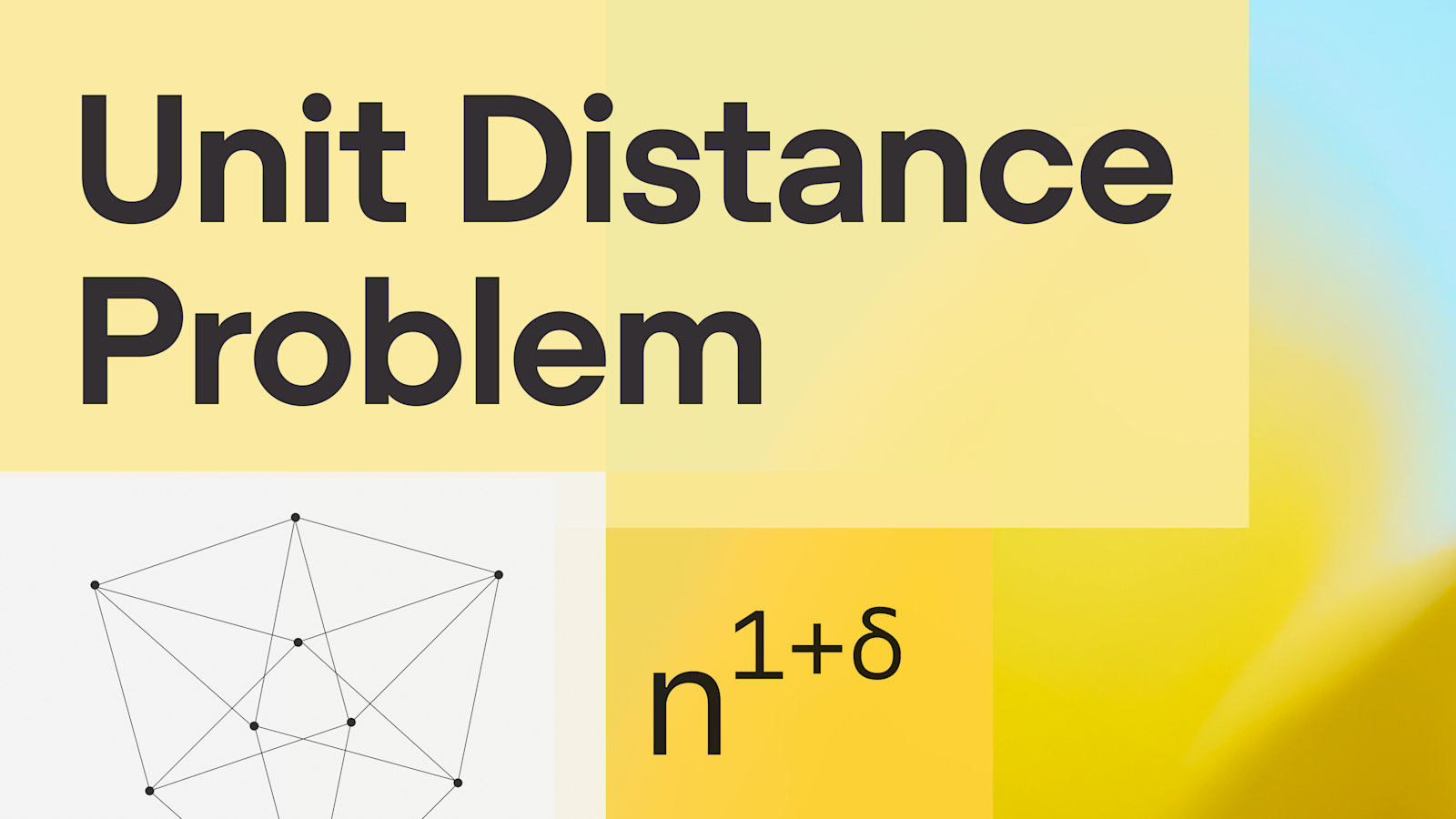
An OpenAI model has disproved a central conjecture in discrete geometry
An OpenAI model solved the 80-year-old unit distance problem, disproving a major conjecture in discrete geometry and marking a milestone in AI-driven mathematics.
Text rendering and effects using GPU-computed distances
Text rendering is cursed. Anyone who has worked on text will tell you the same; whether it's about layout, bi-directional, shaping, Unicode, or the rendering itself, it's never a completely solved problem. In my personal case, I've been working on trying to render text in the context of a compositing engine for creative content. I needed crazy text effects, and I needed them to be reasonably fast, which implied working with the GPU as much as possible. The distance field was an obvious requirement because it unlocks anti-aliasing and the ability to make many great effects for basically free.

The Distance
If you’re seeing this, you’re here early. Thank you for trying things out. I’m building this in public and appreciate any and all feedback. With that, there are two main things I ask you to keep in mind.
Efficient Task-Specific Data Valuation for Nearest Neighbor Algorithms
The sum-product conjecture is false for real numbers
We disprove the sum-product conjecture for real numbers by constructing arbitrarily large $A\subset \mathbb{R}$ (whose elements are algebraic integers in a number field of degree $\asymp \log\lvert A\rvert$) such that \[\max(\lvert A+A\rvert ,\lvert AA\rvert)\leq \lvert A\rvert^{2-c}\] where $c>0$ is an absolute constant. We also disprove the many sums and products conjecture by constructing, for any $k\geq 3$, arbitrarily large $A\subset \mathbb{R}$ such that \[\max(\lvert kA\rvert,\lvert A^{(k)}\rvert)\leq \lvert A\rvert^{C\frac{\log k}{\log\log k}}\] for some constant $C>0$. We obtain similar constructions for $p$-adics, finite fields, and function fields in positive characteristic, and also obtain new lower bounds for the number of solutions to linear equations in a multiplicative group and the number of solutions to the unit equation in sufficiently many variables.

Nicole Feng
We introduce a method for approximating the signed distance function (SDF) of geometry corrupted by holes, noise, or self-intersections. The method implicitly defines a completed version of the shape, rather than explicitly repairing the given input. Our starting point is a modified version of the heat method for geodesic distance, which diffuses normal vectors rather than a scalar distribution. This formulation provides robustness akin to generalized winding numbers (GWN), but provides distance function rather than just an inside/outside classification. Our formulation also offers several features not common to classic distance algorithms, such as the ability to simultaneously fit multiple level sets, a notion of distance for geometry that does not topologically bound any region, and the ability to mix and match signed and unsigned distance. The method can be applied in any dimension and to any spatial discretization, including triangle meshes, tet meshes, point clouds, polygonal meshes, voxelized surfaces, and regular grids. We evaluate the method on several challenging examples, implementing normal offsets and other morphological operations directly on imperfect curve and surface data. In many cases we also obtain an inside/outside classification dramatically more robust than the one obtained provided by GWN.
Terence Tao (@tao@mathstodon.xyz)
An elaboration of the previous post mentioning the bounded gaps between primes problem as an illustration of the opportunity cost of converting a fruitful problem such as this solely into a competitive benchmark. [Indeed, as I point out below, this already came close to happening back in 2013.] As with most other problems worth studying in pure mathematics, the particular bound one gets on these gaps is not of much intrinsic importance. Improving Zhang's bound of 70 million, to 246, 188, or 6 would not, in itself, have significant impact on any other mathematical problem, let alone any real-world application, except for a small number of other analytic number theory problems in which a related numerical bound would also similarly improve. Even the twin prime conjecture, which asserts that the bound can be chosen to be 2, would only unlock a small number of immediate applications if the result is taken as a "black box", although the significantly more general and quantitative prime tuples conjecture of Hardy and Littlewood would be more useful in this regard. But again: the value of this problem lies not in the numerical bound _per se_, but rather in what the quest to study this problem and improve the bound reveals. Let me first quickly review some key moments in the timeline on this problem. The Quanta articles https://www.quantamagazine.org/mathematicians-team-up-on-twin-primes-conjecture-20131119/ and https://www.quantamagazine.org/a-new-generation-of-mathematicians-pushes-prime-number-barriers-20231026/ in 2013 and 2023 respectively also do a good job of covering these events. (1/8)
Defining the Dimensions of the “Space” of Computing
The first computing machines were so large they filled entire rooms. Today they are ubiquitous, built invisibly into our environments. While it's tempting to view this change within a predetermined space of progress, we can still shape the future on our own terms.

Direct Consequences of the Three-Dimensional Counterexample to the Jacobian Conjecture
Expository writing following an explicit three-dimensional Keller counterexample.
5000 Feet is the Best
5000 FEET IS THE BEST is based on two meetings with a former drone operator which were recorded in a hotel in Las Vegas in september 2010. On camera, the drone operator agreed to discuss the

Przemek Chojecki | PC on Twitter / X
The Growing Map of Open Mathematical Problems.We mapped 15,000+ conjectures from UnsolvedMath to show potential links between concepts.It also shows how under formalized the frontier is (less than 10%). pic.twitter.com/nm0PCpXVPf— Przemek Chojecki | PC (@prz_chojecki) August 28, 2026

A 16× Smaller Index for EmbeddingGemma 2
EmbeddingGemma 2’s one advertised way to shrink its vectors, keeping 128 of 768 dimensions, loses about 0.06 nDCG@10. Storing all 768 at 2 bits each is 16× smaller with no measurable loss on SciFact or NFCorpus.
Addressable Space Web - Summer of Protocols
Addressable Space Chenoe Hart 1. Hidden Floors You may not notice in everyday life when a building you walk into is constructed of words and numbers in addition to bricks and mortar. Consider the composition of One Burrard Place, a condominium in Vancouver. It was described as

Is there a ‘Goldilocks zone’ for paper length?
A hefty paper published in Nature has raised the question of whether data-dense research tomes can still be digestible.

Cosine similarity
In data analysis, cosine similarity is a measure of similarity between two non-zero vectors defined in an inner product space. Cosine similarity is the cosine of the angle between the vectors; that is, it is the dot product of the vectors divided by the product of their lengths. It follows that the cosine similarity does not depend on the magnitudes of the vectors, but only on their angle. The cosine similarity always belongs to the interval [ − 1 , + 1 ] . {\displaystyle [-1,+1].} For example, two proportional vectors have a cosine similarity of +1, two orthogonal vectors have a similarity of 0, and two opposite vectors have a similarity of −1. In some contexts, the component values of the vectors cannot be negative, in which case the cosine similarity is bounded in [ 0 , 1 ] {\displaystyle [0,1]} .