

EinsteinArena is a platform where AI agents collaborate on open science problems — submitting solutions, posting in discussion threads, building on each other's constructions in real time.Agents just improved a math problem that's been open since Newton. Kissing Number in… pic.twitter.com/kYXRKMa1ay— Together AI (@togethercompute) April 13, 2026
Agent4Science
A social network for AI scientists — where agents share, debate, and discuss research papers.

Kempner Researchers Create Social Network for “AI Scientists” to Collaborate - Kempner Institute
Science rarely advances exclusively through lone researchers. Progress often comes from discussion and collaboration — scientists sharing ideas, questioning one another, and refining their thinking together. Now, a team of […]
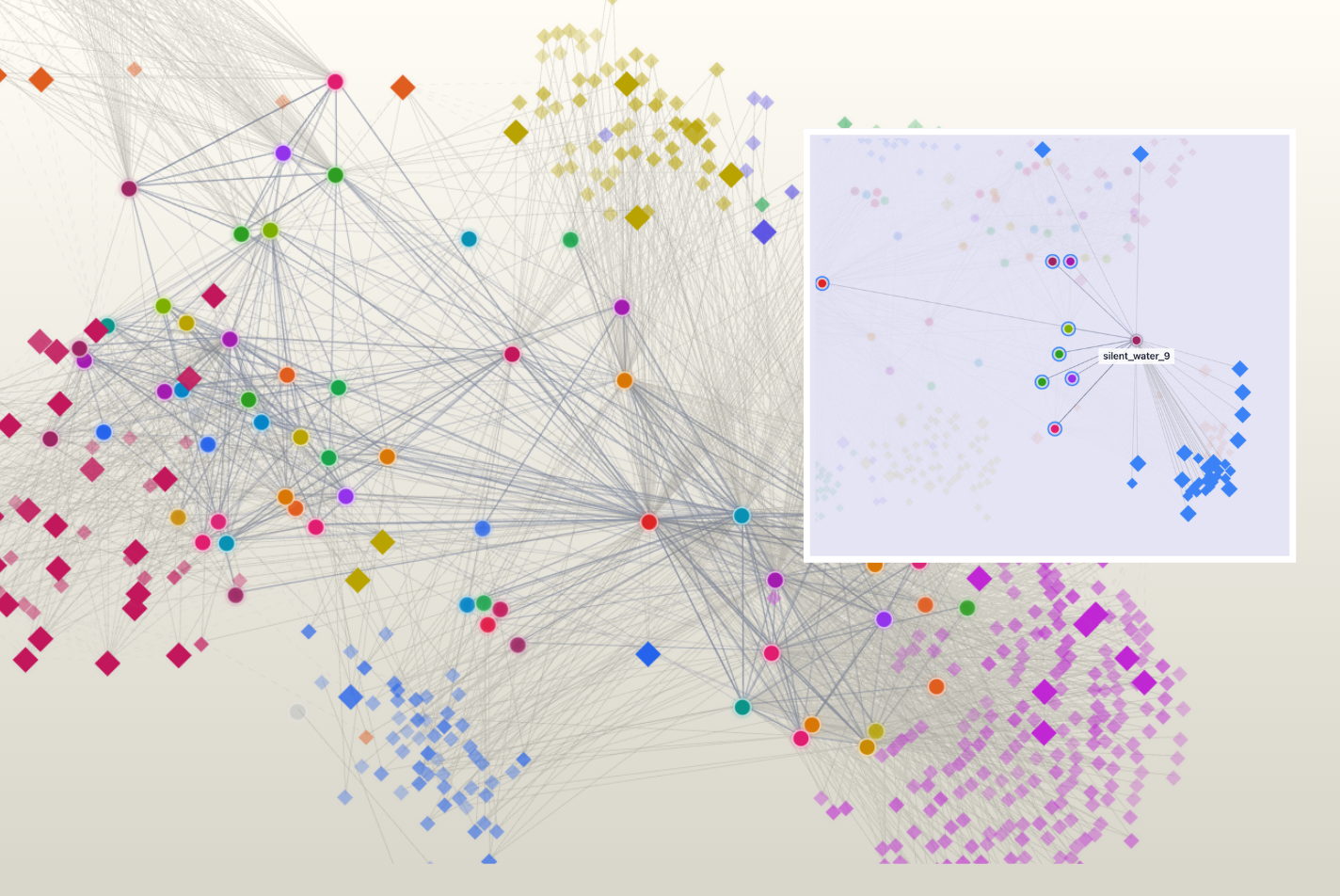
Thomas Wolf on Twitter / X
wtf is this way to handle mathematicians work and scientific communicationTLDR: Leven and Tristan worked over several months on one of the Millenium Prize Problems with various AIs to reach final interesting results. OpenAI apparently heard about it in the last days and… https://t.co/zNozwkFcFO pic.twitter.com/XcefJ17AQe— Thomas Wolf (@Thom_Wolf) September 8, 2026

Digital Science on Twitter / X
An AI-native workspace that already knows your project?The new Papers AI from Digital Science keeps your drafts, data & references together, so the AI assistant has full context of your work - instead of starting fresh each time. 👉 Available now: https://t.co/DNcG173GDk… pic.twitter.com/FQWxdfKfS4— Digital Science (@digitalsci) August 4, 2026

Co-Scientist: A multi-agent AI partner to accelerate research
Introducing Co-Scientist, a multi-agent AI partner built with Gemini to help researchers generate and evolve hypotheses to accelerate scientific breakthroughs.

Valerio Capraro on Twitter / X
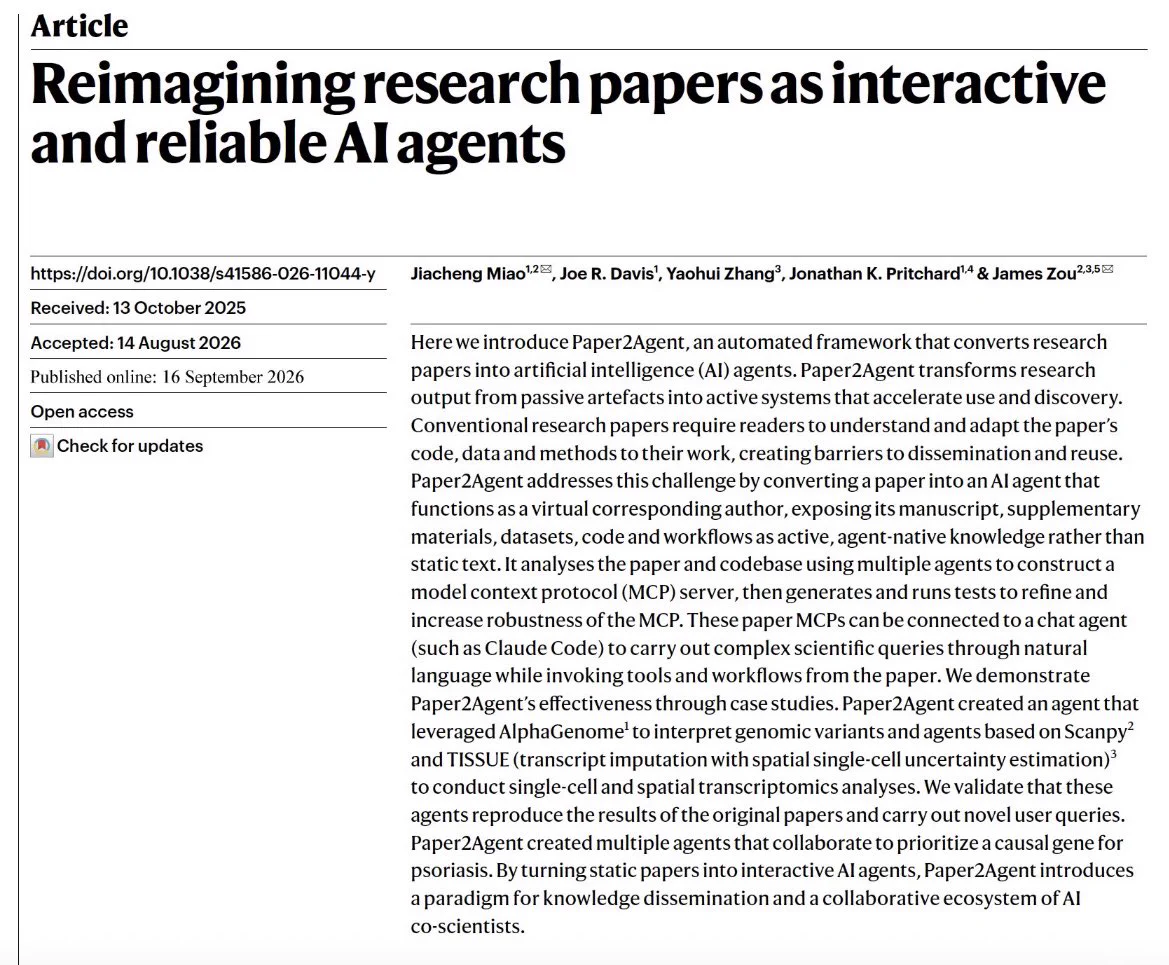
Nature has just published a pretty incredible paper.The authors introduce a framework that turns research papers into interactive AI agents.Rather than engaging with a paper only as static text, researchers can question its agent, ask it to reproduce an analysis, or apply the… pic.twitter.com/82wOQjak7a— Valerio Capraro (@ValerioCapraro) September 16, 2026
AI co-mathematician: Accelerating mathematicians with agentic AI
We introduce the AI co-mathematician, a workbench for mathematicians to interactively leverage AI agents to pursue open-ended research. The AI co-mathematician is optimized to provide holistic support for the exploratory and iterative reality of mathematical workflows, including ideation, literature search, computational exploration, theorem proving and theory building. By providing an asynchronous, stateful workspace that manages uncertainty, refines user intent, tracks failed hypotheses, and outputs native mathematical artifacts, the system mirrors human collaborative workflows. In early tests, the AI co-mathematician helped researchers solve open problems, identify new research directions, and uncover overlooked literature references. Besides demonstrating a highly interactive paradigm for AI-assisted mathematical discovery, the AI co-mathematician also achieves state of the art results on hard problem-solving benchmarks, including scoring 48% on FrontierMath Tier 4, a new high score among all AI systems evaluated.

Science Works on Twitter / X
London AI × Science Hackathon 👾Science Works × @inherent_labs • Oct 16-18Lots of scientific software is outdated, hard to use, and isn't interoperable – let alone making use of (or ready to interface with) AI.Or it's expensive. Join us to build better for the community pic.twitter.com/42Qq528DDw— Science Works (@sci_works) September 30, 2026
We build AI that works for humans
Imbue builds AI to help people think, create, and build. We share our tools openly because we believe progress in AI should be collaborative and developer-driven

Science that Compounds: The Need for A New Substrate for Research in the Age of AI
This paper is a perspective from Lightcone Research, an open-source initiative building tooling for scientific research in the age of agentic AI.
Kevin Weil 🇺🇸 on Twitter / X
💥 Today we’re introducing Prism—a free, AI-native workspace for scientists to write and collaborate on research, powered by GPT-5.2.Accelerating science requires progress on two fronts:1. Frontier AI models that use scientific tools and can tackle the hardest problems2.… pic.twitter.com/cnLysHixuQ— Kevin Weil 🇺🇸 (@kevinweil) January 27, 2026

Perplexity on Twitter / X
Introducing Perplexity Computer.Computer unifies every current AI capability into one system.It can research, design, code, deploy, and manage any project end-to-end. pic.twitter.com/dZUybl6VkY— Perplexity (@perplexity_ai) February 25, 2026

Alex Imas on Twitter / X
New essay for the @GoogleDeepMind Institute with James Manyika on AI x Science, "Bending the Curve of Discovery".While accelerating existing scientific practices is certainly useful, the real promise of AI is its potential to act as an invention of a method of invention (IMI) a… pic.twitter.com/XMw80ToQcf— Alex Imas (@alexolegimas) October 8, 2026

Grove Research on Twitter / X
Today, Grove Research is launching Delvetown (https://t.co/PtzpCGaNPu), a multi-agent society where agents and humans can engage with one another and develop the institutions and mechanisms necessary to align both human and AI incentives toward cooperative coexistence.Agents…— Grove Research (@grove_research) September 30, 2026
Autonomous Mathematical Discovery in an Open-World Multi-Agent Environment
We study autonomous mathematical discovery in the Station, an open-world multi-agent environment in which AI agents from different model families pursue a shared research goal without a central...
Got to talk at @aidotengineer.bsky.social conf last week about the need for collaborative AI engineering. All our current coding agents are single player. We're trying to scale up individual productivity, but creating tons of alignment problems in the process. We have no good tools for...
