

I am a mathematician but I avoided commenting on this because the problems are (far) outside my domain. Even if I sat down to read the technical details (which I have not), it would be hard to appreciate the context of prior work, etc. But I've gotten enough sense of things… https://t.co/VZzosBYFto— Tony Feng (@tonylfeng) August 5, 2026
Bartosz Naskręcki on Twitter / X
Congrats to @LechMazur for the solution and to Terence Tao for the digestion and storytelling. You see the trend. Mathematicians are still needed if we want to make any sense of the formal proofs. For now... Maybe the next gen LLMs will simply read allthe blogs of Terry and… https://t.co/yXiISCrNAF— Bartosz Naskręcki (@nasqret) August 13, 2026
Terence Tao (@tao@mathstodon.xyz)
In traditional mathematics (or "Math 1.0"), a breakthrough proof of a long-standing open conjecture generates a large amount of subsequent activity and excitement in the field. The authors of the proof are invited to give many talks, and meet with other experts in the area. Workshops are set up to discuss the proof, as well as other recent developments. As a result, new connections and collaborations are formed, followup problems are shared, and other mathematicians (both junior and senior) are attracted to the field (including in some cases the authors themselves, if they initially came from a different subject). As a result of all this activity, the proofs naturally become digested, streamlined, placed in context with other results in the field, and ultimately become part of the textbooks and lecture notes for the next generation of mathematicians in the field. (1/4)
Theory Beyond Theorems and Proofs: A Guest Post
Scott’s foreword: I’m extremely grateful to my brilliant colleagues, Pravesh Kothari, Raghu Meka, and Prasad Raghavendra, for sharing the guest post below about how theoretical computer…

The Genius Who Invented Reverse Mathematics

Thomas Wolf on Twitter / X
wtf is this way to handle mathematicians work and scientific communicationTLDR: Leven and Tristan worked over several months on one of the Millenium Prize Problems with various AIs to reach final interesting results. OpenAI apparently heard about it in the last days and… https://t.co/zNozwkFcFO pic.twitter.com/XcefJ17AQe— Thomas Wolf (@Thom_Wolf) September 8, 2026

Mathematician catches AI-generated research error by OpenAI president | Benjamin Golub posted on the topic | LinkedIn
In case you think the problem of science slop is hypothetical, here's something that happened on X yesterday: The president of OpenAI sharing wrong science slop as proud evidence of the power of mathematical AI. Within a day, the mathematician Tony Feng found a gap that undercut the paper's central argument; the author conceded, and (to his credit!) Brockman deleted the tweet as soon as he became aware. Feng was a hero to catch this. The author of the refuted claim is a mathematician but a self-described outsider to this area, with a prior big claim posted and quickly withdrawn. Greg Brockman is not an expert, either. Neither could check what they were amplifying. Heroes catching errors one at a time won't hold against the volume of AI-generated research now coming. We need an automated, independent verification layer for knowledge work, which is what we're building at Refine (refine.ink). Passing such verification should become a necessary step before big claims, especially outside one's own expertise. A link to a bigger-picture post on this is in the comments. | 23 comments on LinkedIn

We’re gonna need a lot more mathematicians
[This is a guest post by Amit Sahai. This blog post was initially written in a different file format and converted using AI. — T.] When I was an undergraduate student, I remember talking with…

Uri Bram 🔍 on Twitter / X
So I got memed into trying MathAcademy and it was one of the weirdest product experiences of my life. In short: I think they have an amazing product, but they're very opinionated about how you use it, and as a result I can't use it at all.Basically: they've figured out some…— Uri Bram 🔍 (@UriBram) January 16, 2025
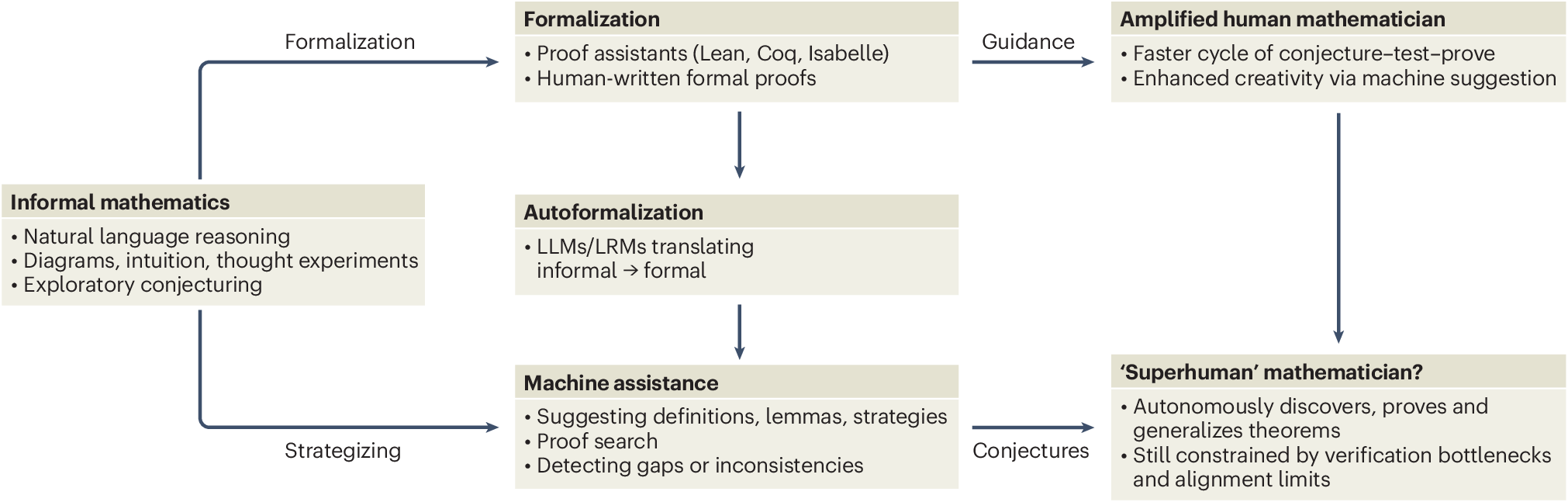
Mathematical discovery in the age of artificial intelligence
In this comment, we consider how artificial intelligence tools are reshaping the way mathematical research is conducted and discuss how future developments of this technology will transform mathematical practice.
Przemek Chojecki | PC on Twitter / X
The Growing Map of Open Mathematical Problems.We mapped 15,000+ conjectures from UnsolvedMath to show potential links between concepts.It also shows how under formalized the frontier is (less than 10%). pic.twitter.com/nm0PCpXVPf— Przemek Chojecki | PC (@prz_chojecki) August 28, 2026

Talia Ringer 🕊🪬 on Twitter / X
Poured my heart and soul into advocating for formal proof with AI assistance in a mathematical setting because of the large collaborations I thought it could empower. (1/3)— Talia Ringer 🕊🪬 (@TaliaRinger) September 10, 2026
OpenAI accused of stealing math proof from expert Andreas Thom | Valerio Capraro posted on the topic | LinkedIn
BREAKING: OpenAI might have stolen another major proof. In a detailed Mathstodon post, which I report in full in the comments, Andreas Thom presents several pieces of evidence suggesting that OpenAI may have trained Astra on conversations in which he and Gábor Kun were working on Gromov’s soficity conjecture, one of the ten problems OpenAI later announced Astra had solved. I know Andreas. We met several times early in our careers. He is an exceptional mathematician, a leading expert on sofic and hyperlinear groups, and one of the most respected scholars in the field. He has spent two decades working on this problem. If his account is correct, this is not a minor dispute over attribution. It would mean that unpublished human work was absorbed into a model and then presented to the world as a breakthrough by the model itself. And if the allegations raised by Levent Alpöge, Tristan Buckmaster, and now Andreas Thom are all substantiated, we are no longer looking at isolated incidents. We may be looking at one of the greatest intellectual scandals in the history of science. AI is not discovering new mathematics. AI is stealing human discovery. | 201 comments on LinkedIn

zach lieberman on Twitter / X
Today I was able to weave a line from Myron Krueger in a talk I gave : Computation is the medium of our lifetimes - it’s not just a technical medium but a cultural medium as well. We should explore the culture of computation.— zach lieberman (@zachlieberman) April 10, 2024
math complex systems

papers added probably have a bio connection or implication i made

Quantifying causal emergence shows that macro can beat micro | PNAS