

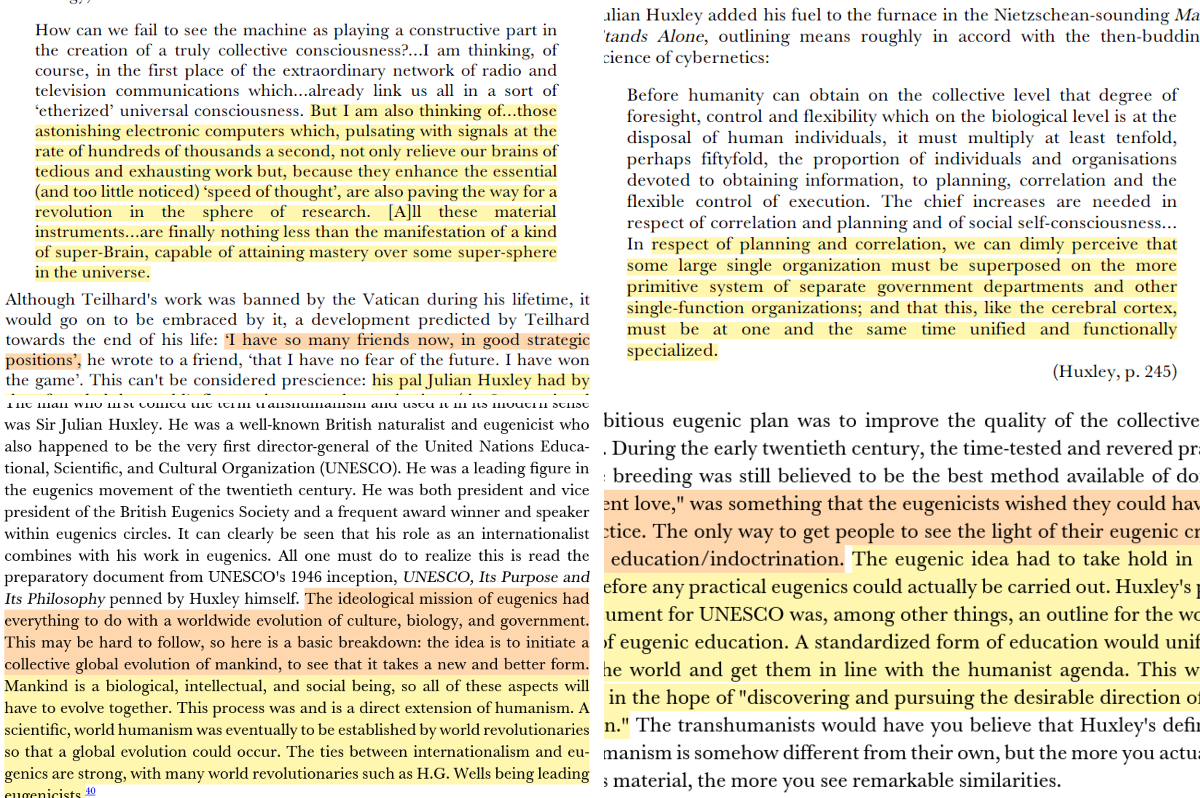
Teilhard de Chardin saw Julian Huxley as an important ally: as head of UNESCO, Huxley could institutionalize their vision. His founding plan called for global eugenic education to unify consciousness & guide mankind's biological and cultural evolution toward a transhuman future. https://t.co/VtsejosxAz pic.twitter.com/WTQ5EPKS3W— RJ Moreau 🇧🇹 (@toxictiramisu) March 17, 2026
RJ Moreau 🇧🇹 on Twitter / X
Human Ecology (CIA MKULTRA front) gave behavioral scientist BF Skinner $5K to write Beyond Freedom and Dignity, where he argued to abolish the inner man & control behavior. His methods later reached schools, where researchers & drug companies tested kids w/ learning difficulties. https://t.co/TQilUoMYQv pic.twitter.com/sZkr4fDqFN— RJ Moreau 🇧🇹 (@toxictiramisu) March 18, 2026

What can we learn from the perennial philosophy of Aldous Huxley? | Aeon Essays
Aldous Huxley argued that all religions in the world were underpinned by universal beliefs and experiences. Was he right?

Digital Eugenics and the Extinction of Humanity
If we are to combat the AI industry’s push to build digital gods, we have to understand the ideology of the antihumanist project, writes Dr. Émile P. Torres.
Three minutes with Hans Rosling will change your mind about the world
Nature - He has influenced leaders from Melinda Gates to Fidel Castro. Now, he is on a mission to save people from their preconceived ideas.

2026 Cosmos HAI Lab Lecture with Jack Clark, Co-founder of Anthropic
How are we writing the future of humanity?
Consciousness spinning

AI, Oligarchs & The Commodification of Public Education With John Koyczek
DOGE Blitzkrieg: on Musk's artificial intelligence statecraft
Published in Science as Culture (Ahead of Print, 2026)

The Secret of Our Success: How Culture Is Driving Human Evolution, Domesticating Our Species, and Making Us Smarter
How our collective intelligence has helped us to evolve and prosperHumans are a puzzling species. On the one hand, we struggle to survive on our own in the wild, often failing to overcome even basic challenges, like obtaining food, building shelters, or avoiding predators. On the other hand, human groups have produced ingenious technologies, sophisticated languages, and complex institutions that have permitted us to successfully expand into a vast range of diverse environments. What has enabled us to dominate the globe, more than any other species, while remaining virtually helpless as lone individuals? This book shows that the secret of our success lies not in our innate intelligence, but in our collective brains—on the ability of human groups to socially interconnect and learn from one another over generations.Drawing insights from lost European explorers, clever chimpanzees, mobile hunter-gatherers, neuroscientific findings, ancient bones, and the human genome, Joseph Henrich demonstrates how our collective brains have propelled our species' genetic evolution and shaped our biology. Our early capacities for learning from others produced many cultural innovations, such as fire, cooking, water containers, plant knowledge, and projectile weapons, which in turn drove the expansion of our brains and altered our physiology, anatomy, and psychology in crucial ways. Later on, some collective brains generated and recombined powerful concepts, such as the lever, wheel, screw, and writing, while also creating the institutions that continue to alter our motivations and perceptions. Henrich shows how our genetics and biology are inextricably interwoven with cultural evolution, and how culture-gene interactions launched our species on an extraordinary evolutionary trajectory.Tracking clues from our ancient past to the present, The Secret of Our Success explores how the evolution of both our cultural and social natures produce a collective intelligence that explains both our species' immense success and the origins of human uniqueness.
RJ Moreau 🇧🇹 on Twitter / X
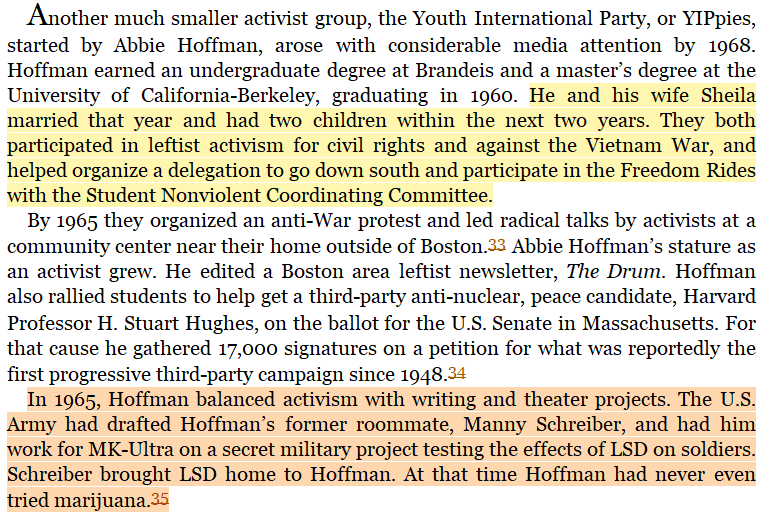
Abbie Hoffman co-founded the Yippies & was a major antiwar activist. His former roommate, involved in MKULTRA LSD testing, introduced him to the drug, leading to regular use. The Yippies were heavily infiltrated by the FBI & also received funding from the Mellon-Hitchcock family. https://t.co/zZ1wOAEzsK pic.twitter.com/OtyCiZVQY2— RJ Moreau 🇧🇹 (@toxictiramisu) April 27, 2026
Eyes on the Prize - Chicago Reader
Over more than two decades, Haki and Safisha Madhubuti have proved that African-centered education can amount to more than a black version of history. It can also be a springboard to a bright future.
Technically Radical
They're so thoroughly hypnotized by the short-term victory of global capitalism that they can't surf the new paradigm, look to the longer term. – Charles Stross, Accelerando One obvious role for a radical intellectual is to do precisely that: look at those who are creating viable alternatives, try to figure out what might be the larger implications of what they are (already) doing, and then offer those ideas back [to the world], not as prescriptions, but as contributions, possibilities—as gifts. – David Graeber, Fragments of an Anarchist Anthropology Over 2024, we saw major tech investors and company owners overtly turn toward the right, overtly backing Donald Trump in his electoral campaign....
Technically Radical
They're so thoroughly hypnotized by the short-term victory of global capitalism that they can't surf the new paradigm, look to the longer term. – Charles Stross, Accelerando One obvious role for a radical intellectual is to do precisely that: look at those who are creating viable alternatives, try to figure out what might be the larger implications of what they are (already) doing, and then offer those ideas back [to the world], not as prescriptions, but as contributions, possibilities—as gifts. – David Graeber, Fragments of an Anarchist Anthropology Over 2024, we saw major tech investors and company owners overtly turn toward the right, overtly backing Donald Trump in his electoral campaign....
Trump’s Plan for Science: More Money for A.I., Less for Universities
Michael Kratsios, President Trump’s science adviser, proposed overhauling how the government funds research. Democrats said Mr. Trump’s actions had weakened science.
