

Human reviewers pull 8.4% of their criticisms from a paper's appendix.Frontier LLM reviewers: 62%.A new study had GPT-6 and Claude 5.5 models review ICLR 2027 submissions, then mapped each weakness to the section it came from. The AI critiques keep going past page 30 of the…— Vansh Bhavsar (@vanshdot) November 17, 2026
AI Reviews Are Biased Towards the Appendix
Large language models (LLMs) are increasingly used by reviewers to highlight weaknesses during the reviewing process, and their outputs often shape the reviews that humans submit. Prior work studies how LLM reviews align with human ones, yet we know little about which parts of a paper these models actually criticize. In this work, we investigate 2,000 papers from ACL, EMNLP, COLM, and ICLR, and show that the latest GPT and Claude models draw about 50% or more of their review weaknesses from the appendix. This behavior holds across the API, coding-agent, and web access methods for using LLMs to review a paper. In contrast, we find that humans draw only 8.4% of their weaknesses from the appendix, and these weaknesses primarily revolve around a paper's presentation and content related to its core idea. Meanwhile, LLMs draw weaknesses from deep in the appendix that concern fine-grained technical details not central to the paper's contributions. We anticipate that our analysis will contribute to the scholarly discourse on AI reviews. Our code is publicly available at: https://github.com/cincynlp/review_appendix.

ReviewBench: An Extensible Framework for Benchmarking Human and AI Manuscript Review
The volume of scientific manuscripts is rising faster than the available pool of expert reviewers, and AI tools are emerging as a possible response, ranging from frontier large language models applied directly to peer review to purpose-built multi-agent systems. Scalable, standardized benchmarks are needed to regularly evaluate how these tools compare to one another and to human reviewers. We present ReviewBench, an open-source, venue-agnostic framework that compares human and AI reviews across structure, alignment with a paper’s major claims, impact, and critique category. We apply ReviewBench to 145,021 review comments from human reviewers, frontier large language models (GPT-5.2, and Gemini 3 Pro), and Reviewer3.com (R3), a multi-agent peer review system. The dataset spans papers in computer science (ICLR 2025, n = 1,000), social science (Nature Human Behaviour, n = 142), and life science (eLife, n = 1,000). Across disciplines, AI reviews are more structured and engage more directly with a paper’s major claims, with R3 more often surfacing consequential comments, defined as comments capable of undermining those claims. When restricting to critical comments, however, human reviewers rank first on consequential rate on more individual papers than any AI source, despite a lower average. We identify a bimodal reviewer distribution with peaks near 0% and 100%, indicating that many reviewers outperform AI on this metric, but a substantial fraction of reviewers near 0% brings the average down. Critique typing demonstrates systematic differences, where humans emphasize contribution and clarity, while AI emphasizes validity, sufficiency, and transparency. Together, these findings argue against framing AI as a replacement for human review and instead support a complementary model in which AI scales technical verification of major claims while human judgment remains essential for evaluating contribution and shaping editorial decisions.

AI Article Reviews Dominate Human Peer Reviews at Their Best: Evidence and Policy Choices
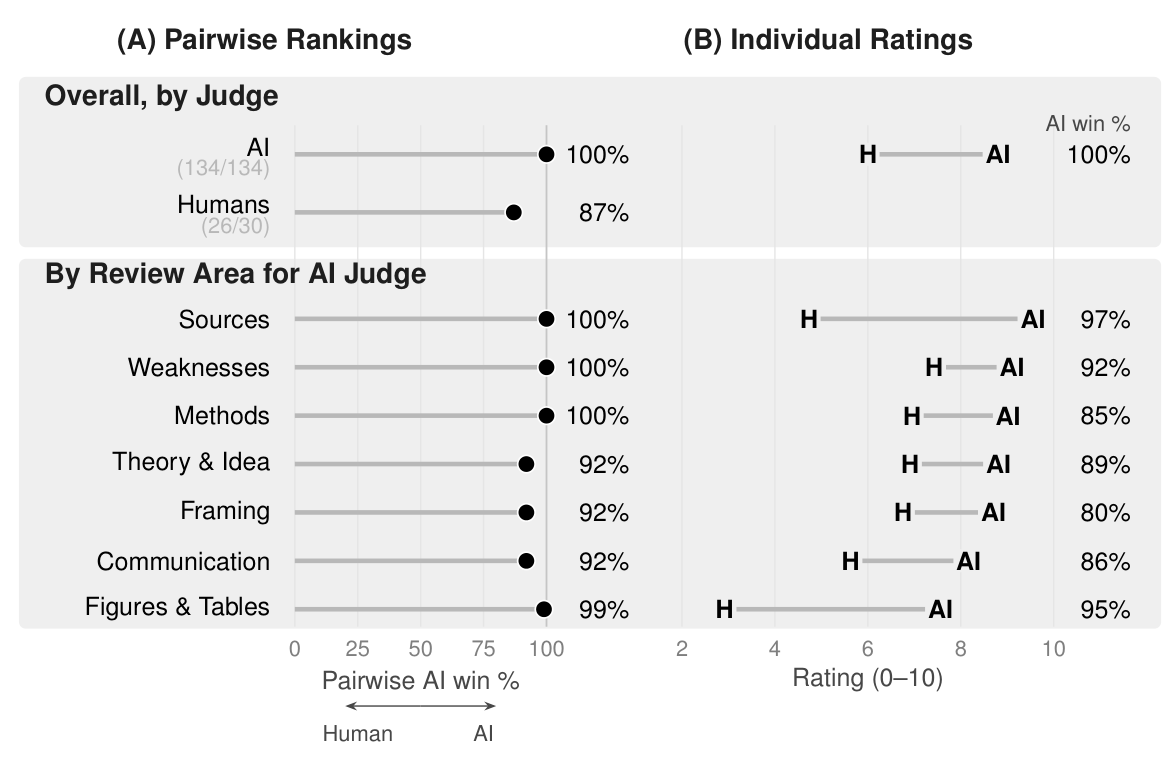
We show that AI-generated article reviews are now better, by every measure we could construct, than reviews written by well-compensated human experts and judged to be of unusually high quality by journal editors and authors. We then discuss how this result may inform journal policy choices, with concerning downsides as well as potential paths to increase publication speed and quality; reduce adversarial interactions; improve the experience of editors, reviewers, authors, and readers; and advance science.
Illicit Use of AI by Philosophers Refereeing for Journals - Daily Nous
In 2024, a study found that “7–17% of the sentences in the reviews [of computer science manuscripts] were written by LLMs”. It was only a […]
A Retrospective on the ICLR 2026 Review Process – ICLR Blog
The selection of papers for ICLR 2026 has fully concluded. We extend our congratulations to the authors whose work will appear at the conference. Creating ICLR’s technical program requires immense effort from the authors, reviewers, and area chairs, and we thank you for your contributions and service. For researchers whose work was rejected, we hope that the review process will help you improve your submission for future publication.
AI reviewers are here — we are not ready
Nature - Artificial intelligence promises rapid and polite feedback on papers — but we must first review the reviewer.

AI Research Assistant Claude Scholar: Open Source, Free, and Citation-Verified | João Cláudio Nunes Carvalho posted on the topic | LinkedIn
🚨 Professors are going to hate this. Someone just open sourced an AI that writes research papers from idea to publication. Conference-ready. Citation-verified. Free. It's called Claude Scholar. An AI-powered research system that handles every step of the academic workflow. Idea to publication. Fully automated. No advisor at 2am. No staring at blank LaTeX files. No crying during rebuttal season. Here's what's inside this thing: → AI brainstorms research topics, reviews literature, and finds gaps nobody has explored → Runs statistical analysis on your experiments. t-tests, ANOVA, ablation studies. Publication-ready figures. → Writes your paper section by section. Abstract to conclusion. Conference-formatted. → Verifies every citation through multi-layer validation so AI never hallucinates a reference → Strips robotic AI language and adds human voice so reviewers can't tell → Self-reviews your draft with a 6-point quality checklist before you submit → Parses reviewer comments, classifies each one, and drafts your entire rebuttal Here's the wildest part: It supports NeurIPS, ICML, ICLR, ACL, AAAI, Nature, Science, Cell, and PNAS. Downloads the conference template, strips sample content, and gives you a clean LaTeX structure ready to write into. The creator says it covers 90% of the academic research lifecycle. Research assistants charge $30 to $60/hour. Conference paper consultants charge $5,000+. Graduate programs cost $50K/year. This is free. All of it. 100% Open Source.

Major AI conference flooded with peer reviews written fully by AI
Nature - Controversy has erupted after 21% of manuscript reviews for an international AI conference were found to be generated by artificial intelligence.

How do authors want to use AI for review?
A survey of researchers who compared AI-generated scientific reviews with journal-agnostic human peer review reveals that they overwhelmingly prefer using AI as a self-checking tool before submission rather than as a replacement for human reviewers. It encourages an “author-centric” model in which AI helps researchers improve their manuscripts before they are reviewed by their peers.


Google opens Deep Review AI tool to help researchers catch manuscript errors
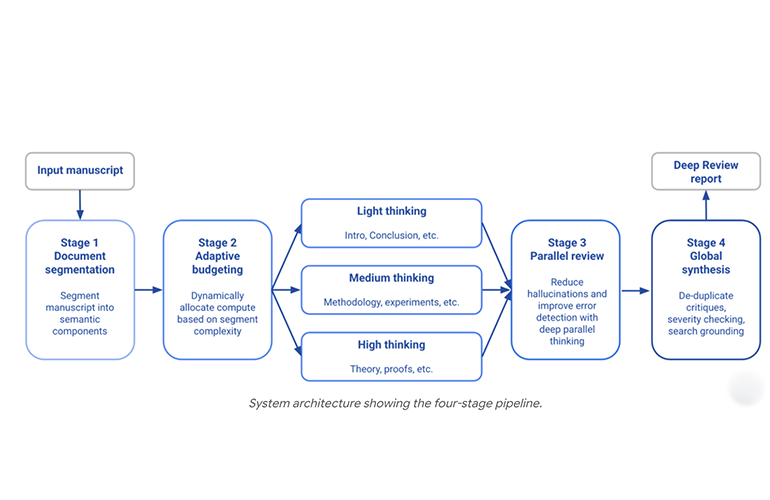
Google Research on Oct. 14 released Deep Review, an AI system designed to flag mathematical errors, logical gaps and unsupported claims in technical documents. The public launch follows pilots that provided feedback on more than 15,000 manuscripts, according to Google. Speaking at Google’s Research@ event in Mountain View, California, Rajesh Jayaram, a research scientist at…
Maksym Andriushchenko on Twitter / X
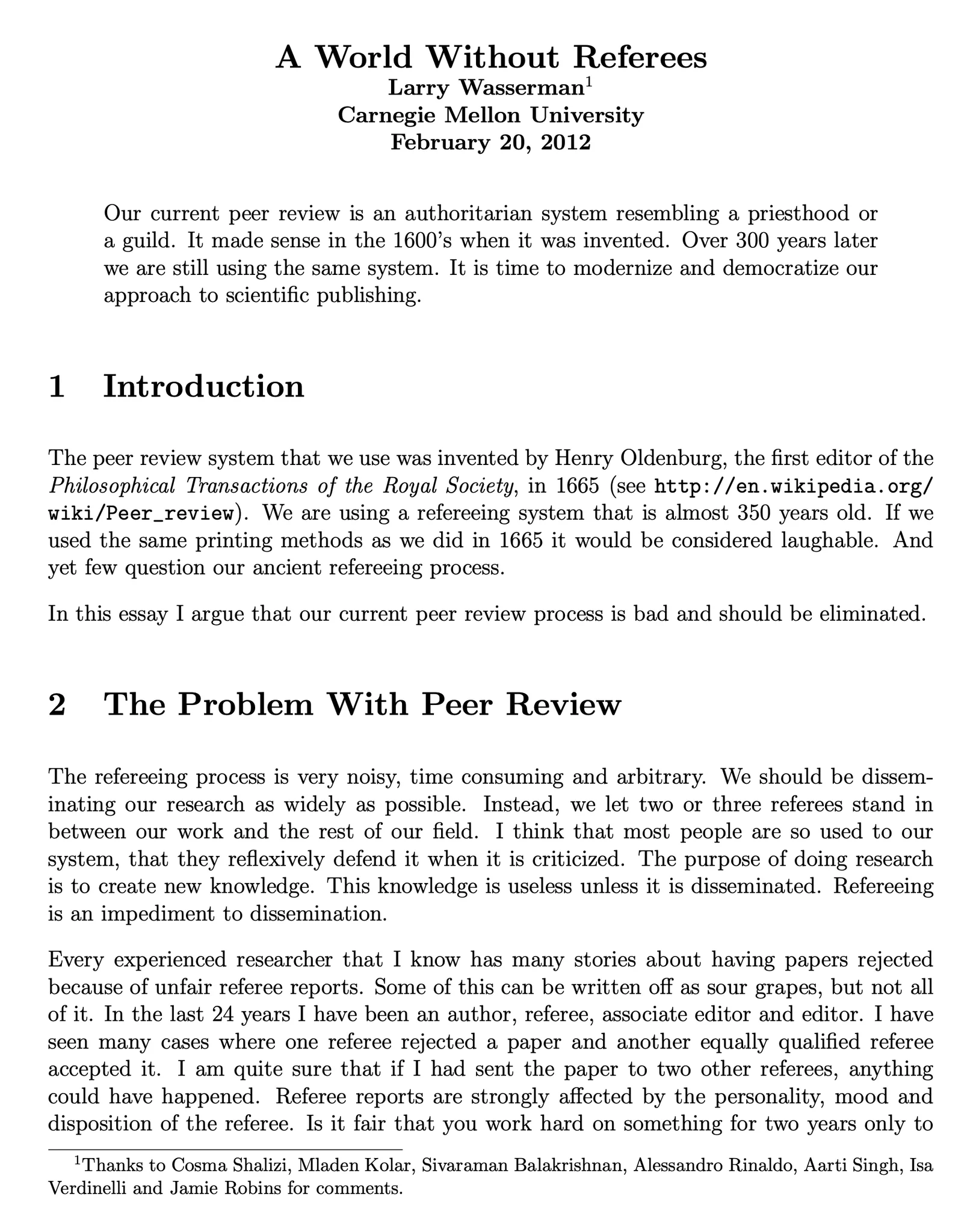
many people seem to be upset by >50k submissions to ICLR. i think we should celebrate it! more people are doing AI (including AI safety) research - isn't it amazing?as for how to navigate the growing amount of papers, luckily, Larry Wasserman formulated a solution back in 2012! pic.twitter.com/U85FGshTqw— Maksym Andriushchenko (@maksym_andr) September 20, 2026
AI-Assisted Peer Review at Scale: The AAAI-26 AI Review Pilot
Scientific peer review faces mounting strain as submission volumes surge, making it increasingly difficult to sustain review quality, consistency, and timeliness. Recent advances in AI have led the community to consider its use in peer review, yet a key unresolved question is whether AI can generate technically sound reviews at real-world conference scale. Here we report the first large-scale field deployment of AI-assisted peer review: every main-track submission at AAAI-26 received one clearly identified AI review from a state-of-the-art system. The system combined frontier models, tool use, and safeguards in a multi-stage process to generate reviews for all 22,977 full-review papers in less than a day. A large-scale survey of AAAI-26 authors and program committee members showed that participants not only found AI reviews useful, but actually preferred them to human reviews on key dimensions such as technical accuracy and research suggestions. We also introduce a novel benchmark and find that our system substantially outperforms a simple LLM-generated review baseline at detecting a variety of scientific weaknesses. Together, these results show that state-of-the-art AI methods can already make meaningful contributions to scientific peer review at conference scale, opening a path toward the next generation of synergistic human-AI teaming for evaluating research.
No. 002: Hallucinated citations at scale, ICML catches AI reviewers, scholarly infrastructure gaps - The Hallway Track
The Hallway Track No. 002 - How AI is affecting the practice of science
How LLMs Distort Our Written Language
Large language models (LLMs) are used by over a billion people globally, most often to assist with writing. In this work, we demonstrate that LLMs not only alter the voice and tone of human writing but also consistently alter the intended meaning. First, we conduct a human user study to understand how people actually interact with LLMs when using them for writing. Our findings reveal that extensive LLM use led to a nearly 70% increase in essays that remained neutral in answering the topic question. Significantly more heavy LLM users reported that the writing was less creative and not in their voice. Next, using a dataset of human-written essays that was collected in 2021 before the widespread release of LLMs, we study how asking an LLM to revise the essay based on the human-written feedback in the dataset induces large changes in the resulting content and meaning. We find that even when LLMs are prompted with expert feedback and asked to only make grammar edits, they still change the text in a way that significantly alters its semantic meaning. We then examine LLM-generated text in the wild, specifically focusing on the 21% of AI-generated scientific peer reviews at a recent top AI conference. We find that LLM-generated reviews place significantly less weight on clarity and significance of the research, and assign scores that, on average, are a full point higher. These findings highlight a misalignment between the perceived benefit of AI use and an implicit, consistent effect on the semantics of human writing, motivating future work on how widespread AI writing will affect our cultural and scientific institutions.