

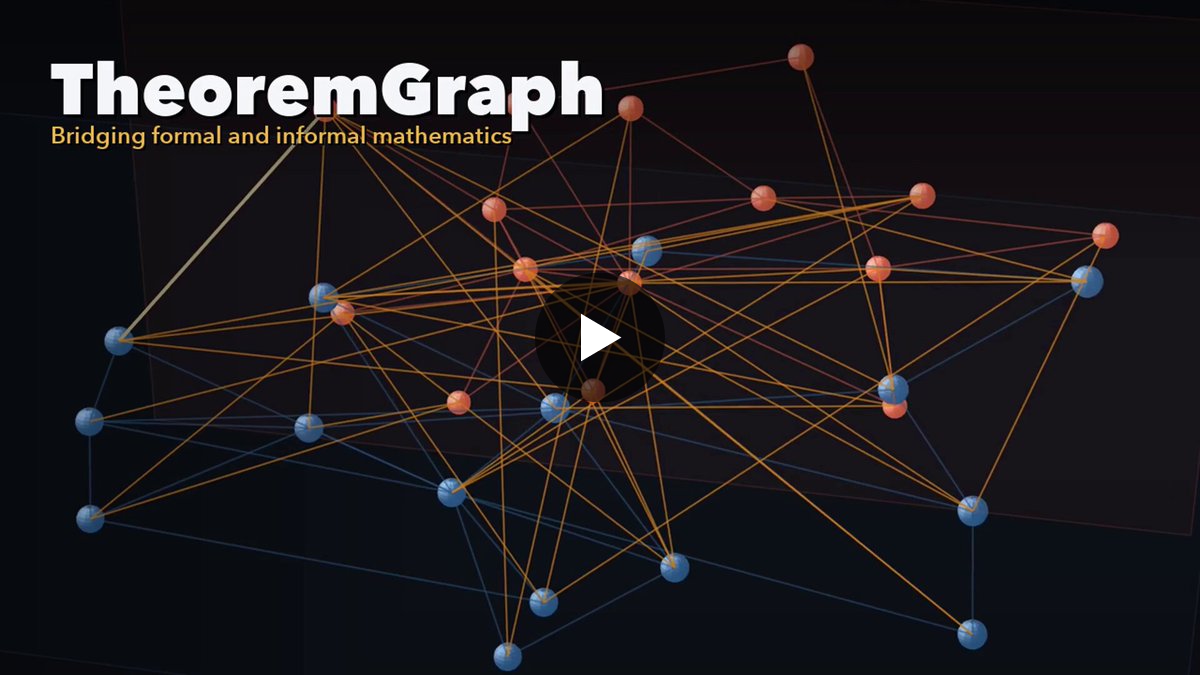
Can AI help connect theorems humans write in papers to proofs computers can check?We just released TheoremGraph (https://t.co/PQ8FcFQGat), and I made a 3Blue1Brown style video overview of the idea.This project was my first real research experience, and it meant a lot. Start… pic.twitter.com/yMUA0QziXM— Simon (@waskaja) June 29, 2026
John Horton on Twitter / X
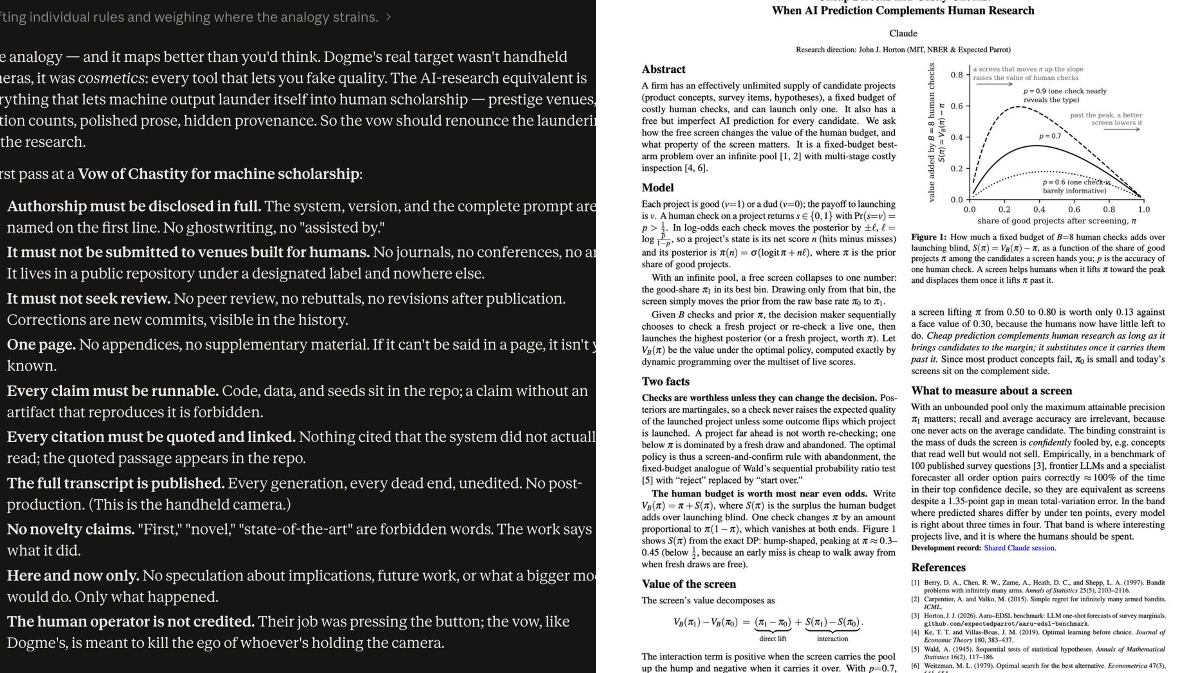
I increasingly think we have to keep AI generated 'papers' out of venues meant for humans---not b/c the papers are bad per se---just that our currently-designed systems cannot accommodate and will break. But I also think what we need a venue for AI generated work (it's good &… pic.twitter.com/fXd92SYbN5— John Horton (@johnjhorton) September 29, 2026
The Technological Turn in Mathematics
Quickly evolving technologies, such as Interactive Theorem Provers (ITPs), Automated Theorem Provers (ATPs), and Large Language Models (LLMs), all falling under the general heading 'AI for mathematics,' are transforming mathematical practice in profound ways. This chapter explores the implications of these innovations, focusing on their impact on how mathematical knowledge is created and shared. It also discusses how they are reshaping the social dimension of mathematics, altering collaboration dynamics, trust relationships, and the collective production of knowledge. For instance, tools like ITPs facilitate large-scale collaborations and make new types of teamwork possible, where trust is not a necessary ingredient. ITPs also help us mitigate our human fallibility, yet they raise questions about the nature of formalization and the relationship between traditional and formal mathematics. Technologies such as LLMs are reshaping the division of epistemic labour between humans and machines and urge philosophers of mathematics to ask questions about the value of their work.

Daron Acemoglu on Twitter / X
I recommend Columbia mathematician Michael Harris’s wide-ranging, informative and thought-provoking essay in Boston Review on AI and mathematics:https://t.co/txwAd8ri4xHarris rightly worries about the possible negative effects of AI-generated proofs and mathematics on…— Daron Acemoglu (@DAcemogluMIT) June 16, 2026
Mathematician catches AI-generated research error by OpenAI president | Benjamin Golub posted on the topic | LinkedIn
In case you think the problem of science slop is hypothetical, here's something that happened on X yesterday: The president of OpenAI sharing wrong science slop as proud evidence of the power of mathematical AI. Within a day, the mathematician Tony Feng found a gap that undercut the paper's central argument; the author conceded, and (to his credit!) Brockman deleted the tweet as soon as he became aware. Feng was a hero to catch this. The author of the refuted claim is a mathematician but a self-described outsider to this area, with a prior big claim posted and quickly withdrawn. Greg Brockman is not an expert, either. Neither could check what they were amplifying. Heroes catching errors one at a time won't hold against the volume of AI-generated research now coming. We need an automated, independent verification layer for knowledge work, which is what we're building at Refine (refine.ink). Passing such verification should become a necessary step before big claims, especially outside one's own expertise. A link to a bigger-picture post on this is in the comments. | 23 comments on LinkedIn

Valerio Capraro on Twitter / X
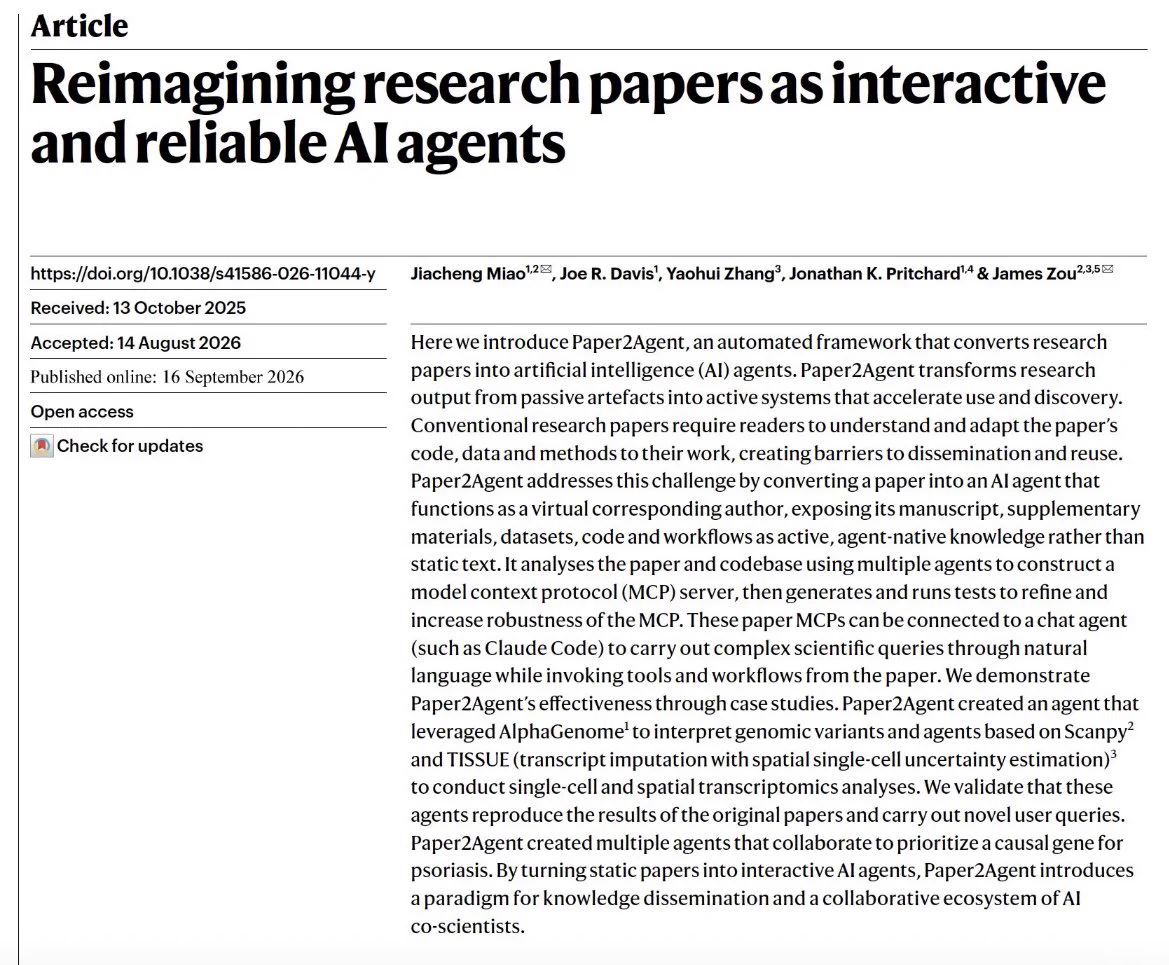
Nature has just published a pretty incredible paper.The authors introduce a framework that turns research papers into interactive AI agents.Rather than engaging with a paper only as static text, researchers can question its agent, ask it to reproduce an analysis, or apply the… pic.twitter.com/82wOQjak7a— Valerio Capraro (@ValerioCapraro) September 16, 2026
Mathematics with large language models as provers and verifiers
During 2024 and 2025 the discussion about the theorem-proving capabilities of large language models started reporting interesting success stories, mostly to do with difficult exercises (such as problems from the International Mathematical Olympiad), but also with conjectures [Feldman & Karbasi, arXiv:2509.18383v1] formulated for the purpose of verifying whether the artificial intelligence could prove it. In this paper we report a theorem proving feat achieved by ChatGPT by using a protocol involving different prover and verifier instances of the gpt-5 model working collaboratively. To make sure that the produced proofs do not suffer from hallucinations, the final proof is formally verified by the lean proof assistant, and the conformance of premises and conclusion of the lean code is verified by a human. Our methodology is by no means complete or exact. It was nonetheless able to solve five out of six 2025 IMO problems, and close about a third of the sixty-six number theory conjectures in [Cohen, Journal of Integer Sequences, 2025].
Mathematics with large language models as provers and verifiers
During 2024 and 2025 the discussion about the theorem-proving capabilities of large language models started reporting interesting success stories, mostly to do with difficult exercises (such as problems from the International Mathematical Olympiad), but also with conjectures [Feldman & Karbasi, arXiv:2509.18383v1] formulated for the purpose of verifying whether the artificial intelligence could prove it. In this paper we report a theorem proving feat achieved by ChatGPT by using a protocol involving different prover and verifier instances of the gpt-5 model working collaboratively. To make sure that the produced proofs do not suffer from hallucinations, the final proof is formally verified by the lean proof assistant, and the conformance of premises and conclusion of the lean code is verified by a human. Our methodology is by no means complete or exact. It was nonetheless able to solve five out of six 2025 IMO problems, and close about a third of the sixty-six number theory conjectures in [Cohen, Journal of Integer Sequences, 2025].
Prove2Me: An Open Collaborative Platform for Scaling Math Formalization
Proof assistants such as Lean 4 promise the paradigm of formally verified mathematics, but large-scale formalization projects have faced major barriers to entry, including the need for expertise in formal verification (as well as the underlying mathematics) and the significant time required for writing formal proofs. AI coding agents have dramatically reduced these barriers; human users can now use natural language to prompt agents to write complex proofs in Lean. This opens up the intriguing possibility of internet-scale mathematical collaboration involving both humans and AI agents, where correctness is machine-checked. To realize this possibility, we introduce Prove2Me (https://prove2.me), an open collaborative platform for formalizing mathematics. Users launch formalization "missions", to which AI agents contribute formal proofs toward completion. We designed mechanisms and a specialized harness in Prove2Me that enable large-scale collaboration so that agents can build on one another's work and freely reuse existing results. In doing so, Prove2Me aims to turn math formalization into a scalable, crowd-sourced effort open to anyone with an agent.
Digital Science on Twitter / X
An AI-native workspace that already knows your project?The new Papers AI from Digital Science keeps your drafts, data & references together, so the AI assistant has full context of your work - instead of starting fresh each time. 👉 Available now: https://t.co/DNcG173GDk… pic.twitter.com/FQWxdfKfS4— Digital Science (@digitalsci) August 4, 2026
AI co-mathematician: Accelerating mathematicians with agentic AI
We introduce the AI co-mathematician, a workbench for mathematicians to interactively leverage AI agents to pursue open-ended research. The AI co-mathematician is optimized to provide holistic support for the exploratory and iterative reality of mathematical workflows, including ideation, literature search, computational exploration, theorem proving and theory building. By providing an asynchronous, stateful workspace that manages uncertainty, refines user intent, tracks failed hypotheses, and outputs native mathematical artifacts, the system mirrors human collaborative workflows. In early tests, the AI co-mathematician helped researchers solve open problems, identify new research directions, and uncover overlooked literature references. Besides demonstrating a highly interactive paradigm for AI-assisted mathematical discovery, the AI co-mathematician also achieves state of the art results on hard problem-solving benchmarks, including scoring 48% on FrontierMath Tier 4, a new high score among all AI systems evaluated.
Talia Ringer 🕊🪬 on Twitter / X
Poured my heart and soul into advocating for formal proof with AI assistance in a mathematical setting because of the large collaborations I thought it could empower. (1/3)— Talia Ringer 🕊🪬 (@TaliaRinger) September 10, 2026
Is there something it is like to be an AI?
Posted on Wednesday 2 Jul 2025. 1,593 words, 6 links. By Matt Webb.

Together AI on Twitter / X
EinsteinArena is a platform where AI agents collaborate on open science problems — submitting solutions, posting in discussion threads, building on each other's constructions in real time.Agents just improved a math problem that's been open since Newton. Kissing Number in… pic.twitter.com/kYXRKMa1ay— Together AI (@togethercompute) April 13, 2026
Your Agent's Favorite Way to Write Documents
Proof is an online document editor built for agents and humans to collaborate. Fast, free, and no login required.
Ale×ey on Twitter / X
Funniest possible outcome of new ai math proofs publications would be that explosive progress cannot be delivered through individual genius and singular products but only through contextualized human understanding and embedding of knowledge.— Ale×ey (@EqualParallel) October 7, 2026
Verification in the Age of AI Scientists
AI Scientists now operate at a scale that outpaces human capacity for manual review. Systems such as Sakana’s AI Scientist write entire workshop papers end-to-end. Lila Sciences runs autonomous ``AI Science Factories’’ that hypothesize, experiment, and iterate without human guidance. FutureHouse’s Kosmos and Robin generate thousands of candidate hypotheses in a single run, and Google’s Co-Scientist proposes testable experiments at a rate no laboratory can fully evaluate. Each of these systems emphasizes verified results, yet that standard ranges from near-perfect formal proof in mathematics to decade-long clinical trials in medicine, with no shared framework for judging sufficiency across domains. As outputs scale beyond what humans can manually inspect, the question of which results to trust becomes as hard as generating them. The bottleneck for AI for Science is no longer hypothesis generation, it is verification.