

You'd think that given the same bytes of input you'd get the same bytes of output. lol. lmao. No, you don't. It's complicated.
Faster double-to-string conversion
There comes a time in every software engineer’s life when they come up with a new binary-to-decimal floating-point conversion method. I guess my time has come. I just wrote one, mostly over a weekend: https://github.com/vitaut/zmij.
Essentials of Compilation
Compilers are notoriously difficult programs to teach and understand. Most books about compilers dedicate one chapter to each progressive stage, a structure ...
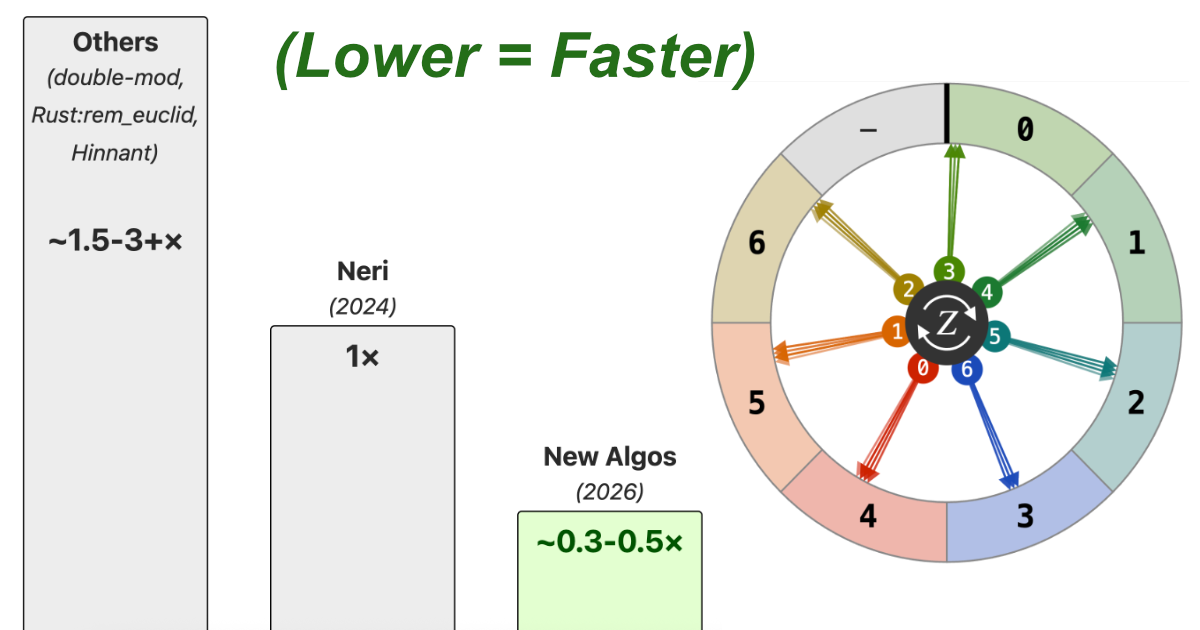
A faster way to calculate the day-of-the-week
A range of fast modulus techniques that beat compiler output
Production Is a Compiler Input - The Phoenix Architecture
using C++ to exploit the C++ that is building the C++
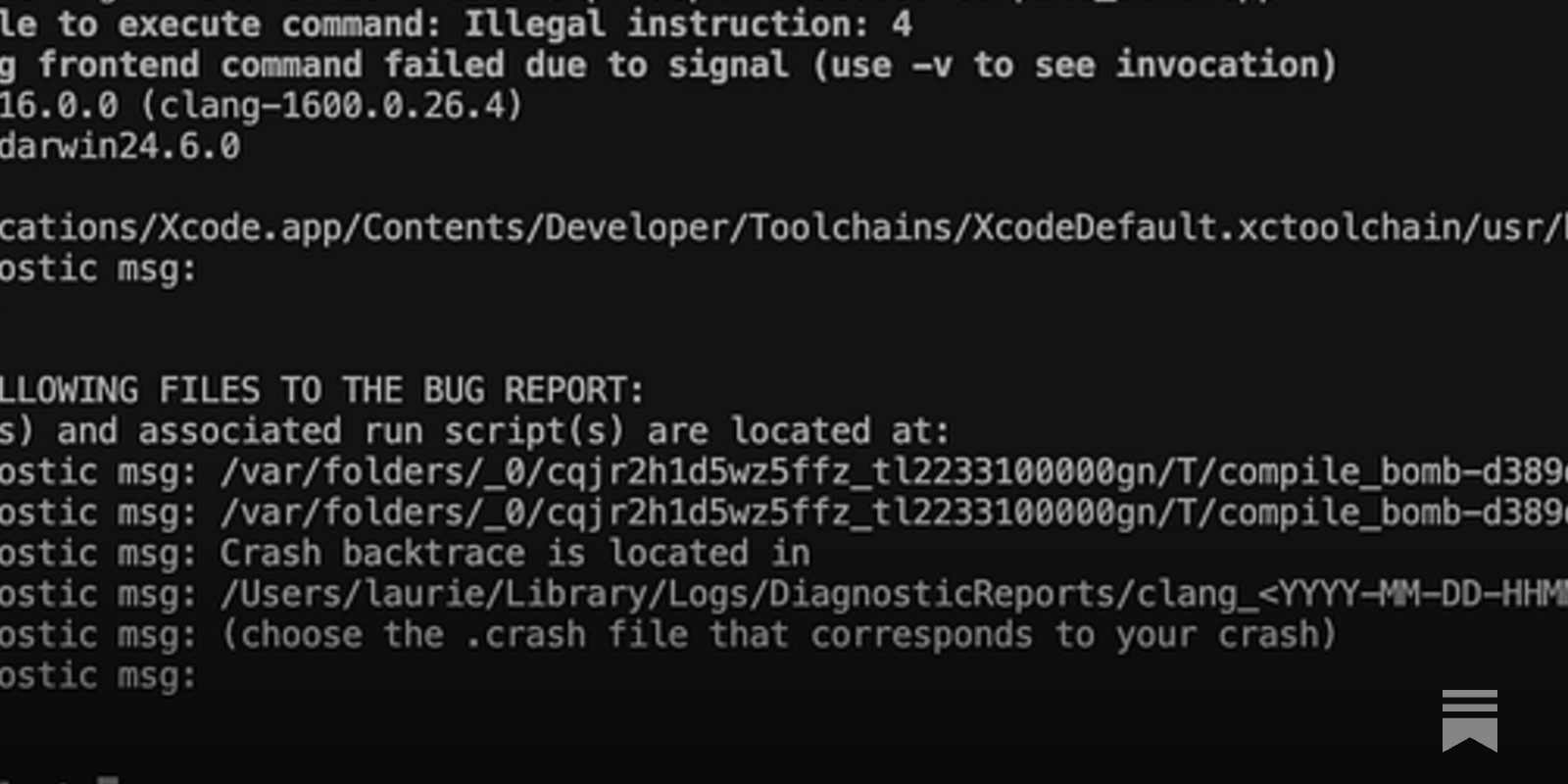
today you’re going to segfault your compiler.
Concise Binary Object Representation (CBOR)
The Concise Binary Object Representation (CBOR) is a data format whose design goals include the possibility of extremely small code size, fairly small message size, and extensibility without the need for version negotiation. These design goals make it different from earlier binary serializations such as ASN.1 and MessagePack. This document obsoletes RFC 7049, providing editorial improvements, new details, and errata fixes while keeping full compatibility with the interchange format of RFC 7049. It does not create a new version of the format.
Deterministic Core, Non-Deterministic Shell - Outdata
Determinism, architecture, and the de-sloppification of legacy code.

On-Device LLM Throughput Calculator - a Hugging Face Space by FL33TW00D-HF
This tool estimates and visualizes the throughput of Large Language Models on devices with memory bandwidth constraints. Users input device and model configurations, and the tool generates a plot s...
Strange and maddening rules
There’s this popular idea among developers that when you face a problem with code, you should get out a rubber duck and explain, to the duck, exactly how your code was supposed to work.

The Matter Compiler™ — Atomic Machines
A new universe of machines. Explore the Matter Compiler and a radically faster way to create.
Signals and Threads
Stephen Dolan works on Jane Street’s Tools and Compilers team where he focuses on the OCaml compiler. In this episode, Stephen and Ron take a trip down memory lane, discussing how to manage computer memory efficiently and safely. They consider trade-offs between reference counting and garbage collection, the surprising gains achieved by prefetching, and how new language features like local allocation and unboxed types could give OCaml users more control over their memory.

Andrew Kelley: A Practical Guide to Applying Data Oriented Design (DoD)
Better bitmap performance with Roaring bitmaps
Bitmap indexes are commonly used in databases and search engines. By exploiting bit-level parallelism, they can significantly accelerate queries. However, they can use much memory, and thus we might prefer compressed bitmap indexes. Following Oracle's lead, bitmaps are often compressed using run-length encoding (RLE). Building on prior work, we introduce the Roaring compressed bitmap format: it uses packed arrays for compression instead of RLE. We compare it to two high-performance RLE-based bitmap encoding techniques: WAH (Word Aligned Hybrid compression scheme) and Concise (Compressed `n' Composable Integer Set). On synthetic and real data, we find that Roaring bitmaps (1) often compress significantly better (e.g., 2 times) and (2) are faster than the compressed alternatives (up to 900 times faster for intersections). Our results challenge the view that RLE-based bitmap compression is best.

Why Can't Transformers Learn Multiplication?...
Language models are increasingly capable, yet still fail at a seemingly simple task of multi-digit multiplication. In this work, we study why, by reverse-engineering a model that successfully...
Why Can't Transformers Learn Multiplication?...
Language models are increasingly capable, yet still fail at a seemingly simple task of multi-digit multiplication. In this work, we study why, by reverse-engineering a model that successfully...
Compiling Match Statements to Bytecode
Full pipeline deep dive for purple garden: AST, BB SSA IR, Bytecode, Optimisations