


How big should a peer-to-peer network be before it generates a steady stream of deals?
Estimating peer effects in noisy, low-rank networks via network smoothing
Peer effect estimation requires precise network measurement, yet most empirical networks are noisy, rendering standard estimators inconsistent. To address measurement error in networks, we propose a method to estimate peer effects in networks whose expected adjacency matrix is low-rank. Our key result shows that peer effects over a true unobserved network are asymptotically equivalent to peer effects over the expected adjacency matrix. This result reduces peer effect estimation in noisy networks to low-rank matrix estimation targeting the expected adjacency matrix. We develop our theory for weighted networks observed with additive noise, but simulations suggest approach can be applied more generally when there is a low-rank estimation method suited to a particular noise structure. We demonstrate via simulations that our approach applies to egocentric samples, aggregated relational data, and networks with missing edges, each requiring a different low-rank estimation method.


Every layer of review makes you 10x slower
We’ve all heard of those network effect laws: the value of a network goes up with the square of the number of members. Or the cost of commun...
The Unsolvable Dilemma: Open Networks vs. Economic Sustainability - Nightflight
A conversation with a Fediverse core developer revealed the structural problem: donation models fail, and even specialized contributors can't make a living.…
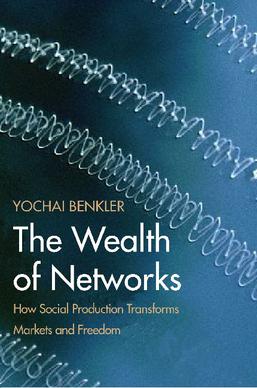
The Wealth of Networks
The Wealth of Networks: How Social Production Transforms Markets and Freedom is a book by Harvard Law School professor Yochai Benkler published by Yale University Press on April 3, 2006. The book has been recognized as one of the most influential works of its time concerning the rise and impact of the Internet on the society, particularly in the sphere of economics. It also helped popularize the term Benkler coined few years earlier, the commons-based peer production (CBPP).
Why isn't Bluesky a peer-to-peer network?
Today in "our novel form of NIH," why did Bluesky choose not to use a peer-to-peer network when designing the AT Protocol?

Why isn't Bluesky a peer-to-peer network?
Today in "our novel form of NIH," why did Bluesky choose not to use a peer-to-peer network when designing the AT Protocol?
Seize the Means of Computation - ProMarket
To regain internet autonomy from Big Tech companies, lower switching costs with legislation that allows new services to subvert network effects and encourage adversarial interoperability. Too often, our discussion of Big Tech’s dominance starts and ends with a simplistic account of network-effects-driven inevitability, as though the winner-take-all market we have today could not have been […]

Omidyar Network
Omidyar Network is a philanthropy whose mission is to bend the arc of the digital revolution toward shared power, prosperity, and possibility.

Open Source infrastructure deserves a business model
Open Source infrastructure is essential, invisible, and chronically underfunded. A more sustainable approach may be to connect the cost of running that infrastructure to the organizations that rely on it most.

How to build a successful business model around open source software
The right approach to open source can be a great revenue model for the software provider — my company did it and we've been profitable since day one.

Open Up Vs Break Up - AVC
There have been many calls to break up the large Internet monopolies; Amazon, Google, Facebook, Apple, etc. Breaking up a large monopoly feels like a very 19th/20th century move to me. I would prefer that politicians and policy makers think about opening up as the better intervention. A good way to explain this is to […]
(PDF) The EigenTrust Algorithm for Reputation Management in P2P Networks
PDF | Peer-to-peer file-sharing networks are currently receiving much attention as a means of sharing and distributing information. However, as recent... | Find, read and cite all the research you need on ResearchGate

We need better ways to sell people on decentralization, AT Protocol, and Bluesky than telling them open networks mean they won't have to suffer through losing yet another platform to an Elon Musk.

Decentralization is Insurance
www.aaronrosspowell.com