

Full pipeline deep dive for purple garden: AST, BB SSA IR, Bytecode, Optimisations
Compiling Models to Megakernels
Fine-grained synchronization, deep pipelines, and zero kernel launch overheads, automatically.

Kaitai Struct: declarative binary format parsing language
Kaitai Struct is a formal language for binary format specification that can be compiled into parser code
Engineering High-Performance Parsers with Data-Oriented Design
Notes from building Yuku: the AST is flat arrays of u32 indices instead of a pointer tree, and memory layout, allocation, strings, unicode, and serialization all follow from that one decision.
mergiraf
A syntax-aware git merge driver for a growing collection of programming languages and file formats.
Towards autonomous biology: Compiler-Verified Protocols as a Foundation for Real-World AI Execution
Artificial intelligence has advanced from analyzing experimental data to autonomously generating hypotheses, designing experiments, and coordinating closed loop discovery. Yet the translation from computational reasoning to physical execution remains bottlenecked by the experimental protocol, which in biology still relies on ambiguous natural-language descriptions: a medium other engineering disciplines abandoned decades ago in favor of compiler verified specification languages. This deficit fragments reproducibility along three axes: protocol accuracy, pre execution verification, and cross platform portability. Existing formalisms address only subsets of these challenges, trading expressiveness for rigor, portability for standardization, or usability for provenance. Here we introduce the Biology Protocol Language (BPL), a domain specific language with a biology-native type system in which every quantity carries physical units, every reagent declares its physical form, and every container maintains compiler-tracked state, so that implicit assumptions must be stated explicitly and physically impossible operations are rejected at compile time. We further develop BPL-COGEN, a pipeline that couples a fine tuned 30 billion parameter language model with the deterministic compiler in a closed generate validate repair loop, iteratively correcting the translation from natural language SOPs to BPL through compiler diagnostics until all physical, dimensional, and state constraints are satisfied. On a benchmark of 300 published Nature Protocols papers, BPL COGEN achieved an overall fidelity score of 95.1 against the source protocols as ground truth. Wet-lab experiment and cross-platform validation in GFP expression library construction and HPLC to UHPLC method translation confirmed that a single BPL source yielded reproducible execution across manual and liquid handler assisted contexts. The results established a novel pipeline that generates compiler-verified protocols, which is an essential prerequisite for physically embodied AI in biology.

Warnings for pattern matching
We examine the ML pattern-matching anomalies of useless clauses and non-exhaustive matches. We state the definition of these anomalies, building upon pattern matching semantics, and propose a simple algorithm to detect them. We have integrated the algorithm in the Objective Caml compiler, but we show that the same algorithm is also usable in a non-strict language such as Haskell. Or-patterns are considered for both strict and non-strict languages.

Speed Comparison - Programming Languages
Benchmarks run on GitHub Actions. Results may vary based on runner hardware.
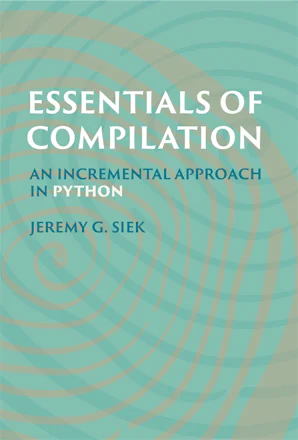
Essentials of Compilation
Compilers are notoriously difficult programs to teach and understand. Most books about compilers dedicate one chapter to each progressive stage, a structure ...
Structured merge with auto-tuning: balancing precision and performance
Software-merging techniques face the challenge of finding a balance between precision and performance. In practice, developers use unstructured-merge (i.e., line-based) tools, which are fast but imprecise. In academia, many approaches incorporate information on the structure of the artifacts being merged. While this increases precision in conflict detection and resolution, it can induce severe performance penalties. Striving for a proper balance between precision and performance, we propose a structured-merge approach with auto-tuning. In a nutshell, we tune the merge process on-line by switching between unstructured and structured merge, depending on the presence of conflicts. We implemented a corresponding merge tool for Java, called JDime. Our experiments with 8 real-world Java projects, involving 72 merge scenarios with over 17 million lines of code, demonstrate that our approach indeed hits a sweet spot: While largely maintaining a precision that is superior to the one of unstructured merge, structured merge with auto-tuning is up to 12 times faster than purely structured merge, 5 times on average.

Semble: Fast and Accurate Code Search for Agents
Fast and Accurate Code Search for Agents. Uses ~98% fewer tokens than grep+read
Production Is a Compiler Input - The Phoenix Architecture
MirrorCode: A benchmark for real-world software projects
Retrieval-Augmented Code Generation: A Survey with Focus on Repository-Level Approaches
Recent advancements in large language models (LLMs) have substantially improved automated code generation. While function-level and file-level generation have achieved promising results, real-world software development typically requires reasoning across entire repositories. This gives rise to the challenging task of Repository-Level Code Generation (RLCG), where models must capture long-range dependencies, ensure global semantic consistency, and generate coherent code spanning multiple files or modules. To address these challenges, Retrieval-Augmented Generation (RAG) has emerged as a powerful paradigm that integrates external retrieval mechanisms with LLMs, enhancing context-awareness and scalability. In this survey, we provide a comprehensive review of research on Retrieval-Augmented Code Generation (RACG), with an emphasis on repository-level approaches. We categorize existing work along several dimensions, including generation strategies, retrieval modalities, model architectures, training paradigms, and evaluation protocols. Furthermore, we summarize widely used datasets and benchmarks, analyze current limitations, and outline key challenges and opportunities for future research. Our goal is to establish a unified analytical framework for understanding this rapidly evolving field and to inspire continued progress in AI-powered software engineering.
steve.prophet on Twitter / X
so get smart about how you generate code... example token analysis of compilation output.model generates DSL / intermediate format, compiler turns it into actual runtime code.need to only generate 796 tokens to deploy 8,265 tokens.10x+ token difference (!!) https://t.co/LAAPjFX9Sc pic.twitter.com/zMoOrWb6yf— steve.prophet (@nilslice) March 18, 2026

The mythical matched modules | Proceedings of the 24th ACM SIGPLAN conference companion on Object oriented programming systems languages and applications
Certified compilers are complex software systems. Like other large systems, they demand modular, extensible designs. While there has been progress in extensible metatheory mechanization, scaling extensibility and reuse to meet the demands of full ...
