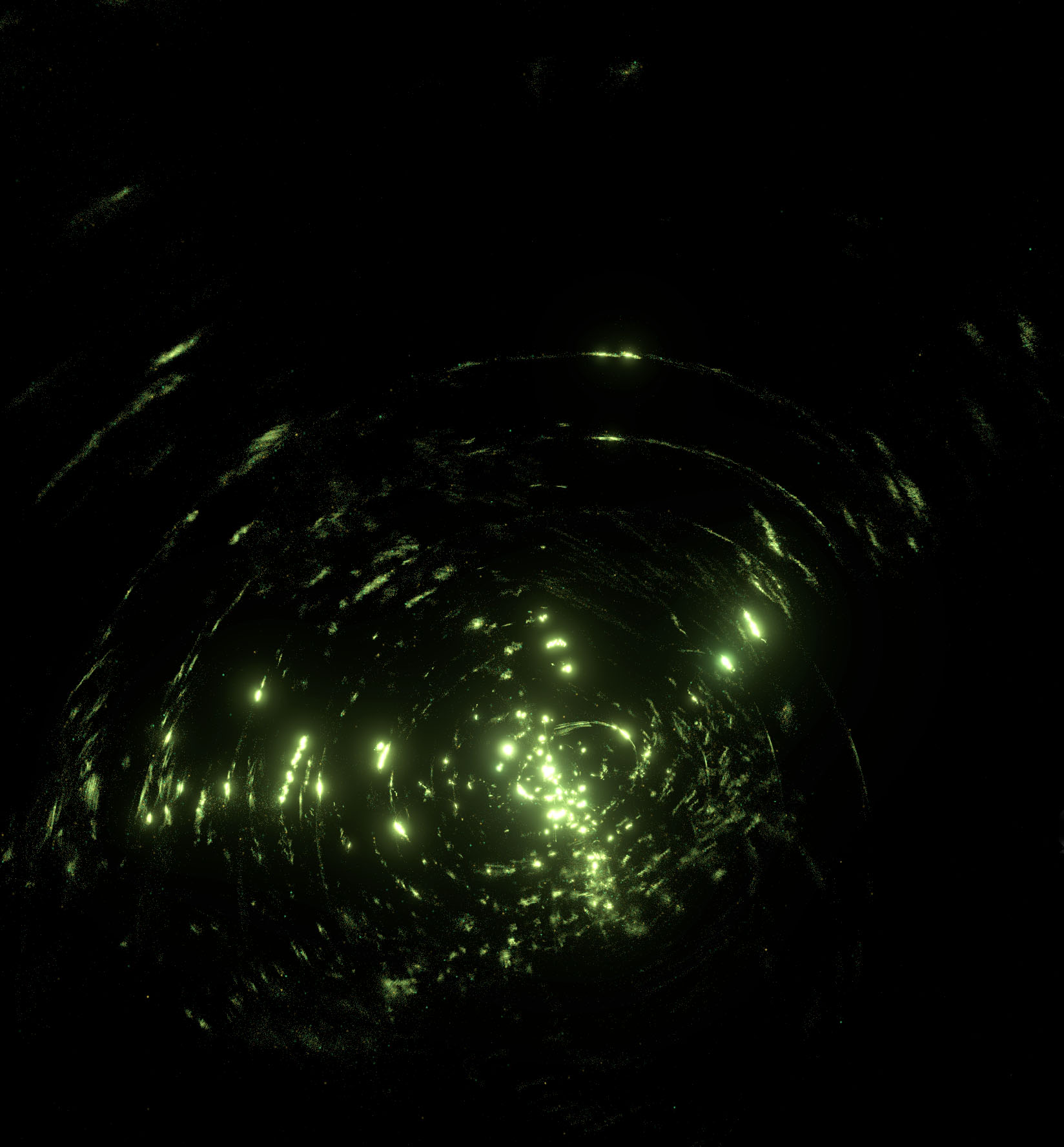
Makie.jl Highlights: Raytracing, Compute Graphs and Complex Recipes by Julius Krumbiegel, Simon Danisch PreTalx: https://pretalx.com/juliacon-2026/talk/3NCWH3/ We want to show off the most exciting developments in Makie over the past year: a new GPU-enabled ray tracing system for beautiful renderings written entirely in Julia, the compute pipeline refactor that replaced Observables in many internals and fixed the age-old multiple updates conundrum, and the upcoming complex recipe system that could change how most users write plotting functions in Makie. Makie is Julia's most comprehensive native plotting ecosystem, with nearly all functionality implemented in Julia itself. In this talk we want to present the highlights of last year's development and take a take a look at what the future might hold for the project. With RayMakie and Hikari, Makie has gained a new photorealistic GPU-accelerated ray tracing backend. Compared to the existing RPRMakie backend which was based on the Radeon ProRender framework and never quite lived up to its potential, RayMakie and its dependencies Hikari and Raycore are written in Julia. This gives a much greater degree of flexibility, the opportunity to implement custom tracing passes, and it allows to target platforms that were unreliable or unusable with ProRender. Built as a Julia port of pbrt-v4, Hikari supports physically-based materials, volumetric media, and environment lighting, all running on different types of GPUs via KernelAbstractions.jl. RayMakie opens up a new world of visualizations for Makie users, where light can be used in a more technical way, like visualizing simulated clouds to verify algorithms, or in more artistic ways, rendering 3D data in a way that sparks curiosity. We'll present some beautiful renderings and give interested users ideas how to get started. Second, we'll cover v0.24's switch from Observables to compute graphs from ComputePipeline.jl. This fundamental refactor enabled synchronized multi-attribute updates and eliminated redundant intermediate computations. Many users are not yet aware how they can utilize the new features or how they might benefit from a rewrite of old Observables based code. We'll go over some typical patterns and also clarify in what situations Observables are still the way to go. Third, we want to introduce complex recipes, an upcoming feature that fills in longstanding gaps in Makie's API and should make it easier for most users to write themeable and composable plotting functions. The existing `@recipe` macro was designed as a low-level building block and never intended to handle multi-axis scenarios with automatic legends, colorbars, or even UI elements, which is nevertheless what people have tried to implement with it. The age-old question "how do I simply add an axis title to my recipe" might finally get some answers. We'll finish off with a brief outlook on the future of the Makie project and where we're headed next.
Makie's new Raytracing backend | Danisch | JuliaCon Global 2026
Welcome to Makie! | Makie
Create impressive data visualizations with Makie, the plotting ecosystem for the Julia language. Build aesthetic plots with beautiful customizable themes, control every last detail of publication quality vector graphics, assemble complex layouts and quickly prototype interactive applications to explore your data live.
Comparison of plotting packages
I want to write a small 2d physical simulation to sharpen my Julia skills and learn how to use Julia to display more than “regular plots” I saw a post suggesting using either Makie, Plots or Javis I don’t want to start a fan war but would appreciate a comparison of the different use cases where each of the packages shines and where it can be challenging to use

Why I no longer recommend Julia
For many years I used the Julia programming language for transforming, cleaning, analyzing, and visualizing data, doing statistics, and performing simulations.
kahliburke/Tachikoma.jl
Build rich terminal apps in Julia — widgets, layouts, sixel graphics, Kitty graphics, animations, and more
GitHub - observablehq/plot: A concise API for exploratory data visualization implementing a layered grammar of graphics
A concise API for exploratory data visualization implementing a layered grammar of graphics - observablehq/plot
The Grammar of Graphics
Preface to First Edition Before writing the graphics for SYSTAT in the 1980’s, I began by teaching a seminar in statistical graphics and collecting as many different quantitative graphics as I could find. I was determined to produce a package that could draw every statistical graphic I had ever seen. The structure of the program was a collection of procedures named after the basic graph types they p- duced. The graphics code was roughly one and a half megabytes in size. In the early 1990’s, I redesigned the SYSTAT graphics package using - ject-based technology. I intended to produce a more comprehensive and - namic package. I accomplished this by embedding graphical elements in a tree structure. Rendering graphics was done by walking the tree and editing worked by adding and deleting nodes. The code size fell to under a megabyte. In the late 1990’s, I collaborated with Dan Rope at the Bureau of Labor Statistics and Dan Carr at George Mason University to produce a graphics p- duction library called GPL, this time in Java. Our goal was to develop graphics components. This book was nourished by that project. So far, the GPL code size is under half a megabyte.

Julia vs Numba and Cython: Looking Beyond Microbenchmarks
We compare the performance of Julia and Numba, for a minimal benchmark that enables to see some fundamental difference between Julia and accelerated-Python.
Vulkan Ray Tracing Tutorial KHR
A comprehensive tutorial for learning Vulkan ray tracing with practical examples.
RightNow AI - YC-Backed GPU Research Lab
YC-backed GPU research lab building the RightNow CUDA editor, RunInfra inference infra, Forge kernels, and publishing AutoMegaKernel and related papers on arXiv.
Rendering Particles with Compute Shaders
Overview I developed a technique to render single-pixel particles (using additive blending) with compute shaders rather than the usual fixed-function rasterization with vertex and fragment shaders. My approach runs 31–350% faster than rasterization on the cases I tested and is particularly faster for some “pathological” cases (which for my application are not actually that uncommon). I observed these speedups on both NVIDIA and AMD GPUs. Using this technique allowed me to ship an app that runs on minimum-spec hardware without sacrificing visual fidelity.