

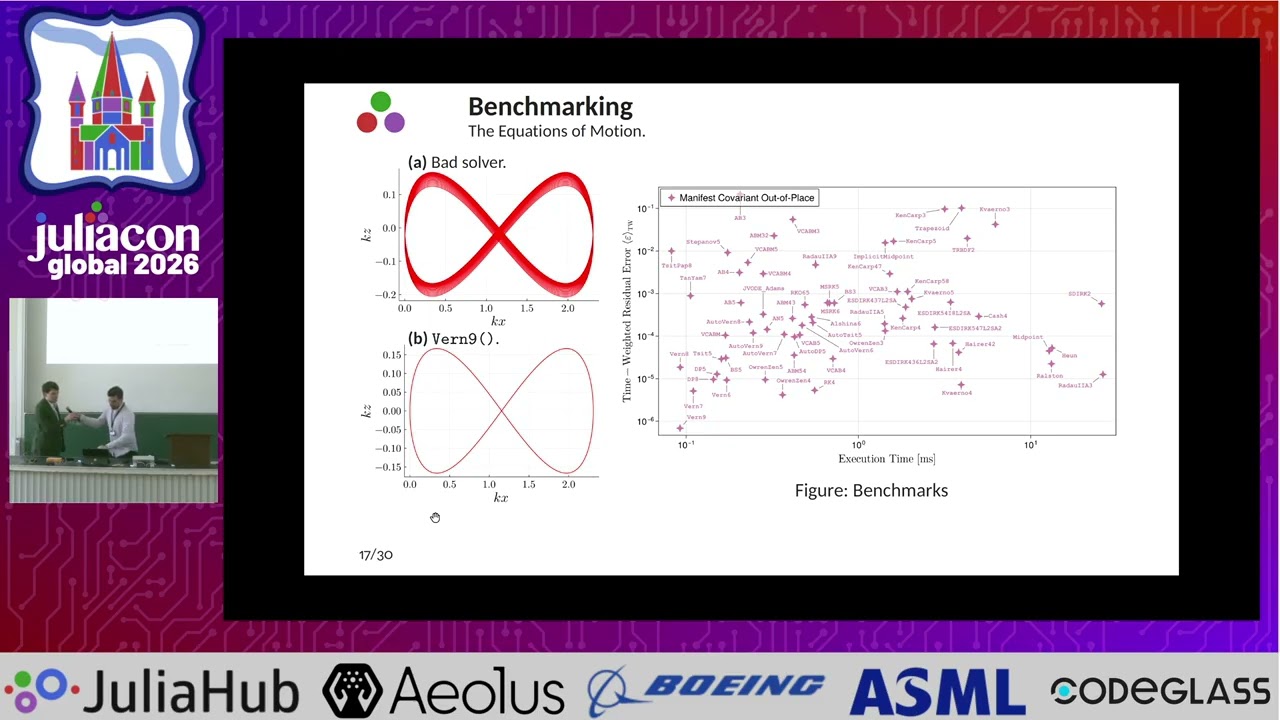
A purely numeric approach to the nonlinear coherent Thomson scattering by structured light. by Petru-Vlad TOMA, Sebastian Micluța-Câmpeanu PreTalx: https://pretalx.com/juliacon-2026/talk/N7CSPV/ flyer-N7CSPV: https://pretalx.com/media/juliacon-2026/submissions/N7CSPV/resources/N7CSPV_CgKzQLO.png Slides: https://github.com/toma-vlad/juliacon2026-EDM-slides/blob/main/edm-slides.pdf Structured light in interaction with matter has been of interest, particularly as it relates to the production of high intensity gamma beams. In our package, [ElectronDynamicsModels.jl]([url](https://github.com/SebastianM-C/ElectronDynamicsModels.jl)), we developed a way to efficiently compute the radiated field resulting from the scattering of a Laguerre-Gauss laser beam off a thin sheet of electrons. The electrons are represented as relativistic classical particles whose motion is integrated using _DifferentialEquations.jl_. _ModellingToolkit.jl_ was used to formulate the model, allowing us to take advantage of its compiler to generate efficient _Julia_ code. Moreover, this also enables an easy scaling to parallel ensemble simulations on the CPU and GPU. Besides performance, this approach is also useful for enabling higher precision computations, which naturally leverage _Julia_'s multiple dispatch. Once the trajectories are known, the far electromagnetic field can be computed over a grid of pixels from the Lienardt-Wiechert potentials, and finally we compute their Fourier transform. In our thin sheet model each electron interacts only with the incident radiation and its motion is described by the manifest covariant equations of motion (used here for accuracy and speed reasons) which is a system of 8 ODEs expressed in term of proper time. Thus, by taking advantage of _ModellingToolkit.jl_'s codegen we can readily construct a _DifferentialEquations.jl_ `EnsembleProblem` in order to perform the embarrassing parallelism of solving for the particles' trajectories. Since our goal is to compute the Fourier transform of the total radiated field with respect to laboratory time, it's necessary that for each pixel on our screen we accumulate the synchronized (for the sake of coherence) contribution. This is achieved by solving an implicit ODE relating the screen advanced time to the proper time of each particle. Finally, using the sampled screen electromagnetic field we approximate the continuous Fourier transform using _FFTW.jl_ in order to get the spatial profile and phase of the resulting harmonics of the Thomson scattered radiation, as well as evaluate how coherence is lost for increasingly more intense incident radiation.
Release Neural Cloud Scattering · dBagrat/rendering-demos
Cheap cloud scattering approximation using tiny neural networks that I was working on a while back for our engine. iPhone 12, 1080p, 60+ fps
Evaluating and Sampling Glinty NDFs in Constant Time
Geometric features between the micro and macro scales produce an expressive family of visual effects grouped under the term 'glints'. Efficiently rendering these effects amounts to finding the highlights caused by the geometry under each pixel. To allow for fast rendering, we represent our faceted geometry as a 4D point process on an implicit multiscale grid, designed to efficiently find the facets most likely to cause a highlight. The facets' normals are generated to match a given micro-facet normal distribution such as Trowbridge-Reitz (GGX) or Beckmann, to which our model converges under increasing surface area. Our method is simple to implement, memory-and-precomputation-free, allows for importance sampling and covers a wide range of different appearances such as anisotropic as well as individually colored particles. We provide a base implementation as a standalone fragment shader.
Understanding The Math Behind ReSTIR GI
Recently, I had the pleasure of contributing to Nvidia’s Zorah project, the flagship demo for the RTX 50 Series GPUs. My primary role was to provide technical support for light transport in Zorah, which included collaborating with my colleague Daqi Lin to implement a brand new ReSTIR-based global illumination solution, specifically, ReSTIR PT[1], within the NvRTX branch of Unreal Engine. A GDC presentation video on Zorah was released a few weeks ago.
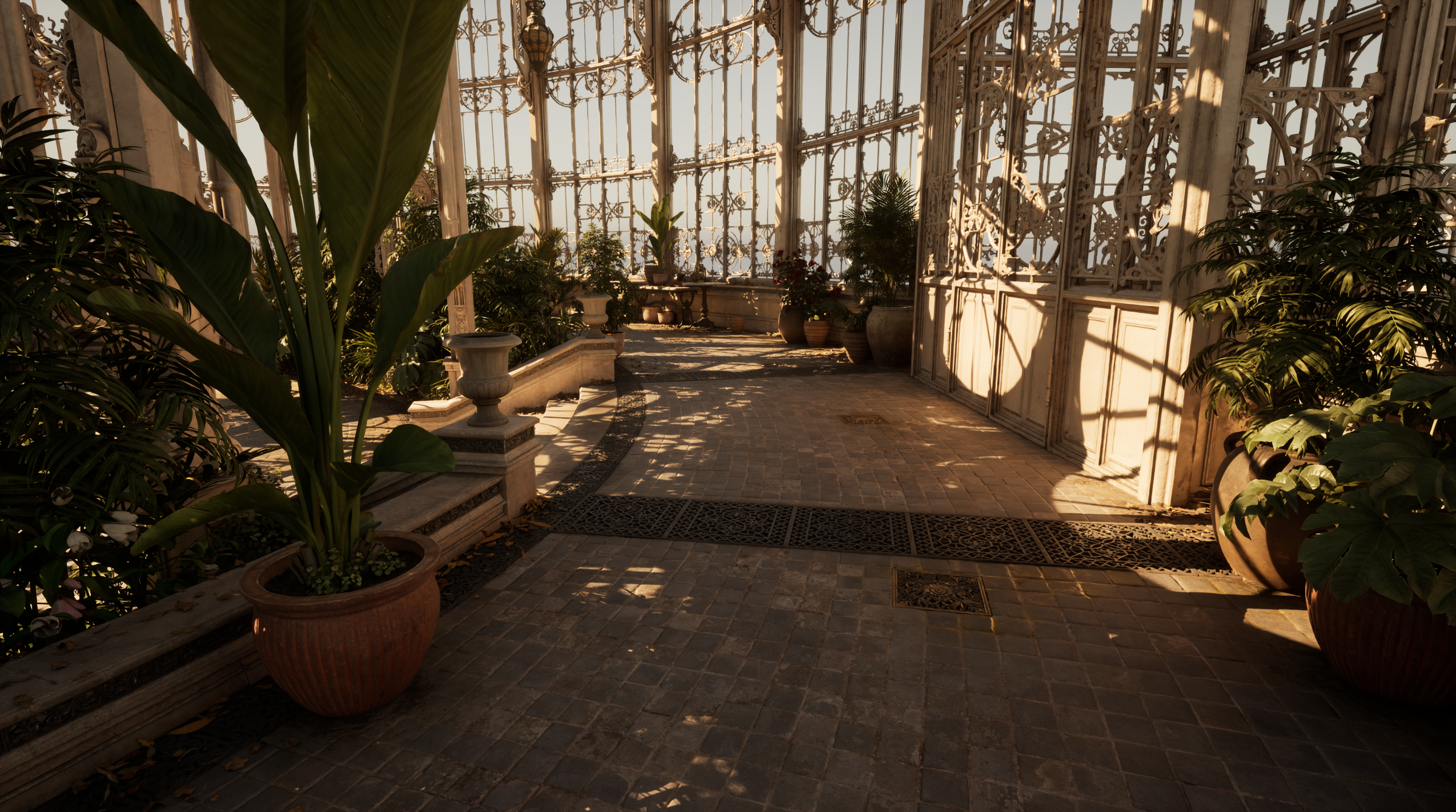
Khronos Showcases Significant glTF Momentum for Efficient Transmission of 3D Scenes and Models
The Khronos™ Group, an open consortium of leading hardware and…

Rendering Particles with Compute Shaders
Overview I developed a technique to render single-pixel particles (using additive blending) with compute shaders rather than the usual fixed-function rasterization with vertex and fragment shaders. My approach runs 31–350% faster than rasterization on the cases I tested and is particularly faster for some “pathological” cases (which for my application are not actually that uncommon). I observed these speedups on both NVIDIA and AMD GPUs. Using this technique allowed me to ship an app that runs on minimum-spec hardware without sacrificing visual fidelity.
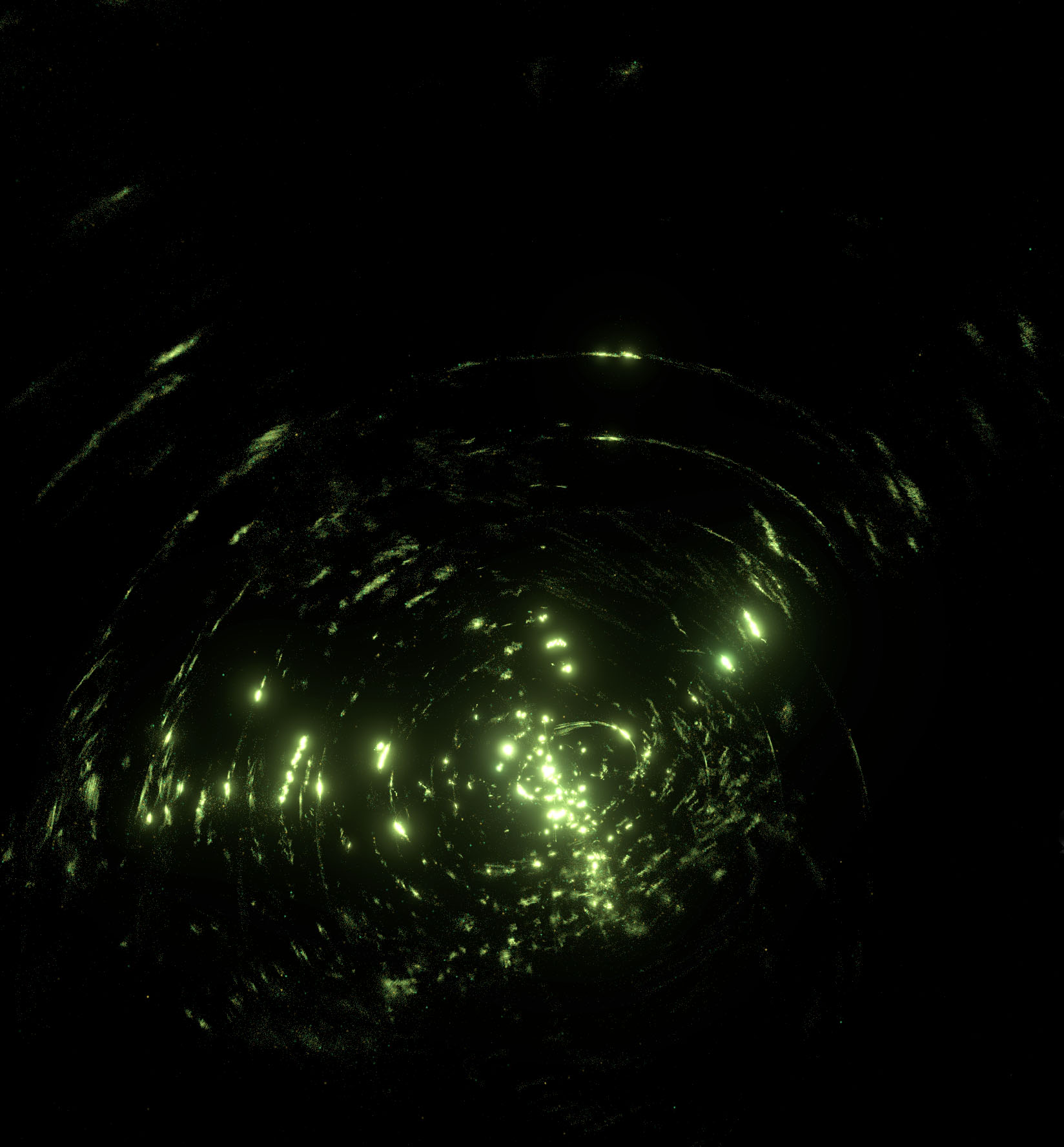
Notes on Gamma
The nuance between seeing and perceiving, linearity and non-linearity, what EOTFs are – and how to draw nice smooth gradients against the odds

Single photon isolation and nonreciprocal frequency conversion in atom-waveguide systems
In this work, we utilize a two-level atom and a $Λ$-type atom to link two identical waveguides, subsequently extending the model to a giant-atom configuration. Our analytical solutions and numerical simulations demonstrate that this setup can achieve single-photon isolation and nonreciprocal frequency conversion by tuning the atom-waveguide coupling strengths $g_i$, respectively. We also examine single-photon scattering in the giant-atom model within both the Markovian and non-Markovian regimes. The results reveal that ultranarrow scattering windows are induced by the phases $φ_1$ and $φ_2$ under specific conditions, making them well-suited for precise frequency conversion and sensing. Additionally, in the non-Markovian regime, the spectra exhibit irregular polygonal shapes, offering enhanced opportunities for exploring nonreciprocal frequency conversion in the off-resonant regime. Our work provides a new perspective on achieving optical nonreciprocity at the single-photon level in atom-waveguide systems.

warpfork/try-electron
Contribute to warpfork/try-electron development by creating an account on GitHub.
Planck 2018 results - VI. Cosmological parameters
We present cosmological parameter results from the final full-mission Planck measurements of the cosmic microwave background (CMB) anisotropies, combining information from the temperature and polarization maps and the lensing reconstruction. Compared to the 2015 results, improved measurements of large-scale polarization allow the reionization optical depth to be measured with higher precision, leading to significant gains in the precision of other correlated parameters. Improved modelling of the small-scale polarization leads to more robust constraints on many parameters, with residual modelling uncertainties estimated to affect them only at the 0.5σ level. We find good consistency with the standard spatially-flat 6-parameter ΛCDM cosmology having a power-law spectrum of adiabatic scalar perturbations (denoted “base ΛCDM” in this paper), from polarization, temperature, and lensing, separately and in combination. A combined analysis gives dark matter density Ωch2 = 0.120 ± 0.001, baryon density Ωbh2 = 0.0224 ± 0.0001, scalar spectral index ns = 0.965 ± 0.004, and optical depth τ = 0.054 ± 0.007 (in this abstract we quote 68% confidence regions on measured parameters and 95% on upper limits). The angular acoustic scale is measured to 0.03% precision, with 100θ* = 1.0411 ± 0.0003. These results are only weakly dependent on the cosmological model and remain stable, with somewhat increased errors, in many commonly considered extensions. Assuming the base-ΛCDM cosmology, the inferred (model-dependent) late-Universe parameters are: Hubble constant H0 = (67.4 ± 0.5) km s−1 Mpc−1; matter density parameter Ωm = 0.315 ± 0.007; and matter fluctuation amplitude σ8 = 0.811 ± 0.006. We find no compelling evidence for extensions to the base-ΛCDM model. Combining with baryon acoustic oscillation (BAO) measurements (and considering single-parameter extensions) we constrain the effective extra relativistic degrees of freedom to be Neff = 2.99 ± 0.17, in agreement with the Standard Model prediction Neff = 3.046, and find that the neutrino mass is tightly constrained to ∑mν < 0.12 eV. The CMB spectra continue to prefer higher lensing amplitudes than predicted in base ΛCDM at over 2σ, which pulls some parameters that affect the lensing amplitude away from the ΛCDM model; however, this is not supported by the lensing reconstruction or (in models that also change the background geometry) BAO data. The joint constraint with BAO measurements on spatial curvature is consistent with a flat universe, ΩK = 0.001 ± 0.002. Also combining with Type Ia supernovae (SNe), the dark-energy equation of state parameter is measured to be w0 = −1.03 ± 0.03, consistent with a cosmological constant. We find no evidence for deviations from a purely power-law primordial spectrum, and combining with data from BAO, BICEP2, and Keck Array data, we place a limit on the tensor-to-scalar ratio r0.002 < 0.06. Standard big-bang nucleosynthesis predictions for the helium and deuterium abundances for the base-ΛCDM cosmology are in excellent agreement with observations. The Planck base-ΛCDM results are in good agreement with BAO, SNe, and some galaxy lensing observations, but in slight tension with the Dark Energy Survey’s combined-probe results including galaxy clustering (which prefers lower fluctuation amplitudes or matter density parameters), and in significant, 3.6σ, tension with local measurements of the Hubble constant (which prefer a higher value). Simple model extensions that can partially resolve these tensions are not favoured by the Planck data.
Researchers get trapped photons to act like massive particles
Put enough photons in a confined space, and they'll apparently start acting as …

Julia vs Numba and Cython: Looking Beyond Microbenchmarks
We compare the performance of Julia and Numba, for a minimal benchmark that enables to see some fundamental difference between Julia and accelerated-Python.
The Illustris simulation: the evolving population of black holes across cosmic time
We study the properties of black holes and their host galaxies across cosmic time in the Illustris simulation. Illustris is a large scale cosmological hydrodynamical simulation which resolves a (106.5 Mpc)^3 volume with more than 12 billion resolution elements and includes state-of-the-art physical models relevant for galaxy formation. We find that the black hole mass density for redshifts z = 0 - 5 and the black hole mass function at z = 0 predicted by Illustris are in very good agreement with the most recent observational constraints. We show that the bolometric and hard X-ray luminosity functions of AGN at z = 0 and 1 reproduce observational data very well over the full dynamic range probed. Unless the bolometric corrections are largely underestimated, this requires radiative efficiencies to be on average low, epsilon_r <= 0.1, noting however that in our model radiative efficiencies are degenerate with black hole feedback efficiencies. Cosmic downsizing of the AGN population is in broad agreement with the findings from X-ray surveys, but we predict a larger number density of faint AGN at high redshifts than currently inferred. We also study black hole -- host galaxy scaling relations as a function of galaxy morphology, colour and specific star formation rate. We find that black holes and galaxies co-evolve at the massive end, but for low mass, blue and star-forming galaxies there is no tight relation with either their central black hole masses or the nuclear AGN activity.