

Levels Chief Medical Officer, Dr. Casey Means, chatted with our advisor, Dr. David Perlmutter on the discovery of how the elevation of uric acid in the body is a causative mechanism in the development of metabolic diseases, and one of the key links between obesity, diabetes, heart disease, neurologic diseases like dementia, ADHD, fatty liver disease, and more. Sign Up to Get Your Ultimate Guide to Glucose: https://levels.link/youtube?utm_campaign=uric-acid They also covered: - The several mechanisms of how uric acid causes cellular dysfunction and insulin resistance, including oxidative stress, inflammation, and even preventing insulin from getting out of the blood stream effectively. - The evolutionary reasons why the metabolic dysfunction and weight gain caused by uric acid would have benefitted us historically in terms of low access to food and water, by letting us more easily pack on weight and raise blood pressure. And how we now live in an evolutionary-environmental mismatch where this survival mechanism is now hurting us in the face of caloric abundance. - The different dietary and environmental factors that generate uric acid, including fructose, purine rich foods and umami foods, dehydration, alcohol, and more. - The optimal levels for uric acid. - How uric acid impairs our hunger signals, drives us to eat, and even promotes risk taking behavior. We talked about how to reverse high uric acid levels as a way to unlock optimal health. 00:00 - Intro 03:12 - More than just gout 05:06 - A causative role 07:44 - The number one cause of death 15:24 - Evolutionary environmental mismatch 16:58 - High fructose corn syrup 22:27 - The dangers of uric acid 23:38 - Uric acid and dementia 30:33 - Too much fructose 41:32 - Erectile dysfunction and cardiovascular risk 01:03:17 - No need to eat sugar Transcript & Show notes: https://www.levels.com/podcasts/116-uric-acid-a-key-cause-of-weight-gain-diabetes-heart-disease-and-dementia-and-simple-steps-to-lower-it-dr-david-perlmutter-dr-casey-means
In Utero Metabolic Disruption—A Preventable Antecedent of Adult Disease?
The early manifestation of metabolic syndrome (MetS) in children, characterized by the premature onset of visceral obesity, elevated blood pressure, and the progression to dyslipidemia and type 2 diabetes, is associated with adult cardiovascular disease. Tackling the rising epidemic of obesity and...

Calorie restriction in humans builds strong muscle and stimulates healthy aging genes
NIH study suggests a small reduction in daily calories is beneficial for wellness.

Sugar disrupts microbiome, eliminates protection against obesity and diabetes
A study of mice found that dietary sugar alters the gut microbiome, setting off a chain of events that leads to metabolic disease, pre-diabetes, and weight gain. The findings suggest that diet matters, but an optimal microbiome is equally important for the prevention of metabolic syndrome, diabetes, and obesity.

The ‘Omics’ of Exercise (Published 2020)
When we exercise, even for a few minutes, hundreds of molecules related to our metabolic health rise and fall in our bloodstreams.

Research Shows Supplement Boosts Muscle and Mitochondria Health
Urolithin A may enhance muscle endurance and mitochondrial health by promoting mitophagy, according to a new study.
Soy consumption and serum uric acid levels: A systematic review and meta-analysis
BackgroundSoy consumption has health benefits, but the relationship between soy and uric acid remains uncertain. This meta-analysis and systematic review evaluated effects of soy intake on plasma uric acid.MethodsPubMed, Embase, CNKI, and the Cochrane Library were searched for studies evaluating the effects of soy, soy products, soy protein, and soy isoflavones on uric acid levels. The primary outcome was serum or plasma uric acid concentration. Study quality was evaluated by the Cochrane Collaboration and SYRCLE risk-of-bias tools.ResultsSeventeen studies were included. Qualitative analysis of three human clinical studies of acute effects revealed that soy consumption increased serum uric acid concentration; however, soy-derived products, including tofu, bean curd cake, and dried bean curd sticks, had no significant effect on serum uric acid. Meta-analysis of five long-term human studies (10 data sets) revealed that soy protein and soy isoflavones had no significant effects on uric acid levels (weighted mean difference [WMD] = −2.11; 95% confidence interval [CI]: −8.78, 4.55; p = 0.53). However, most epidemiological data revealed that soy intake is inversely associated with uric acid levels. Meta-analysis of nine animal trials (29 data sets) revealed that soy protein and soy isoflavones significantly reduced serum uric acid concentrations (vs. controls; MD = −38.02; 95% CI: −50.60, −25.44; p < 0.001). ConclusionSoy and its products have different effects on serum uric acid. Soy products like tofu, bean curd cake, and dried bean curd sticks could be high-quality protein sources for individuals with hyperuricemia or gout. It can be beneficial to nutritionists and health-care decision makers reconsider their conceptions about the relationship between soy and uric acid levels according to latest and further scientific study results.

It’s the Sugar, Folks
A new study shows solid links between added sugar and the onset of diabetes.

Scientists discover 'obesity master switch' for burning or storing fat
Scientists have discovered a genetic pathway, which - when manipulated - shows pro- and anti-obesity effects by switching between storage and burning in fat cells.
Brains of overweight people ‘ten years older’ than lean counterparts at middle-age
Our brains naturally shrink with age, but scientists are increasingly recognising that obesity – already linked to conditions such as diabetes, cancer and heart disease – may also affect the onset and progression of brain ageing; however, direct studies to support this link are lacking.

Integration of metabolomics, genomics, and immune phenotypes reveals the causal roles of metabolites in disease
Background Recent studies highlight the role of metabolites in immune diseases, but it remains unknown how much of this effect is driven by genetic and non-genetic host factors. Result We systematically investigate circulating metabolites in a cohort of 500 healthy subjects (500FG) in whom immune function and activity are deeply measured and whose genetics are profiled. Our data reveal that several major metabolic pathways, including the alanine/glutamate pathway and the arachidonic acid pathway, have a strong impact on cytokine production in response to ex vivo stimulation. We also examine the genetic regulation of metabolites associated with immune phenotypes through genome-wide association analysis and identify 29 significant loci, including eight novel independent loci. Of these, one locus (rs174584-FADS2) associated with arachidonic acid metabolism is causally associated with Crohn’s disease, suggesting it is a potential therapeutic target. Conclusion This study provides a comprehensive map of the integration between the blood metabolome and immune phenotypes, reveals novel genetic factors that regulate blood metabolite concentrations, and proposes an integrative approach for identifying new disease treatment targets. Supplementary Information The online version contains supplementary material available at 10.1186/s13059-021-02413-z.

Inverse association between coffee drinking and serum uric acid concentrations in middle-aged Japanese males
Consumption of caffeine-rich beverages, which have diuretic properties, may decrease serum uric acid concentrations. We examined cross-sectionally the relationship of coffee and green tea consumption to serum uric acid concentrations in 2240 male self-defence officials who received a pre-retirement health examination at four hospitals of the Self-Defence Forces between 1993 and 1994. The mean levels of coffee and green tea consumption were 2·3 and 3·1 cups/d respectively. There was a clear inverse relationship between coffee consumption and serum uric acid concentration. When adjusted for hospital only, those consuming less than one cup of coffee daily had a mean serum uric acid concentration of 60 mg/l, while that of those drinking five or more cups of coffee daily was 56 mg/l (P < 0·0001). No such relationship was observed for green tea, another major dietary source of caffeine in Japan. The relationship between coffee consumption and serum uric acid concentration was independent of age, rank in the Self-Defence Forces, BMI, systolic blood pressure, serum creatinine, serum total cholesterol and serum HDL-cholesterol concentrations, smoking status, alcohol use, beer consumption and intake of dairy products. These findings suggest that coffee drinking may be associated with lower concentrations of serum uric acid, and further studies are needed to confirm the association.
U.S. Montmorency Tart Cherry Juice Decreases Bone Resorption in Women Aged 65–80 Years
Pre-clinical studies have demonstrated that tart cherries, rich in hydroxycinnamic acids and anthocyanins, protect against age-related and inflammation-induced bone loss. This study examined how daily consumption of Montmorency tart cherry juice (TC) alters biomarkers of bone metabolism in older women. Healthy women, aged 65–80 years (n = 27), were randomly assigned to consume ~240 mL (8 fl. oz.) of juice once (TC1X) or twice (TC2X) per day for 90 d. Dual-energy x-ray absorptiometry (DXA) scans were performed to determine bone density at baseline, and pre- and post-treatment serum biomarkers of bone formation and resorption, vitamin D, inflammation, and oxidative stress were assessed. Irrespective of osteoporosis risk, the bone resorption marker, tartrate resistant acid phosphatase type 5b, was significantly reduced with the TC2X dose compared to baseline, but not with the TC1X dose. In terms of indicators of bone formation and turnover, neither serum bone-specific alkaline phosphatase nor osteocalcin were altered. No changes in thiobarbituric acid reactive substances or high sensitivity C-reactive protein were observed in response to either TC1X or TC2X. We conclude that short-term supplementation with the higher dose of tart cherry juice decreased bone resorption from baseline without altering bone formation and turnover biomarkers in this cohort.
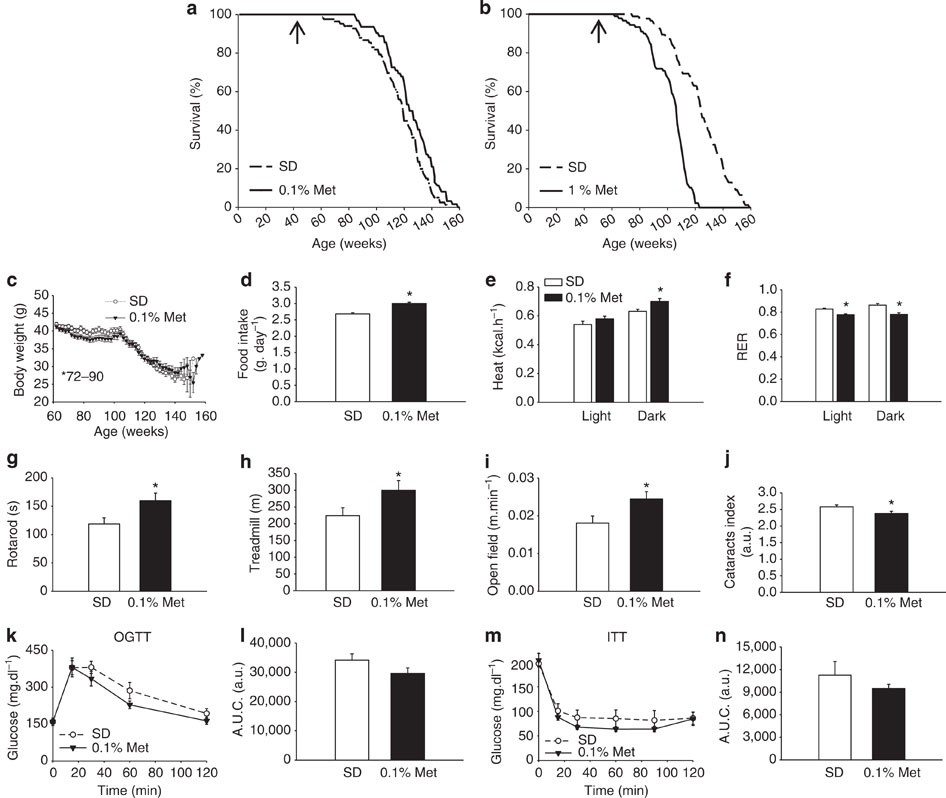
Metformin improves healthspan and lifespan in mice
Metformin is a drug commonly prescribed to treat patients with type 2 diabetes. Here we show that long-term treatment with metformin (0.1% w/w in diet) starting at middle age extends healthspan and lifespan in male mice, while a higher dose (1% w/w) was toxic. Treatment with metformin mimics some of the benefits of calorie restriction, such as improved physical performance, increased insulin sensitivity, and reduced low-density lipoprotein and cholesterol levels without a decrease in caloric intake. At a molecular level, metformin increases AMP-activated protein kinase activity and increases antioxidant protection, resulting in reductions in both oxidative damage accumulation and chronic inflammation. Our results indicate that these actions may contribute to the beneficial effects of metformin on healthspan and lifespan. These findings are in agreement with current epidemiological data and raise the possibility of metformin-based interventions to promote healthy aging.
Nut intake and hyperuricemia risk in young adults
Objective:The relationship between dietary nut intake and hyperuricemia risk remains unclear. The aim of this study was to investigate the relationship between different nut intake and hyperuricemia risk with a cross-sectional study.Design:A semi-quantitative FFQ was adopted to collect dietary information. Biochemical and anthropometric parameters were measured by standard methods. Multivariate-adjusted logistic regression models were implemented to analyse the relationship between individual nut intake and hyperuricemia risk.Setting:Qingdao University in Shandong Province, China.Participants:During 2018–2019, a total of 14 056 undergraduates (6862 males and 7194 females) aged 15–25 years participated in the study.Results:After adjusting for multiple confounding factors, compared with the lowest quartile, the highest quartile intakes of pine nut (95 % CI (0·51, 0·98)) was significantly associated with 29 % reduction in hyperuricemia risk, the highest quartile intake of walnut (OR = 0·78; 95 % CI (0·58, 1·05)) was marginally negatively associated with hyperuricemia risk.Conclusions:The present study showed that the relationships between intakes of different nuts and hyperuricemia risk were different. Increased dietary intakes of walnut and pine nut are negatively associated with the hyperuricemia.
Personalized microbiome-driven effects of non-nutritive sweeteners on human glucose tolerance
A study of the effects of non-nutritive sweeteners on human metabolism as well as their microbiomes reveals how these can induce individual-specific, microbiome-dependent changes to glycemic responses, warranting follow-up clinical studies to understand long-term impact.
