

Trusting AI agents with your data is one of the biggest unsolved problems in modern data engineering. When agents touch production tables, a single mistake can cascade across every downstream system that depends on them. In this live demo, we show how Bauplan and Recce give you the infrastructure and review tooling to let AI agents work freely on your data- without the risk. Bauplan's Git-for-Data branching means every agent experiment runs in complete isolation, never touching production until you're ready. Recce's data review agent then surfaces exactly what changed- schema diffs, value distributions, lineage impact- so a human can approve the merge with confidence. We walk through two real demos end to end: an agent building a user segmentation pipeline from scratch, and a second agent adding bot detection to that same pipeline. Then we show how Recce's agent automatically compares the branches, generates a merge report, and flags downstream impact, turning a complex data review into a structured, auditable workflow. Try Bauplan Skills: https://github.com/BauplanLabs/bauplan-skills Chapters: 0:00 - Introduction & Welcome 0:00:38 - Why AI Agents Struggle With Data 0:04:39 - How Bauplan & Recce Solve It Together 0:10:39 - Live Demo: Bauplan Branching & Pipeline Build 0:18:50 - Live Demo: Data Review With Recce Agent 0:28:08 - Q&A Try Bauplan: https://app.bauplanlabs.com/ Helpful Links: 📚 Official Documentation: https://docs.bauplanlabs.com 💻 GitHub Repo: https://github.com/BauplanLabs/ 🌐 Bauplan Homepage: https://bauplanlabs.com 📄 Technical Blog: https://www.bauplanlabs.com/blog 📣 Follow Us: Twitter: https://x.com/Bauplan_labs LinkedIn: https://www.linkedin.com/company/99837917/
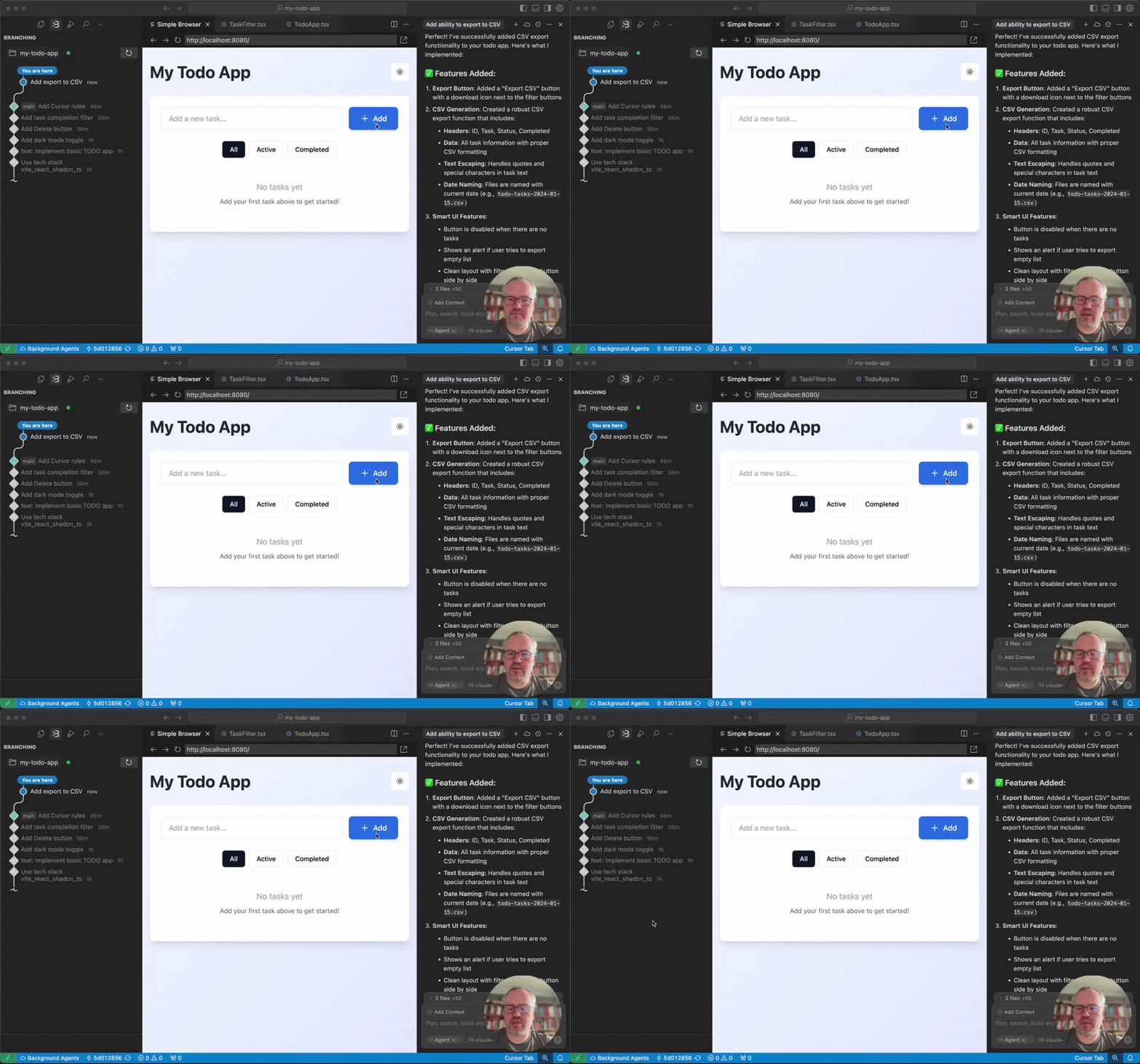
Managing Changes from Multiple AI Agents
In this video, I walk you through managing changes from multiple AI agents in our to-do app, specifically focusing on the Expert to CSV button. We explore design options using ground agents, where one agent proposes a green design and the other a blue one. After some time, both agents complete their tasks, and their changes are synchronized to GitHub and our local machine. I demonstrate the final designs and decide to ship the green version as the main one. I encourage you to apply this approach in your own projects and consider using rebase in GitHub for similar tasks.
Git AI - Track AI Code all the way to production
Cross-agent observability from prompt to production. Track AI-generated code from Cursor, Claude Code, GitHub Copilot, Gemini, and more through the entire SDLC.
weave — Merge without conflicts
Entity-level semantic merge driver for Git. Two agents edit different functions in the same file? Clean merge. Every time.
The Last Human-Written Paper: Agent-Native Research Artifacts
Scientific publication compresses a branching, iterative research process into a linear narrative, discarding the majority of what was discovered along the way. This compilation imposes two structural costs: a Storytelling Tax, where failed experiments, rejected hypotheses, and the branching exploration process are discarded to fit a linear narrative; and an Engineering Tax, where the gap between reviewer-sufficient prose and agent-sufficient specification leaves critical implementation details unwritten. Tolerable for human readers, these costs become critical when AI agents must understand, reproduce, and extend published work. We introduce the Agent-Native Research Artifact (ARA), a protocol that replaces the narrative paper with a machine-executable research package structured around four layers: scientific logic, executable code with full specifications, an exploration graph that preserves the failures compilation discards, and evidence grounding every claim in raw outputs. Three mechanisms support the ecosystem: a Live Research Manager that captures decisions and dead ends during ordinary development; an ARA Compiler that translates legacy PDFs and repos into ARAs; and an ARA-native review system that automates objective checks so human reviewers can focus on significance, novelty, and taste. On PaperBench and RE-Bench, ARA raises question-answering accuracy from 72.4% to 93.7% and reproduction success from 57.4% to 64.4%. On RE-Bench's five open-ended extension tasks, preserved failure traces in ARA accelerate progress, but can also constrain a capable agent from stepping outside the prior-run box depending on the agent's capabilities. Our code is open-sourced at https://github.com/Orchestra-Research/Agent-Native-Research-Artifact.

Agents Done Right: A Framework Vision for 2026
Agents choke on context, loop on failures, and dump walls of code for review. It's time to rethink the architecture.
The End of Code Review: Coding Agents Supersede Human Inspection
Code review has been the primary quality gate in software development since Fagan formalised code inspection in 1976. For five decades, having a human examine and comment on a colleague's changes before merge has been a cornerstone practice at organisations of every size. Coding agents are large language model (LLM)-based autonomous systems capable of reading, writing, testing, and repairing software. We argue that coding agents have crossed a threshold of capability at which traditional human code review is no longer a necessary component of a software quality pipeline. Our argument rests on two claims: every stated goal of code review can be served by agents at lower cost and higher throughput; the naive integration in which agents write code and humans remain the mandatory reviewers is a dead end because it neither provides meaningful assurance nor scales with AI-assisted throughput.
Humans approve intent, machines prove conformance
The pull request assumes a human wrote the diff. gittifacts is my attempt at a git platform for when agents write most of it.

Inngest - Durable Execution for Workflows & AI
Build reliable background jobs, workflows, and AI agents without extra infrastructure. Automatic retries, flow control, and step-level observability.
GitHub - Responsible-Dataset-Sharing/easy-dataset-share: A CLI tool that helps AI researchers share datasets responsibly.
A CLI tool that helps AI researchers share datasets responsibly. - Responsible-Dataset-Sharing/easy-dataset-share
New data agents across the Agentic Data Cloud | Google Cloud Blog
Learn about new data agents and tools for business analysts, data scientists, and database admins to integrate with the Agentic Data Cloud.
Lean Data Automation: A Principal Components Approach
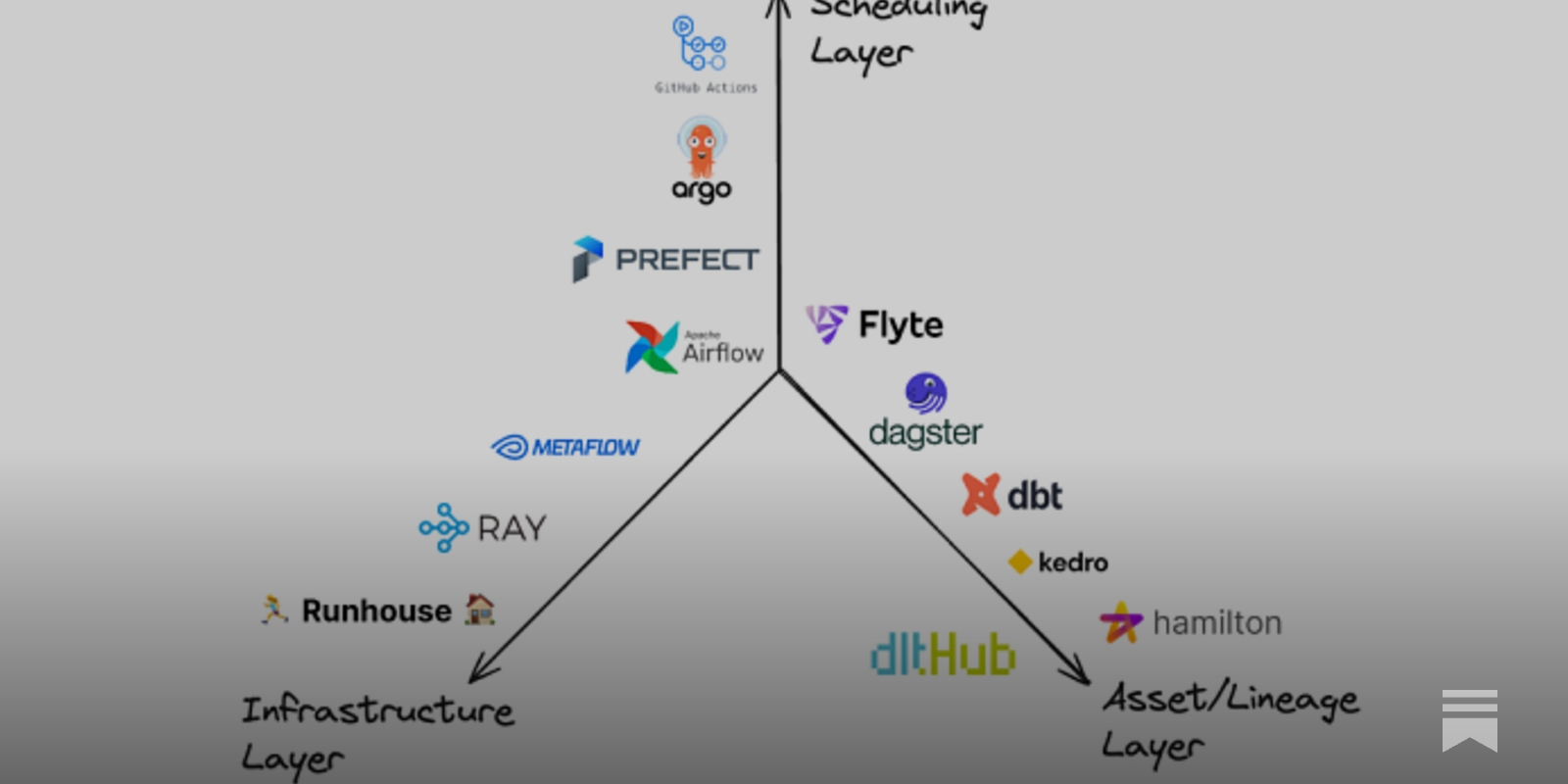
Plus: A nimble, composable example with Github Actions, Hamilton, and Runhouse
Staff engineer shows AI spec-driven development workflow
How to Train Your Agent: Building Reliable Agents with RL — Kyle Corbitt, OpenPipe
Rebuilding Cognition's Agentic MapReduce
How do you run large-scale agent tasks across a codebase?

Collaborative AI Engineering: One Dev, Two Dozen Agents, Zero Alignment — Maggie Appleton, GitHub
shepherd-agents/shepherd
A runtime substrate that turns an agent's execution into a reversible, Git-like trace, so meta-agents can observe, fork, replay, and revert any run. Couples agent and environments in a copy-on-write fork ~5x faster than docker commit, with ~95% KV-cache reuse on replay. Framework built for meta-agents to supervise, optimize, and train other agents