Presented at All Things Open AI 2025 Presented by Rachel-Lee Nabors - AgentQL Title: The Death of the Browser Abstract: In ten years, Internet Browsers may be a nostalgic memory. As enterprises face mounting API costs and integration headaches, a new paradigm is emerging. The internet's evolution from an open highway into a maze of walled gardens and monetized APIs has created significant challenges for businesses—but it has also set the stage for accessing and organizing the world’s information. This lightning talk traces our journey from the invention of the browser to the arms race of scraping for data and access to it to the dawn of AI agents, showing how the challenges of today opened the door to tomorrow. See how technologies refined by the web scraping community are combining with large language models to create practical alternatives to costly API integrations. From the rise of platform monopolies to the emergence of AI agents, this timeline-based exploration will help you understand where we've been, where we are, and where we're heading. Join us for a glimpse of how AI agents are enabling a return to the era of free information with ""the web as the API. Slides can be found here: https://www.slideshare.net/slideshow/the-death-of-the-browser-rachel-lee-nabors-agentql/277168377 ### 👩🚀 Save the date: All Things Open 2025 is happening October 12-14, 2025 -- Raleigh, NC | https://2025.allthingsopen.org/ ### About We Love Open Source We Love Open Source is an open source community educational hub that includes blogs, interviews, presentations, podcasts, how-to's, and more, from the All Things Open community members: * Start reading: https://allthingsopen.org/articles * How to contribute: https://allthingsopen.org/welcome-to-we-love-open-source About All Things Open All Things Open is a universe of open source events and platforms designed to educate and connect technologists around the world. It includes the All Things Open conference, the largest open source / tech / web event on the U.S. East Coast, meetups in the Research Triangle Park (RTP) of NC, South Carolina, and New York City, and a YouTube channel with more than 1,000 free recordings. On the web: https://www.allthingsopen.org/ Twitter: https://twitter.com/AllThingsOpen LinkedIn: https://www.linkedin.com/company/all-things-open/ Instagram: https://www.instagram.com/allthingsopen/ Facebook: https://www.facebook.com/AllThingsOpen Mastodon: https://mastodon.social/@allthingsopen Threads: https://www.threads.net/@allthingsopen Bluesky: https://bsky.app/profile/allthingsopen.bsky.social 2025 conference: https://2025.allthingsopen.org/
Reimagining Web Infrastructure for the Age of AI Agents
How core internet components will transform for an agent-driven web and the new opportunities for startup founders
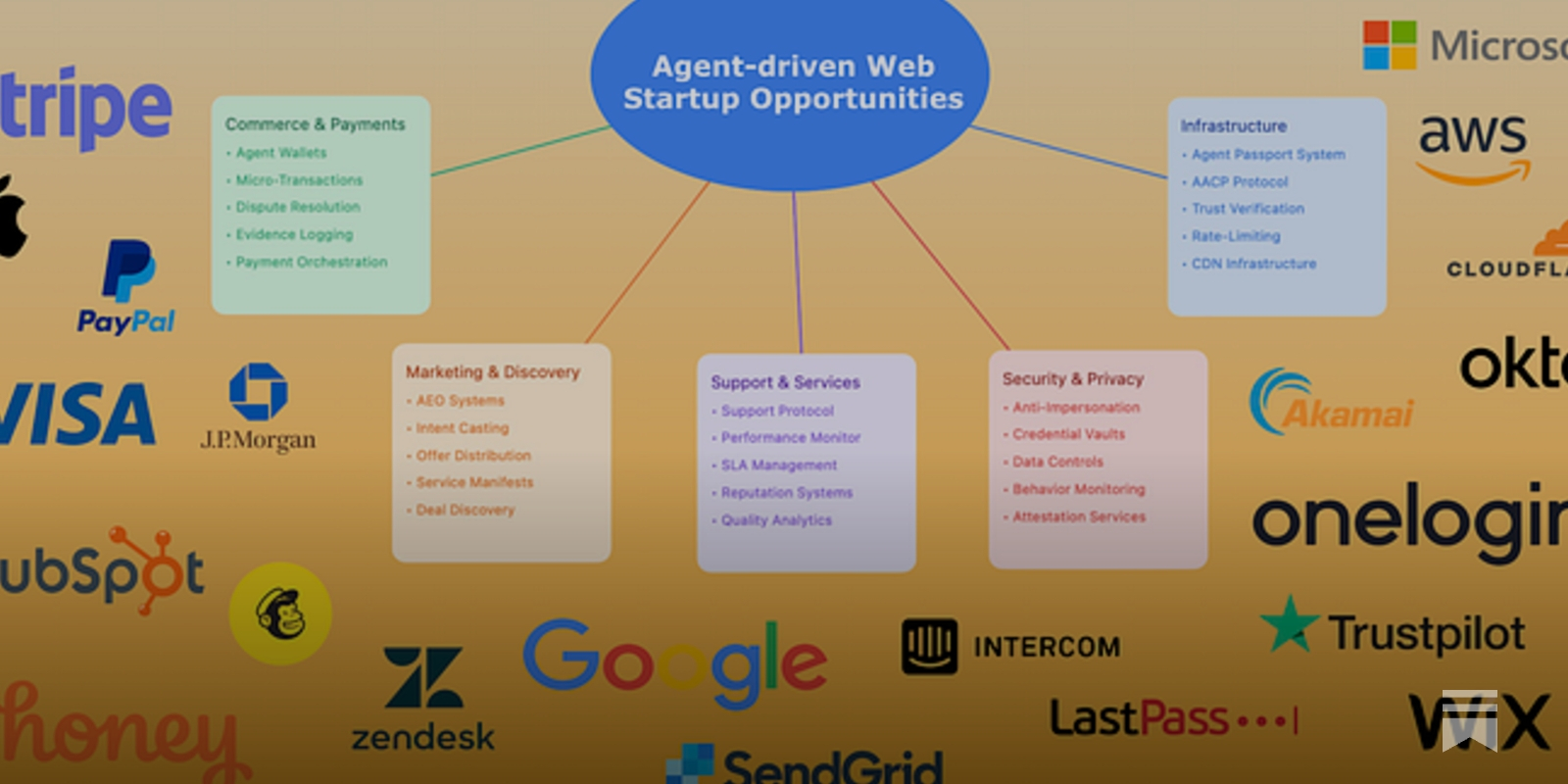
Reimagining Web Infrastructure for the Age of AI Agents
How core internet components will transform for an agent-driven web and the new opportunities for startup founders
The Adoption and Usage of AI Agents: Early Evidence from Perplexity
This paper presents the first large-scale field study of the adoption, usage intensity, and use cases of general-purpose AI agents operating in open-world web environments. Our analysis centers on Comet, an AI-powered browser developed by Perplexity, and its integrated agent, Comet Assistant. Drawing on hundreds of millions of anonymized user interactions, we address three fundamental questions: Who is using AI agents? How intensively are they using them? And what are they using them for? Our findings reveal substantial heterogeneity in adoption and usage across user segments. Earlier adopters, users in countries with higher GDP per capita and educational attainment, and individuals working in digital or knowledge-intensive sectors -- such as digital technology, academia, finance, marketing, and entrepreneurship -- are more likely to adopt or actively use the agent. To systematically characterize the substance of agent usage, we introduce a hierarchical agentic taxonomy that organizes use cases across three levels: topic, subtopic, and task. The two largest topics, Productivity & Workflow and Learning & Research, account for 57% of all agentic queries, while the two largest subtopics, Courses and Shopping for Goods, make up 22%. The top 10 out of 90 tasks represent 55% of queries. Personal use constitutes 55% of queries, while professional and educational contexts comprise 30% and 16%, respectively. In the short term, use cases exhibit strong stickiness, but over time users tend to shift toward more cognitively oriented topics. The diffusion of increasingly capable AI agents carries important implications for researchers, businesses, policymakers, and educators, inviting new lines of inquiry into this rapidly emerging class of AI capabilities.

browser-use/browser-use
🌐 Make websites accessible for AI agents. Automate tasks online with ease.
Content Independence Day, one year on- building the business model for the agentic Internet
One year after declaring Content Independence Day, a dynamic market for monetized content has officially emerged. In this report, we examine how the rise of autonomous AI agents is upending traditional search referrals and detail the new infrastructure required to support a sustainable web economy.

Is Misinformation More Open? A Study of robots.txt Gatekeeping on the Web
Web scraping, the automated process of extracting information from websites, has long played a foundational role in the Internet ecosystem (Gray, 1995). It supports services such as search engine indexing, price comparison tools, and competitive intelligence. More recently, it has become a core component in the development of large-scale generative AI models. These Large Language Models (LLMs) require enormous volumes of training data, often in the terabyte range (Kaplan et al., 2020; Lehane, 2025), and the public web remains a low-cost, attractive source. Major model developers, including those behind OpenAI’s Chat-GPT (OpenAI, 2025), Google’s Bard (now known as Gemini) & Vertex AI (Romain, Danielle, 2023), and Anthropic’s Claude (Romain, Danielle, 2025), openly acknowledge the use of web scraping to construct their training corpora (Abdin et al., 2024; Brown et al., 2020; Chowdhery et al., 2023; Grattafiori et al., 2024; Team et al., 2024; Touvron et al., 2023).
Big Help or Big Brother? Auditing Tracking, Profiling, and Personalization in Generative AI Assistants
Generative AI (GenAI) browser assistants integrate powerful capabilities of GenAI in web browsers to provide rich experiences such as question answering, content summarization, and agentic navigation. These assistants, available today as browser extensions, can not only track detailed browsing activity such as search and click data, but can also autonomously perform tasks such as filling forms, raising significant privacy concerns. It is crucial to understand the design and operation of GenAI browser extensions, including how they collect, store, process, and share user data. To this end, we study their ability to profile users and personalize their responses based on explicit or inferred demographic attributes and interests of users. We perform network traffic analysis and use a novel prompting framework to audit tracking, profiling, and personalization by the ten most popular GenAI browser assistant extensions. We find that instead of relying on local in-browser models, these assistants largely depend on server-side APIs, which can be auto-invoked without explicit user interaction. When invoked, they collect and share webpage content, often the full HTML DOM and sometimes even the user's form inputs, with their first-party servers. Some assistants also share identifiers and user prompts with third-party trackers such as Google Analytics. The collection and sharing continues even if a webpage contains sensitive information such as health or personal information such as name or SSN entered in a web form. We find that several GenAI browser assistants infer demographic attributes such as age, gender, income, and interests and use this profile--which carries across browsing contexts--to personalize responses. In summary, our work shows that GenAI browser assistants can and do collect personal and sensitive information for profiling and personalization with little to no safeguards.
The Web Browser Is All You Need - Paul Klein IV, Browserbase
AI Scraping Bots Are Breaking Open Libraries, Archives, and Museums
"This is a moment where that community feels collectively under threat and isn't sure what the process is for solving the problem.”

Google for Developers Blog - News about Web, Mobile, AI and Cloud
An open specification for finding and verifying tools, skills, and agents across the web.Agents are ...

Google for Developers Blog - News about Web, Mobile, AI and Cloud
An open specification for finding and verifying tools, skills, and agents across the web.Agents are ...

AI Agent Traps
As autonomous AI agents increasingly navigate the web, they face a novel challenge: the information environment itself. This gives rise to a critical vulnerabil

Meet Opera’s AI Browser Operator
We're introducing an AI agent into the browser making us the first major browser with AI-based agentic browsing.

Browser Use - The way AI uses the internet
78,000+ GitHub stars. Trusted by Fortune 500. The #1 open-source browser automation platform.