

MirrorCode is Epoch AI's benchmark (co-developed with METR) to test AI models on long-horizon coding tasks. In MirrorCode, Models are tasked with reimplementing entire programs end-to-end, without access to the original source code and with no human in the loop. AI-generated solutions must match the original program’s output exactly on end-to-end tests, including held-out tests. epoch.ai/MirrorCode MirrorCode’s 25 target programs span different areas of computing: Unix utilities, data serialization and query tools, bioinformatics, interpreters, static analysis, cryptography, and compression.
MirrorCode: evidence AI can already do some weeks-long coding tasks
Early results from MirrorCode benchmark with METR: AI agents can complete weeks-long coding tasks, including reimplementing a 16,000-line codebase.
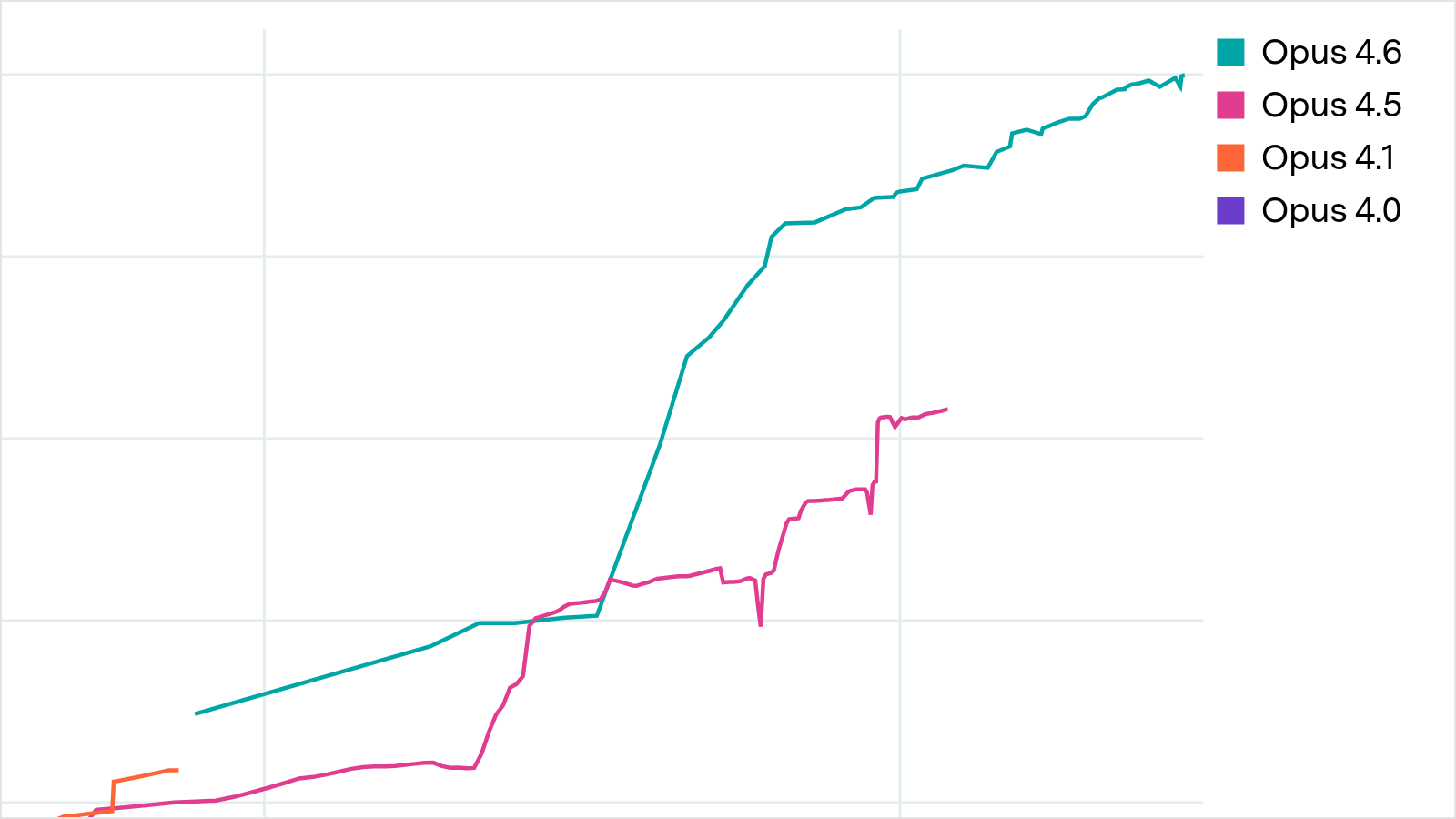
Best LLM for Coding 2026 | AI Coding Model Rankings & Benchmarks
Which AI model writes the best code? We rank every major LLM — open and closed source — across SWE-bench, HumanEval, LiveCodeBench, and Terminal-Bench coding benchmarks. Compare the best LLMs for coding, software engineering, and programming.

AI Coding Agent Benchmarks & Leaderboard | Artificial Analysis
We measure real-world performance of coding agents on software engineering tasks, including cost, token usage, and execution time. We compare how performance changes across agents, models, and execution settings.
ExploitGym: Can AI Agents Turn Security Vulnerabilities into Real Attacks?
AI agents are rapidly gaining capabilities that could significantly reshape cybersecurity, making rigorous evaluation urgent. A critical capability is exploitation: turning a vulnerability, which is not yet an attack, into a concrete security impact, such as unauthorized file access or code execution. Exploitation is a particularly challenging task because it requires low-level program reasoning (e.g., about memory layout), runtime adaptation, and sustained progress over long horizons. Meanwhile, it is inherently dual-use, supporting defensive workflows while lowering the barrier for offense. Despite its importance and diagnostic value, exploitation remains under-evaluated. To address this gap, we introduce ExploitGym, a large-scale, diverse, realistic benchmark on the exploitation capabilities of AI agents. Given a program input that triggers a vulnerability, ExploitGym tasks agents with progressively extending it into a working exploit. The benchmark comprises 898 instances sourced from real-world vulnerabilities across three domains, including userspace programs, Google's V8 JavaScript engine, and the Linux kernel. We vary the security protections applied to each instance, isolating their impact on agent performance. All configurations are packaged in reproducible containerized environments. Our evaluation shows that while exploitation remains challenging, frontier models can successfully exploit a non-trivial fraction of vulnerabilities. For example, the strongest configurations are Anthropic's latest model Claude Mythos Preview and OpenAI's GPT-5.5, which produce working exploits for 157 and 120 instances, respectively. Notably, even with widely used defenses enabled, models retain non-trivial success rates. These results establish ExploitGym as an effective testbed for exploitation and highlight the growing cybersecurity risks posed by increasingly capable AI agents.

ExploitGym: Can AI Agents Turn Security Vulnerabilities into Real Attacks?
AI agents are rapidly gaining capabilities that could significantly reshape cybersecurity, making rigorous evaluation urgent. A critical capability is exploitation: turning a vulnerability, which is not yet an attack, into a concrete security impact, such as unauthorized file access or code execution. Exploitation is a particularly challenging task because it requires low-level program reasoning (e.g., about memory layout), runtime adaptation, and sustained progress over long horizons. Meanwhile, it is inherently dual-use, supporting defensive workflows while lowering the barrier for offense. Despite its importance and diagnostic value, exploitation remains under-evaluated. To address this gap, we introduce ExploitGym, a large-scale, diverse, realistic benchmark on the exploitation capabilities of AI agents. Given a program input that triggers a vulnerability, ExploitGym tasks agents with progressively extending it into a working exploit. The benchmark comprises 898 instances sourced from real-world vulnerabilities across three domains, including userspace programs, Google's V8 JavaScript engine, and the Linux kernel. We vary the security protections applied to each instance, isolating their impact on agent performance. All configurations are packaged in reproducible containerized environments. Our evaluation shows that while exploitation remains challenging, frontier models can successfully exploit a non-trivial fraction of vulnerabilities. For example, the strongest configurations are Anthropic's latest model Claude Mythos Preview and OpenAI's GPT-5.5, which produce working exploits for 157 and 120 instances, respectively. Notably, even with widely used defenses enabled, models retain non-trivial success rates. These results establish ExploitGym as an effective testbed for exploitation and highlight the growing cybersecurity risks posed by increasingly capable AI agents.
Wolfram LLM Benchmarking Project
Results from Wolfram's ongoing tracking of LLM performance. The benchmark is based on a Wolfram Language code generation task.

Speed Comparison - Programming Languages
Benchmarks run on GitHub Actions. Results may vary based on runner hardware.
SlopCodeBench: Benchmarking How Coding Agents Degrade Over Long-Horizon Iterative Tasks
Software development is iterative, yet agentic coding benchmarks hide design issues through their single-shot setup. Recent iterative benchmarks attempt to remedy this but heavily constrain an agent's design decision space, making it impossible to faithfully measure how their decisions shape future extensions. We introduce SlopCodeBench, a benchmark of 36 problems and 196 checkpoints where agents repeatedly extend their own solutions. Unlike prior iterative benchmarks, our evolving specifications demand architectural decisions but leave internal structure to the agent. We measure two forms of degradation: structural erosion (concentrated complexity) and verbosity (redundant code). Evaluating 15 coding agents across open and closed models, we find that no agent fully solves any problem end-to-end, and the best agent passes 14.8% of checkpoints. Quality degrades across checkpoints, with structural erosion rising in 77% of trajectories and verbosity in 75.5%. Compared to 473 open-source Python repositories, agent code is 2.3x more verbose and 2.0x more eroded, and the human repositories degrade less often and by smaller margins across their git histories. Explicit quality guidance reduces initial verbosity and erosion by up to a third, without affecting degradation rates. SlopCodeBench provides the first measurement of code degradation under iterative extension, revealing that agents pass checkpoints while producing code that erodes and bloats with each turn.
SlopCodeBench: Benchmarking How Coding Agents Degrade Over Long-Horizon Iterative Tasks
Software development is iterative, yet agentic coding benchmarks overwhelmingly evaluate single-shot solutions against complete specifications. Code can pass the test suite but become progressively harder to extend. Recent iterative benchmarks attempt to close this gap, but constrain the agent’s design decisions too tightly to faithfully measure how code quality shapes future extensions. We introduce SlopCodeBench, a language-agnostic benchmark comprising 20 problems and 93 checkpoints, in which agents repeatedly extend their own prior solutions under evolving specifications that force architectural decisions without prescribing internal structure. We track two trajectory-level quality signals: verbosity, the fraction of redundant or duplicated code, and structural erosion, the share of complexity mass concentrated in high-complexity functions. No agent solves any problem end-to-end across 11 models; the highest checkpoint solve rate is 17.2%. Quality degrades steadily: erosion rises in 80% of trajectories and verbosity in 89.8%. Against 48 open-source Python repositories, agent code is 2.2x more verbose and markedly more eroded. Tracking 20 of those repositories over time shows that human code stays flat, while agent code deteriorates with each iteration. A prompt-intervention study shows that initial quality can be improved, but it does not halt degradation. These results demonstrate that pass-rate benchmarks systematically undermeasure extension robustness, and that current agents lack the design discipline iterative software development demands.
Introducing Pipette: A benchmarking suite for on-device intelligence — Blog
Meet Pipette, an open-source platform for reproducible on-device AI benchmarks across models, quantization, runtimes and hardware.
CyberGym: Evaluating AI Agents' Real-World Cybersecurity Capabilities at Scale
AI agents have significant potential to reshape cybersecurity, making a thorough assessment of their capabilities critical. However, existing evaluations fall short, because they are based on small-scale benchmarks and only measure static outcomes, failing to capture the full, dynamic range of real-world security challenges. To address these limitations, we introduce CyberGym, a large-scale benchmark featuring 1,507 real-world vulnerabilities across 188 software projects. Adjustable to different vulnerability analysis settings, CyberGym primarily tasks agents with generating a proof-of-concept test that reproduces a vulnerability, given only its text description and the corresponding codebase. Our extensive evaluation highlights that CyberGym effectively differentiates agents' and models' cybersecurity capabilities. Even the top-performing combinations only achieve a ~20% success rate, demonstrating the overall difficulty of CyberGym. Beyond static benchmarking, we show that CyberGym leads to the discovery of 34 zero-day vulnerabilities and 18 historically incomplete patches. These results underscore that CyberGym is not only a robust benchmark for measuring AI's progress in cybersecurity but also a platform for creating direct, real-world security impact.
Separating signal from noise in coding evaluations
A new analysis from OpenAI reveals issues in SWE-Bench Pro, a popular coding benchmark, raising concerns about reliability and accuracy in evaluating AI models.
When Science Goes Agentic
In a couple of years, we will inspect AI-generated source code about as often as we inspect the assembly output of a compiler. Which is to say, far less often—outside of high-stakes and adversarial settings. The trajectory is clear: vibe coding is not a fad but a transition, a stepping stone. Debugging AI-generated code will shrink dramatically for a lot of everyday software—not because the code will be flawless, but because the feedback loops between generation, testing, and correction will tighten until human inspection becomes the bottleneck rather than the safeguard. In this respect, requiring the co-generation, with code, of mechanically verifiable formal attestations can also improve the process.

SWE-Bench Pro: Can AI Agents Solve Long-Horizon Software Engineering Tasks?
Large Language Model (LLM) agents have been widely adopted in modern software development workflows. SWE-bench [13] and related works [23, 24, 22, 25, 15] establish the task of issue resolution as a de-facto standard for assessing their capability and usefulness. In this setting, an agent is given an entire codebase, a task description (e.g., a bug report or feature request) in natural language and is instructed to produce a code patch that resolves the issue and passes the repository’s test suite. These benchmarks have been instrumental in demonstrating both the substantial potential and the persistent limitations of current models as SWE agents.
Measuring the Impact of Early-2025 AI on Experienced Open-Source...
Despite widespread adoption, the impact of AI tools on software development in the wild remains understudied. We conduct a randomized controlled trial (RCT) to understand how AI tools at the...
Reproducible Execution Environment (REE) | Tech | Gensyn
Run AI model inference in a machine-agnostic environment where the same model and inputs produce the same outputs across supported hardware.
