

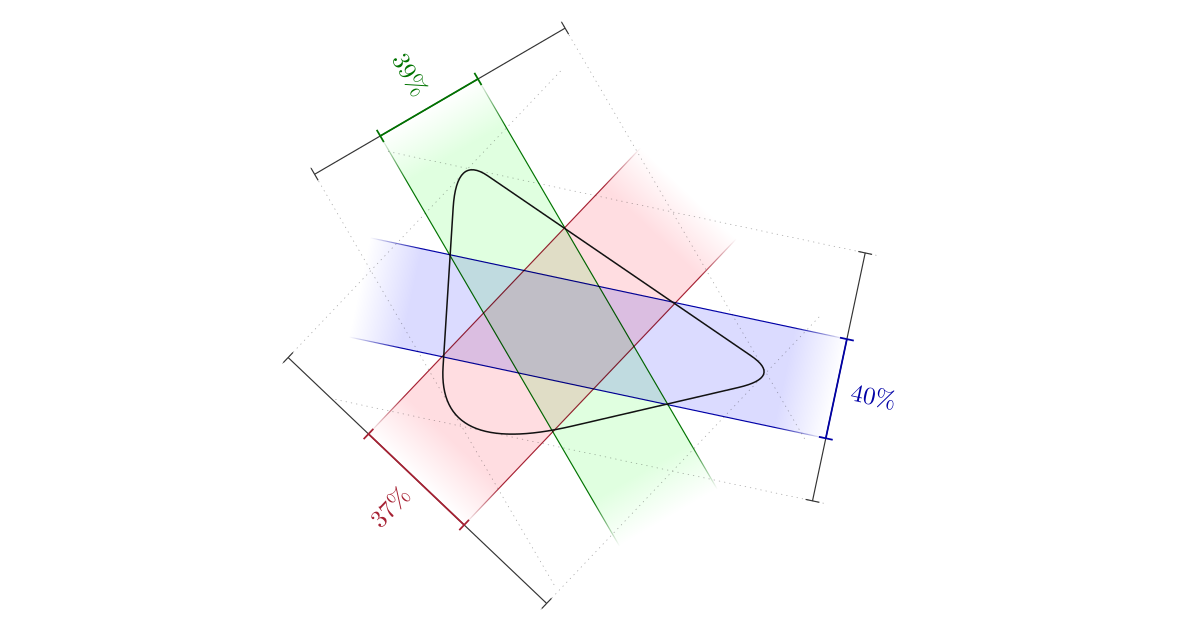
An illustrated explanation of relative plank widths, an interactive visualization, and proofs for three planks.
How I Vibed a Proof of Conway’s Conjecture — overreacted
You can just prove things, apparently.
An OpenAI model has disproved a central conjecture in discrete geometry
An OpenAI model solved the 80-year-old unit distance problem, disproving a major conjecture in discrete geometry and marking a milestone in AI-driven mathematics.

Przemek Chojecki | PC on Twitter / X
The Growing Map of Open Mathematical Problems.We mapped 15,000+ conjectures from UnsolvedMath to show potential links between concepts.It also shows how under formalized the frontier is (less than 10%). pic.twitter.com/nm0PCpXVPf— Przemek Chojecki | PC (@prz_chojecki) August 28, 2026

Notes from the Lab - March 2025 · folk-js folkjs · Discussion #36
This month, we restructured the repository in preparation for publishing. We extracted and optimized geometry utilities into a separate package, implemented Bounding Volume Hierarchies for efficien...
Chomba Bupe on Twitter / X
It appears OpenAI Astra's mathematical feat was more of surface level stitching of components."The LLM-generated proof hinges on a particular mathematical argument that it presented as its own but that actually first appeared in a 2016 paper by Miller and a collaborator." pic.twitter.com/labUnQMRab— Chomba Bupe (@ChombaBupe) August 7, 2026

A Topological Picture Book, Rendered
Hand-hatched surfaces after the mid-century manner of Francis, Apéry, Hilbert–Cohn-Vossen. Drag to turn the model freely (shift-drag to roll it); scroll to approach.
Junyu Ren on Twitter / X
How we solved the 70-year-old Pierce–Birkhoff conjecture in real algebraic geometry with $400.One thing we kept noticing: models from different families (including the latest public models from GPT and Claude) seemed to complement each other, even when they were independently… pic.twitter.com/7MzWstXfy6— Junyu Ren (@junyu_r) September 9, 2026

Direct Consequences of the Three-Dimensional Counterexample to the Jacobian Conjecture
Expository writing following an explicit three-dimensional Keller counterexample.
Truly Subquadratic 3SUM and Truly Subcubic APSP via Triangles in Sparse Lopsided Graphs
We give the first polynomial improvements over the textbook algorithms for $3$SUM and All-Pairs Shortest Paths (APSP): we show how to deterministically solve $3$SUM on $n$ integers of polynomial size in $O(n^{1.9992})$ time and APSP on directed $n$-vertex graphs with polynomially bounded integer weights in $O(n^{2.9995})$ time. This refutes the $3$SUM and APSP hypotheses. Using known reductions, we also refute the real-valued versions of the $3$SUM and APSP hypotheses, the Exact Triangle hypothesis, the Zero-Weight $k$-Clique hypotheses, and the three rectangular hinted Online Matrix--Vector conjectures of van den Brand, Nanongkai, and Saranurak, and we give polynomial speedups for a variety of other problems. All of these results follow from a single new algorithm for thin matrix products. Let $X$ be an $N\times D$ integer matrix and $Y$ a $D\times N$ integer matrix with $D\le N^{1/18}$, and let $W$ be any set of at most $N^2/\sqrt D$ positions. We compute the entries $(XY)[I,J]$, $(I,J)\in W$, in $O(N^2/D^{0.063})$ operations, which is polynomially less than the time needed to write down $XY$ or to compute $N^2/\sqrt D$ inner products one by one. We design this algorithm by modifying a variant of Coppersmith's rectangular matrix multiplication algorithm, built from a ten-multiplication identity of Schönhage, to perform only the operations needed for the entries in $W$, and show that few operations are needed. Interpreted as a graph algorithm, this solves the All-Edges Sparse Triangle problem in truly subquadratic time on sparse lopsided tripartite graphs where two parts have $n$ vertices but one part has $n^{\varepsilon}$ vertices for $\varepsilon<0.12$. By known reductions, Exact Triangle, and hence $3$SUM and APSP, reduce to this problem. We also give a data structure version that answers queries for single entries of $XY$, not known in advance.

Computational Geometry in C (Second Edition)
Homepage for textbook on Computational Geometry
Notes for a Theory | Alberto Garutti

First Shape Found That Can’t Pass Through Itself | Quanta Magazine
After more than three centuries, a geometry problem that originated with a royal bet has been solved.

Computing Substrates


Introducing Patchwork-26

What is Malleable Software Now | Bryan Min (02-27-2026)
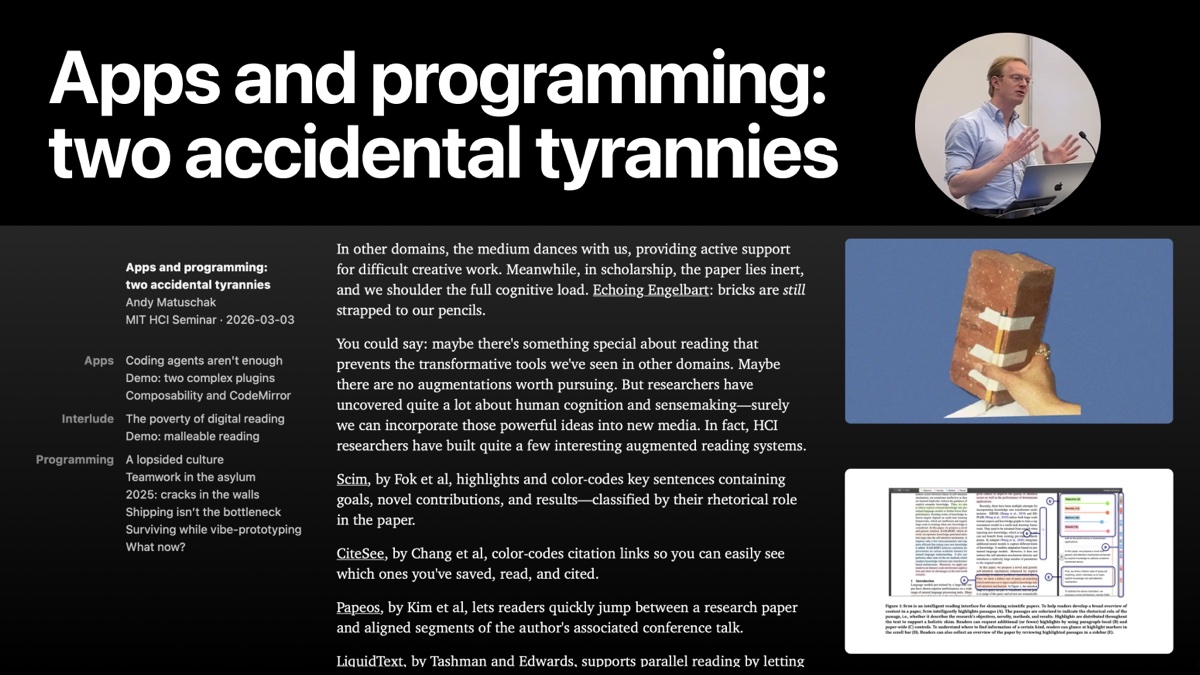
Apps and programming: two accidental tyrannies
Substrates 2025 - Proceedings
pure.au.dk

𝕮 (@chrisshank.com)