

Summary for Policymakers of the Thematic Assessment Report on the Interlinkages among Biodiversity, Water, Food and Health of the Intergovernmental Science-Policy Platform on Biodiversity and Ecosystem Services. The IPBES Nexus Assessment was initiated following a decision from the IPBES Plenary at its eigth session (IPBES-8) in June 2021. The summary for policymakers was approved by the IPBES Plenary at its eleventh session (IPBES-11) in December 2024.
Summary for policymakers of the global assessment report on biodiversity and ecosystem services
IPBES is an independent intergovernmental body comprising over 130 member Governments. Established by Governments in 2012, IPBES provides policymakers with objective scientific assessments about the state of knowledge regarding the planet’s biodiversity, ecosystems and the contributions they make to people, as well as options and actions to protect and sustainably use these vital natural assets. The IPBES Global Assessment of Biodiversity and Ecosystem Services represents the landmark product of the first work programme of IPBES (2014-2018). The Global Assessment was initiated following a decision from the IPBES Plenary at its fourth session (IPBES 4, Kuala Lumpur, 2016), and considered by the IPBES Plenary at its seventh session (IPBES 7, Paris, 2019). It is composed of a summary for policymakers, which was approved at IPBES 7, and six chapters, which were accepted at IPBES 7.
IPBES Transformative Change Assessment: Summary for Policymakers
Summary for Policymakers of the Thematic Assessment Report on the Underlying Causes of Biodiversity Loss and the Determinants of Transformative Change and Options for Achieving the 2050 Vision for Biodiversity of the Intergovernmental Science-Policy Platform on Biodiversity and Ecosystem Services. The IPBES Transformative Change Assessment was initiated following a decision from the IPBES Plenary at its eigth session (IPBES-8, June 2021), and has been approved by the IPBES Plenary at its eleventh session (IPBES-11, Windhoek, 2024). It is composed of a Summary for Policymakers and five Chapters. IPBES is an independent intergovernmental body established by Governments in 2012, IPBES provides policymakers with objective scientific assessments about the state of knowledge regarding the planet’s biodiversity, ecosystems and the contributions they make to people, as well as options and actions to protect and sustainably use these vital natural assets.
Global assessment report on biodiversity and ecosystem services of the Intergovernmental Science-Policy Platform on Biodiversity and Ecosystem Services
IPBES is to perform regular and timely assessments of knowledge on biodiversity and ecosystem services and their interlinkages at the global level. Also addressing an invitation by the Conference of the Parties of the Convention on Biological Diversity (CBD) to prepare a global assessment of biodiversity and ecosystem services building, inter alia, on its own and other relevant regional, subregional and thematic assessments, as well as on national reports. The overall scope of the assessment is to assess the status and trends with regard to biodiversity and ecosystem services, the impact of biodiversity and ecosystem services on human well-being and the effectiveness of responses, including the Strategic Plan and its Aichi Biodiversity Targets. It is anticipated that this deliverable will contribute to the process for the evaluation and renewal of the Strategic Plan for Biodiversity and its Aichi Biodiversity Targets. The IPBES Global Assessment on Biodiversity and Ecosystem Services is composed of 1) a Summary for Policymakers (SPM), approved by the IPBES Plenary at its 7th session in May 2019 in Paris, France (IPBES-7); and 2) a set of six Chapters, accepted by the IPBES Plenary.
IPBES Transformative Change Assessment : Full report
Thematic assessment of the underlying causes of biodiversity loss, determinants of transformative change and options for achieving the 2050 Vision for Biodiversity of the Intergovernmental Science-Policy Platform on Biodiversity and Ecosystem Services (IPBES) is composed of 1) a Summary for Policymakers (SPM), and 2) a set of five Chapters. All products of the assessment are available on Zenodo. Find all the links on the side bar "has part"
Assessing nature's contributions to people
Recognizing culture, and diverse sources of knowledge, can improve assessments , A major challenge today and into the future is to maintain or enhance beneficial contributions of nature to a good quality of life for all people. This is among the key motivations of the Intergovernmental Science-Policy Platform on Biodiversity and Ecosystem Services (IPBES), a joint global effort by governments, academia, and civil society to assess and promote knowledge of Earth's biodiversity and ecosystems and their contribution to human societies in order to inform policy formulation. One of the more recent key elements of the IPBES conceptual framework ( 1 ) is the notion of nature's contributions to people (NCP), which builds on the ecosystem service concept popularized by the Millennium Ecosystem Assessment (MA) ( 2 ). But as we detail below, NCP as defined and put into practice in IPBES differs from earlier work in several important ways. First, the NCP approach recognizes the central and pervasive role that culture plays in defining all links between people and nature. Second, use of NCP elevates, emphasizes, and operationalizes the role of indigenous and local knowledge in understanding nature's contribution to people.

Metrics for biodiversity and health policy integration
Despite over a decade of progressive commitments from parties to the Convention on Biological Diversity (CBD), integrated biodiversity and health indicators and monitoring mechanisms remain limited, hampering achievement of the sustainable development goals and improvements in health and well-being. Adoption of the Kunming-Montreal Global Biodiversity Framework (2022) and the Global Action Plan on Biodiversity and Health (2024) provide a renewed entry point to shape the way governments approach health and wellbeing and address the environmental burden of disease. This is a critical opportunity that scholars at the health-environment nexus should not miss. This Perspective outlines building blocks to mobilize the field, starting with essential terminology and a scope of metrics needed by governments. We then evaluate elements to be considered in the construction of integrated metrics, including concepts, overarching challenges, a review of scientific hypotheses from an ecological perspective, as well as a set of principles and characteristics for indicators. To raise awareness across parallel communities of practice working at the health-environment nexus, we then briefly examine four approaches to integrated metrics developed by: conservationists, Indigenous scholars, One Health experts, and planetary health experts. We conclude with actionable steps to enhance governance, mobilize funding, and apply integrated indicators in national and global strategies. A broad science community is needed to support national governments to meet global commitments to address biodiversity loss and the environmental burden of disease concurrently. The overall aim of this paper is to contribute to addressing biodiversity loss by effectively linking policy and transdisciplinary practice at the health-environment nexus.
UN Common Approach to Biodiversity | United Nations - CEB
In the spring of 2021, the UN System Chief Executives Board for Coordination endorsed the "Common approach to integrating biodiversity and nature-based...
Tackling the Nature Emergency - strategic framework for biodiversity: consultation
A consultation on Scotland’s Strategic Framework for Biodiversity, including the first 5-year Delivery Plan for the Scottish Biodiversity Strategy, and elements of the proposed Natural Environment Bill.

Key Principles for the Intergovernmental Science–Policy Panel on Chemicals and Waste
In 2021, the United Nations Environment Programme (UNEP) recognized chemical pollution as a planetary crisis tantamount to climate change and biodiversity
Biodiversity: delivery plan 2024 to 2030
The first in a series of rolling Delivery Plans which form part of our Strategic Framework for Biodiversity, in conjunction with the Scottish Biodiversity Strategy. It includes actions needed to ensure we are on track to achieving the vision and outcomes in the Strategy.
Sustainable Development Goals
The 2030 Agenda for Sustainable Development was adopted by all United Nations Member States in 2015. It is built around 17 Sustainable Development Goals (SDGs) and 169 targets that represent an ambitious plan for achieving sustainable development and serves as the basis for countries to shape their national policies and priorities. At the heart of the agenda is the recognition that truely sustainable development must combine economic growth and poverty alleviation with strategies that improve health and education, reduce inequality, while addressing climate change and protecting nature. Thus, the interlinked nature of the SDGs calls for an integrated approach to policy decisions. As the international statistical standard for measuring the environment and its relationship with the economy, the SEEA is well positioned to support integrated policies based on a better understanding of the interactions and trade-offs between the environment and economy. Progress toward the 17 goals and 169 targets of the 2030 Agenda are monitored through 244 indicators, entailing the collection of substantial amounts of data. The UN Statistical Commission (UNSC) has encouraged the Inter-Agency and Expert Group on SDG Indicators (IAEG-SDGs), the body tasked with developing and implementing the global indicator framework for the 2030 Agenda, to consider existing standards and frameworks that can improve SDG monitoring, including the System of Environmental-Economic Accounting (SEEA). System of Environmental-Economic Accounting (SEEA). Recently, the Secretariat of the Convention on Biological Diversity (CBD), UN Environment and the UN Statistics Division brought a proposal on upgrading the status of Indicator 15.9.1 to the tenth meeting of the IAEG-SDGs, where the group agreed to the proposal and reclassified the indicator from Tier III to Tier II. The United Nations Committee of Experts on Environmental-Economic Accounting (UNCEEA), an intergovernmental body established by the UNSC to provide overall vision, coordination, prioritization and direction in the field of environmental economic accounting and supporting statistics, has assessed that currently 40 indicators for nine Sustainable Development Goals can be informed by the SEEA. The SEEA is particularly well-suited for deriving ratio indicators that compare environmental and economic information.

Marine Biodiversity Observation Network
A global collaborative initiative contributing to the effective management of marine biodiversity and ecosystem services. A thematic node of GEO BON.
Biodiversity strategy to 2045: tackling the nature emergency - draft
This draft biodiversity strategy sets out our clear ambition for Scotland to be Nature Positive by 2030, and to have restored and regenerated biodiversity across the country by 2045.
Measuring biodiversity: research into approaches
This report considers methodologies for measuring biodiversity at site-level for use in Scotland.
Mapping citizen science contributions to the UN sustainable development goals
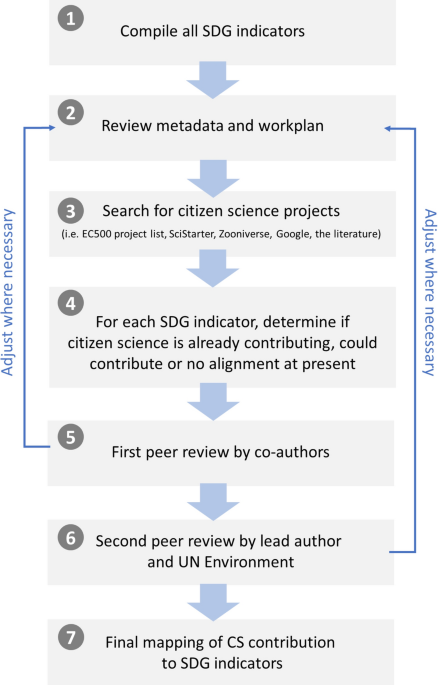
The UN Sustainable Development Goals (SDGs) are a vision for achieving a sustainable future. Reliable, timely, comprehensive, and consistent data are critical for measuring progress towards, and ultimately achieving, the SDGs. Data from citizen science represent one new source of data that could be used for SDG reporting and monitoring. However, information is still lacking regarding the current and potential contributions of citizen science to the SDG indicator framework. Through a systematic review of the metadata and work plans of the 244 SDG indicators, as well as the identification of past and ongoing citizen science initiatives that could directly or indirectly provide data for these indicators, this paper presents an overview of where citizen science is already contributing and could contribute data to the SDG indicator framework. The results demonstrate that citizen science is “already contributing” to the monitoring of 5 SDG indicators, and that citizen science “could contribute” to 76 indicators, which, together, equates to around 33%. Our analysis also shows that the greatest inputs from citizen science to the SDG framework relate to SDG 15 Life on Land, SDG 11 Sustainable Cities and Communities, SDG 3 Good Health and Wellbeing, and SDG 6 Clean Water and Sanitation. Realizing the full potential of citizen science requires demonstrating its value in the global data ecosystem, building partnerships around citizen science data to accelerate SDG progress, and leveraging investments to enhance its use and impact.
GBIF
Global Biodiversity Information Facility. Free and Open Access to Biodiversity Data.