Code release for publications related to quantifying pfas levels in human liver and serum from Juliana Agudelo.
Per- and Polyfluoroalkyl Substances in Human Liver and Serum
<p> This dataset contains measured concentrations of 54 targeted per- and polyfluoroalkyl substances (PFAS) in 211 human liver samples and 18 matched serum samples, determined using liquid chromatography–tandem high-resolution mass spectrometry (LC-HRMS/MS). The dataset is supplemented with anonymized demographic and physiological information for the matched samples. </p> <p>The dataset comprises:</p> <ul> <li>(i) a list of targeted PFAS compounds included in the LC-MS/MS analyses for both liver and serum,</li> <li>(ii) 12 raw data files generated from LC-MS/MS analyses,</li> <li>(iii) information on individual samples, including quality control samples such as blanks, continuous calibration verification samples, and matrix spikes,</li> <li>(iv) quality control criteria thresholds for extracted internal standard recoveries, ion abundance ratios, and retention time shifts, as well as the input parameters used to process the raw data files,</li> <li>(v) combined processed results of PFAS contamination levels, and</li> <li>(vi) anonymized demographic and physiological information.</li> </ul> <p> The combined processed results (v) were generated by processing the raw data files (ii) using a Jupyter-based data cleaning and QA/QC pipeline for targeted PFAS LC-MS/MS, as referenced in the Related Publications. Sample information (iii), quality control criteria thresholds, and processing input parameters (iv) were used as inputs to run this pipeline. </p> <p> Raw data files are tagged as <em>raw data</em>. File names indicate the date of sample preparation for each batch (YYYYMMDD), the matrix type (liver or serum), and the analytical method used (core or extended). </p> <p> The <strong>core method</strong> measures contamination levels of the following PFAS compounds: </p> <p> PFBA, PFPeA, PFHxA, PFHpA, PFOA, PFNA, PFDA, PFUdA, PFDoA, PFTrDA, PFTeDA, PFBS, PFPeS, L-PFHxS, Br-PFHxS, PFHpS, L-PFOS, Br-PFOS, PFNS, PFDS, FBSA, FPeSA, FHxSA, FHpSA, FOSA, 4:2 FTS, 6:2 FTS, 8:2 FTS, 10:2 FTS. </p> <p> The <strong>extended method</strong> measures contamination levels of: </p> <p> PFPrA, 3:3 FTCA, 5:3 FTCA, 7:3 FTCA, FOEA, PFPrS, MeFBSA, N-EtFBSA-M, L-N-MeFOSAA, Br-N-MeFOSAA, L-N-EtFOSAA, Br-N-EtFOSAA, MeFOSA, EtFOSA, HFPO-DA, DONA, 9ClPF3ONS, 11ClPF3OUdS, 3,6-OPFHpA, PF4OPeA, PF5OHxA, PFECHS, PFEESA, N-AP-FHxSA, N-TAmP-FHxSA. </p> <p> Sample information, quality control thresholds, and simulation parameters are tagged as <em>simulation input</em>. Files ending in <em>_liver.csv</em> or <em>_serum.csv</em> apply only to liver or serum samples, respectively; files without these suffixes apply to both matrix types. </p> <p> Combined processed results across all batches for liver and serum samples are tagged as <em>processed data</em>. Specimen demographic data are tagged accordingly. </p>
Paired Liver:Plasma PFAS Concentration Ratios from Adolescents in the Teen-LABS Study and Derivation of Empirical and Mass Balance Models to Predict and Explain Liver PFAS Accumulation
Abstract. Animal studies have pointed at the liver as a hotspot for per- and polyfluoroalkyl substances (PFAS) accumulation and toxicity; however, these fi

Unbound Fractions of PFAS in Human and Rodent Tissues: Rat Liver a Suitable Proxy for Evaluating Emerging PFAS?
Abstract. Adverse health effects associated with exposures to perfluoroalkyl and polyfluoroalkyl substances (PFAS) are a concern for public health and are

Can profiles of poly- and Perfluoroalkyl substances (PFASs) in human serum provide information on major exposure sources?
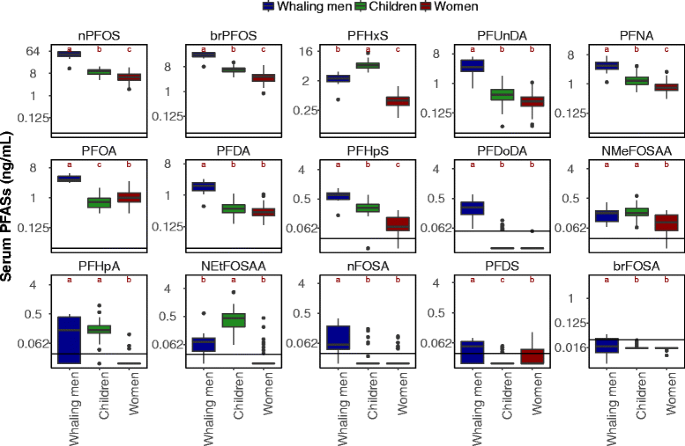
Humans are exposed to poly- and perfluoroalkyl substances (PFASs) from diverse sources and this has been associated with negative health impacts. Advances in analytical methods have enabled routine detection of more than 15 PFASs in human sera, allowing better profiling of PFAS exposures. The composition of PFASs in human sera reflects the complexity of exposure sources but source identification can be confounded by differences in toxicokinetics affecting uptake, distribution, and elimination. Common PFASs, such as perfluorooctanoic acid (PFOA), perfluorooctane sulfonic acid (PFOS) and their precursors are ubiquitous in multiple exposure sources. However, their composition varies among sources, which may impact associated adverse health effects.
Binding of Per- and Polyfluoroalkyl Substances (PFAS) to Serum Proteins: Implications for Toxicokinetics in Humans
Abstract. Per- and polyfluoroalkyl substances (PFAS) are a diverse class of highly persistent anthropogenic chemicals that are detectable in the serum of m

Addressing Urgent Questions for PFAS in the 21st Century
Abstract. Despite decades of research on per- and polyfluoroalkyl substances (PFAS), fundamental obstacles remain to addressing worldwide contamination by

Liver and Intestinal Fatty Acid Binding Proteins Are Not Critical for Perfluorooctanesulfonate (PFOS) Tissue Distribution and Elimination in Mice
Abstract. Perfluorooctanesulfonate (PFOS) is a persistent environmental pollutant in the per- and polyfluoroalkyl substances (PFAS) class, known to accumul
PFAS Statewide Sampling Dataset: PFAS drinking water sampling data from U.S. community water systems
This repository contains a sample of U.S. community water systems (CWS) included in the PFAS statewide sampling dataset. In the first versions of this dataset, 18 states were included as part of Liddie et al., 2023. The statewide sampling dataset now includes compiled data from 28 U.S. statewide sampling campaigns of CWS for per- and polyfluoroalkyl substances (PFAS) in drinking water. The full dataset of samples spans the 2016-2024 period. All data were either publicly available or provided by state agencies upon request. The full dataset contains approximately 98,000 samples from 11,138 CWS in Alabama, Arizona, California, Colorado, Georgia, Illinois, Indiana, Iowa, Kentucky, Maine, Maryland, Massachusetts, Michigan, Minnesota, Missouri, New Hampshire, New Jersey, New York, Ohio, Pennsylvania, Rhode Island, South Carolina, Tennessee, Utah, Vermont, Virginia, Washington, and Wisconsin. Concentrations of 5-40 targeted PFAS were analyzed by multiple labs contracted by the states using comparable methods, including either US EPA Method 537, 537.1, or 533. We assigned a conservative, uniform detection limit at the 98th percentile of all reports detection limits (5 ng/L) for the 5 PFAS that were measured in all states consistently. This dataset also incorporates data from the US EPA’s Safe Drinking Water Information System, including the source water type, county served, zip code, system city, and total population served. The 8-digit hydrological unit code in which a CWS intake is estimated to reside is also provided using data from the United States Geological Survey. This was done by geocoding each CWS using geographical data provided by state agencies, reported zip codes (when available), or based on additional information provided by each system (e.g., system name, city, city served). At this time, the full datasets (either system-level or sample-level) are available by request (see contact information below). Note that additional fields, such continuous concentration data, reported detection limits, concentrations of other PFAS analytes, are also available. Proper citation of both this repository and the original associated paper (see recommended citations below) are required for use of these data. Due to the significant time investment required to curate these data, additional data requests beyond the scope of the details listed here are welcomed but should be agreed upon (e.g., in terms of co-authorship) with the primary point of contact. Please contact Jahred Liddie (jliddie@g.harvard.edu) for questions/suggestions, access to additional variables, or access to the full sampling datasets.
Characterizing the Areal Extent of PFAS Contamination in Fish Species Downgradient of AFFF Source Zones
Dataset of targeted PFAS and extractable organofluorine concentrations in water, sediment, and biological tissue samples that support data included in two papers: "Characterizing the Areal Extent of PFAS Contamination in Fish Species Downgradient of AFFF Source Zones" and "Bioaccumulation of Perfluoroalkyl Sulfonamides (FASA)"
Occurrence of Major Perfluorinated Alkylate Substances in Human Blood and Target Organs
Abstract. Human exposure to perfluorinated alkylate substances (PFASs) is usually assessed from the concentrations in serum or plasma, assuming one-compart

Species-Specific Unbound Fraction Differences in Highly Bound PFAS: A Comparative Study across Human, Rat, and Mouse Plasma and Albumin
Per- and polyfluoroalkyl substances (PFAS) are a diverse group of fluorinated compounds which have yet to undergo comprehensive investigation regarding potential adverse health effects and bioaccumulative properties. With long half-lives and accumulative properties, PFAS have been linked to several toxic effects in both non-clinical species such as rat and mouse as well as human. Although biological impacts and specific protein binding of PFAS have been examined, there is no study focusing on the species-specific fraction unbound (fu) in plasma and related toxicokinetics. Herein, a presaturation equilibrium dialysis method was used to measure and validate the binding of 14 individual PFAS with carbon chains containing 4 to 12 perfluorinated carbon atoms and several functional head-groups to albumin and plasma of mouse (C57BL/6 and CD-1), rat, and human. Equivalence testing between each species-matrix combination showed positive correlation between rat and human when comparing fu in plasma and binding to albumin. Similar trends in binding were also observed for mouse plasma and albumin. Relatively high Spearman correlations for all combinations indicate high concordance of PFAS binding regardless of matrix. Physiochemical properties of PFAS such as molecular weight, chain length, and lipophilicity were found to have important roles in plasma protein binding of PFAS.

Emerging questions in exposure, regulation, and remediation of PFAS
My research is highly interdisciplinary and includes exposure and risk analysis. Many of our colleagues have diverse backgrounds and work together to address the interdisciplinary challenges associated with PFAS contamination …I think one of the largest gaps right now is understanding the importance of different exposure pathways for the general population.Given the tremendous physical and mental toll affected communities have experienced due to their exposure to PFAS, there is an unusually strong connection between citizens and scientists, and I hope that bond will strengthen over time.

PFAS Exposure Pathways for Humans and Wildlife: A Synthesis of Current Knowledge and Key Gaps in Understanding
Abstract. We synthesize current understanding of the magnitudes and methods for assessing human and wildlife exposures to poly‐ and perfluoroalkyl substanc
SunderlandLab/oxidizable-pfas-precursor-inference
Contribute to SunderlandLab/oxidizable-pfas-precursor-inference development by creating an account on GitHub.
AI Assistant Tool QED Scores bioRxiv Preprint Quality | The Scientist
QED, an AI assistant tool, evaluates the originality and validity of bioRxiv preprints, assigning them QED Scores. Researchers report that its rankings often align with expert opinion.

Understanding Mechanisms of PFAS Absorption, Distribution, and Elimination Using a Physiologically Based Toxicokinetic Model
Abstract. Exposures to some per- and polyfluoroalkyl substances (PFAS), including perfluoroalkyl acids (PFAA), have been associated with diverse adverse he