Critical Artificial Intelligence Literacies (CAILs) is the collection of ways of thinking about and relating to so-called artificial intelligence (AI) that rejects dominant frames presented by the technology industry, by naive computationalism, and by dehumanising ideologies. Instead, CAILs centre human cognition and uphold the integrity of academic research and education. We present a selection of CAILs across research and education, which we analyse into the following non-orthogonal dimensions: conceptual clarity, critical thinking, decoloniality, respecting expertise, and slow science. Finally, we note how we see the present with and without a wider adoption of CAILs — a fundamental aspect is the assertion that AI cannot be allowed to drive change, even positive change, in education or research. Instead cultivation of and adherence to shared values and goals must guide us. Ultimately, CAILs minimally ask us to contemplate how we as academics can stop AI companies from wielding so much power.

The Impact of Artificial Intelligence on Human Thought
This research paper examines, from a multidimensional perspective (cognitive, social, ethical, and philosophical), how AI is transforming human thought. It highlights a cognitive offloading effect: the externalization of mental functions to AI can reduce intellectual engagement and weaken critical thinking. On the social level, algorithmic personalization creates filter bubbles that limit the diversity of opinions and can lead to the homogenization of thought and polarization. This research also describes the mechanisms of algorithmic manipulation (exploitation of cognitive biases, automated disinformation, etc.) that amplify AI's power of influence. Finally, the question of potential artificial consciousness is discussed, along with its ethical implications. The report as a whole underscores the risks that AI poses to human intellectual autonomy and creativity, while proposing avenues (education, transparency, governance) to align AI development with the interests of humanity.

AI and the Future of Science
Contra Literacy-Laundering: Mechanistic Critical AI Literacy
Critical discourse on large language models (LLMs) has bifurcated between epistemic dismissal that invokes some form of the stochastic parrot metaphor to puncture hype, and pragmatic accommodation that treats LLM capability improvements as grounds for updating the critique. We argue that both misdiagnose the problem as the issue is not whether or not LLMs work, but what kind of working is happening and at whose cost. Drawing on meta-theoretical frameworks of cognitive science, feminist labor analysis and critical pedagogy, we propose a conceptual reorientation. We develop this claim through registers of (i) the cognitive, examining what is forfeited when statistical pattern-matching substitutes for the iterative, grounded processes that constitute thinking; (ii) the pedagogical, examining how “AI literacy” as currently deployed is itself a symptom of the confusion it purports to address; and (iii) the political, examining how the infrastructure framing of AI naturalizes asymmetric labor displacement, particularly of feminized cognitive and reproductive work. The stochastic parrot, deployed with mechanistic precision rather than mere rhetorical convenience, specifies what is forfeited when cognitive labor is delegated, who bears the cost, and why a literacy adequate to this moment must begin from the epistemology of those most harmed by the systems it describes. We conclude with underlining that critical AI literacy, which this paper embodies an instance of, is the only sensible way forward.
Critical AI
On this page are some resources for Critical AI Literacy (CAIL) from my perspective.
AI and the Humanities: A Framework for Language and Literary Scholarship – MLA Task Force on AI in Research and Teaching
AI Is Hollowing Out Higher Education
Olivia Guest & Iris van Rooij urge teachers and scholars to reject tools that commodify learning, deskill students, and promote illiteracy.
AI Literacy Across the Curriculum
As you have no doubt seen, AI is becoming ubiquitous in our lives and in the technologies we use every day. Generative AI is no longer an experimental tool, but a deployed technology in many of the…

Artificial intelligence tools expand scientists’ impact but contract science’s focus
Developments in artificial intelligence (AI) have accelerated scientific discovery1. Alongside recent AI-oriented Nobel prizes2–9, these trends establish the role of AI tools in science10. This advancement raises questions about the influence of AI tools on scientists and science as a whole, and highlights a potential conflict between individual and collective benefits11. To evaluate these questions, we used a pretrained language model to identify AI-augmented research, with an F1-score of 0.875 in validation against expert-labelled data. Using a dataset of 41.3 million research papers across the natural sciences and covering distinct eras of AI, here we show an accelerated adoption of AI tools among scientists and consistent professional advantages associated with AI usage, but a collective narrowing of scientific focus. Scientists who engage in AI-augmented research publish 3.02 times more papers, receive 4.84 times more citations and become research project leaders 1.37 years earlier than those who do not. By contrast, AI adoption shrinks the collective volume of scientific topics studied by 4.63% and decreases scientists’ engagement with one another by 22%. By consequence, adoption of AI in science presents what seems to be a paradox: an expansion of individual scientists’ impact but a contraction in collective science’s reach, as AI-augmented work moves collectively towards areas richest in data. With reduced follow-on engagement, AI tools seem to automate established fields rather than explore new ones, highlighting a tension between personal advancement and collective scientific progress.

The case for friction in AI-mediated information seeking and learning
Introduction. This paper challenges the assumption that frictionless AI-mediated information seeking represents progress. We argue that AI systems eliminating productive friction, such as uncertainty, exploration, and reflective processes, undermine intellectual virtues essential for critical thinking in an AI-saturated information environment. Method. This conceptual article employs a theory synthesis approach, drawing on library information science (LIS) theories of information behaviour, experience, and literacy, virtue epistemology, and human–computer interaction (HCI) friction design literature. Analysis. We map intellectual virtues such as curiosity, thoroughness, and intellectual humility onto the Association of College and Research Libraries (ACRL) Framework for Information Literacy for Higher Education, building on and extending previous analyses. We connect dimensions of virtuous search to AI system design principles and align friction types with specific intellectual virtues. Results. We propose three design principles for human-centred AI systems (representation, affordance, and facilitation) and develop a typology that maps friction interventions to intellectual virtues, providing concrete examples for each. Conclusion. Productive friction should be understood as a feature supporting intellectual development, not a barrier to efficiency. The design choices made today will determine whether AI serves as intellectual scaffolding or cognitive crutch.
Artificial intelligence and illusions of understanding in scientific research
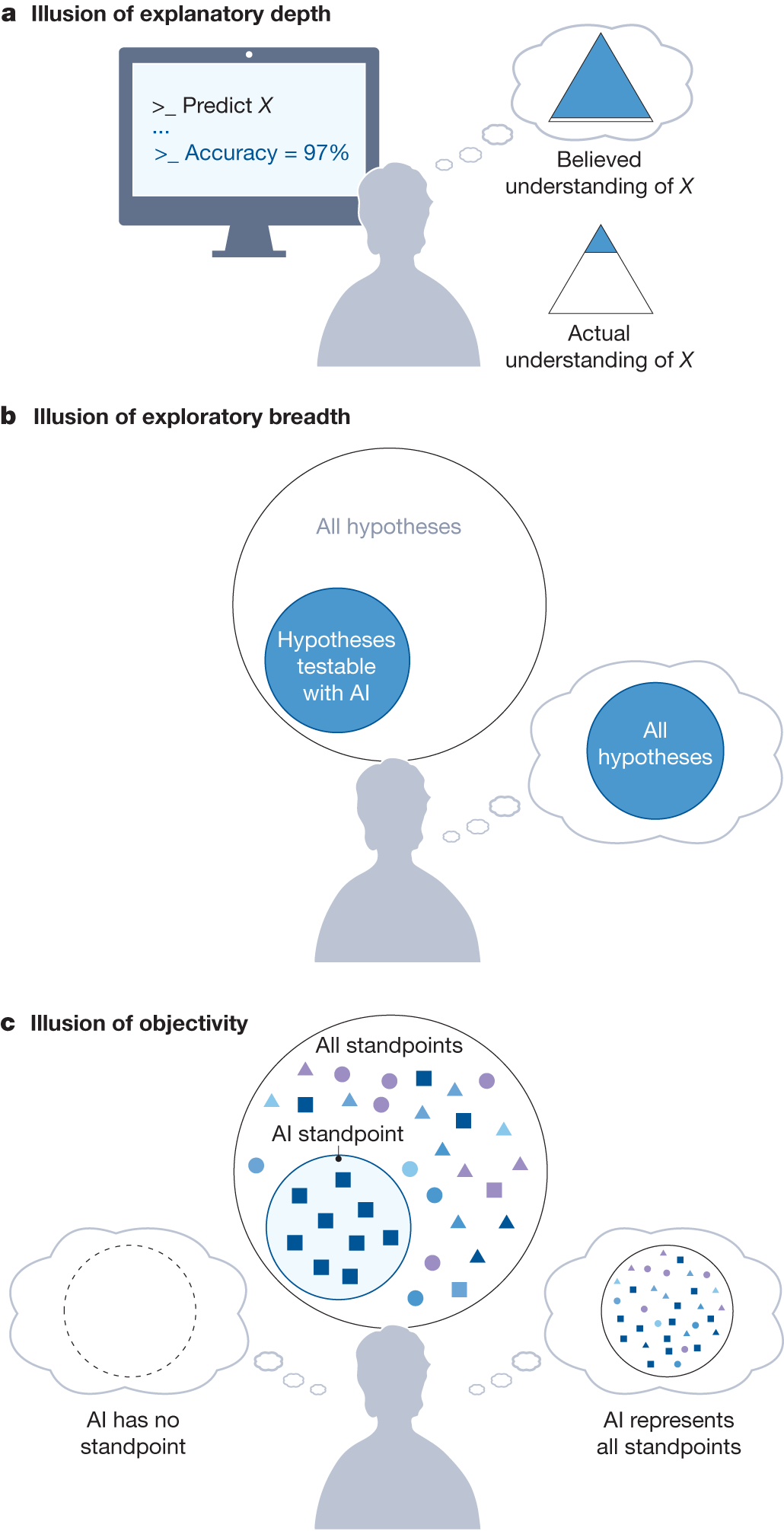
Scientists are enthusiastically imagining ways in which artificial intelligence (AI) tools might improve research. Why are AI tools so attractive and what are the risks of implementing them across the research pipeline? Here we develop a taxonomy of scientists’ visions for AI, observing that their appeal comes from promises to improve productivity and objectivity by overcoming human shortcomings. But proposed AI solutions can also exploit our cognitive limitations, making us vulnerable to illusions of understanding in which we believe we understand more about the world than we actually do. Such illusions obscure the scientific community’s ability to see the formation of scientific monocultures, in which some types of methods, questions and viewpoints come to dominate alternative approaches, making science less innovative and more vulnerable to errors. The proliferation of AI tools in science risks introducing a phase of scientific enquiry in which we produce more but understand less. By analysing the appeal of these tools, we provide a framework for advancing discussions of responsible knowledge production in the age of AI.
AI Tools in Society: Impacts on Cognitive Offloading and the Future of Critical Thinking
The proliferation of artificial intelligence (AI) tools has transformed numerous aspects of daily life, yet its impact on critical thinking remains underexplored. This study investigates the relationship between AI tool usage and critical thinking skills, focusing on cognitive offloading as a mediating factor. Utilising a mixed-method approach, we conducted surveys and in-depth interviews with 666 participants across diverse age groups and educational backgrounds. Quantitative data were analysed using ANOVA and correlation analysis, while qualitative insights were obtained through thematic analysis of interview transcripts. The findings revealed a significant negative correlation between frequent AI tool usage and critical thinking abilities, mediated by increased cognitive offloading. Younger participants exhibited higher dependence on AI tools and lower critical thinking scores compared to older participants. Furthermore, higher educational attainment was associated with better critical thinking skills, regardless of AI usage. These results highlight the potential cognitive costs of AI tool reliance, emphasising the need for educational strategies that promote critical engagement with AI technologies. This study contributes to the growing discourse on AI’s cognitive implications, offering practical recommendations for mitigating its adverse effects on critical thinking. The findings underscore the importance of fostering critical thinking in an AI-driven world, making this research essential reading for educators, policymakers, and technologists.

AI Tools in Society: Impacts on Cognitive Offloading and the Future of Critical Thinking
The proliferation of artificial intelligence (AI) tools has transformed numerous aspects of daily life, yet its impact on critical thinking remains underexplored. This study investigates the relationship between AI tool usage and critical thinking skills, focusing on cognitive offloading as a mediating factor. Utilising a mixed-method approach, we conducted surveys and in-depth interviews with 666 participants across diverse age groups and educational backgrounds. Quantitative data were analysed using ANOVA and correlation analysis, while qualitative insights were obtained through thematic analysis of interview transcripts. The findings revealed a significant negative correlation between frequent AI tool usage and critical thinking abilities, mediated by increased cognitive offloading. Younger participants exhibited higher dependence on AI tools and lower critical thinking scores compared to older participants. Furthermore, higher educational attainment was associated with better critical thinking skills, regardless of AI usage. These results highlight the potential cognitive costs of AI tool reliance, emphasising the need for educational strategies that promote critical engagement with AI technologies. This study contributes to the growing discourse on AI’s cognitive implications, offering practical recommendations for mitigating its adverse effects on critical thinking. The findings underscore the importance of fostering critical thinking in an AI-driven world, making this research essential reading for educators, policymakers, and technologists.
AI and the crisis of the author
Editor’s note (September 21, 2026): We have removed this essay. AI was used in its preparation. The TLS editorial guidelines prohibit the use of AI in the
The artificial intelligence disclosure penalty: Humans persistently devalue AI-generated creative writing.
No. 030: Google Deep Review, AI research taste, AI in dissertations - The Hallway Track
The Hallway Track No. 030 - How AI is affecting the practice of science