ZML is a production inference stack, purpose-built to decouple AI workloads from proprietary hardware.
Z-Space Local AI
ZAI is the Z-Space Local AI project, exploring hardware and software systems at the community level.

Systems Programming with Zig
Zig delivers performance, reliability, and complex integration in systems programming in a simple, modern package. Zig hits the sweet spot for systems programming. This new programming language is high-performance, low-level, ultra-reliable, and perfectly suited for serious projects like writing libraries, daemons and shell utilities, and even operating systems and embedded code. Systems Programming with Zig shows you how to write quality, useful Zig applications without relying on libraries or frameworks-even if you’re new systems programming. In Systems Programming with Zig you’ll learn how to: Understand the Zig perspective on systems programming Write idiomatic Zig code Integrate Zig with C, systems libraries, and scripting languages Networking, interpreters, and graphics from the ground up Unlike UI-centric applications that form the public face of your software, systems programs like OS kernels, device drivers, and utilities interact directly with the hardware or operating system. In these low-level programs, performance and safety are paramount. Zig is a new programming language that builds on the legacy of C, C++, and even Rust to provide a high-productivity systems programming environment that does not rely on awkward libraries and frameworks.

Devlog ⚡ Zig Programming Language
This page contains a curated list of recent changes to main branch Zig.
Semantic computing with IEML - Pierre Lévy, 2023
This paper presents IEML, Information Economy MetaLanguage, a constructed language with the same expressive power as a natural language and with computable sema...

Why and How to Run Local Models in Zed
From the Zed Blog: You can run local AI models in Zed to get better performance and control over your data. Here's how.
Andrew Kelley: A Practical Guide to Applying Data Oriented Design (DoD)
Introducing LFM2: The Fastest On-Device Foundation Models on the Market | Liquid AI
Today, we release LFM2, a new class of Liquid Foundation Models (LFMs) that sets a new standard in quality, speed, and memory efficiency for on-device deployment. Built on a hybrid architecture, LFM2 delivers 200% faster decode and prefill performance than Qwen3 and Gemma 3 on CPU. It also significantly outperforms models in each size class on instruction-following and function calling—the core capabilities that make LLMs reliable for building AI agents.

zimfw/zimfw
Zim Framework: The Zsh configuration framework with blazing speed and modular extensions.
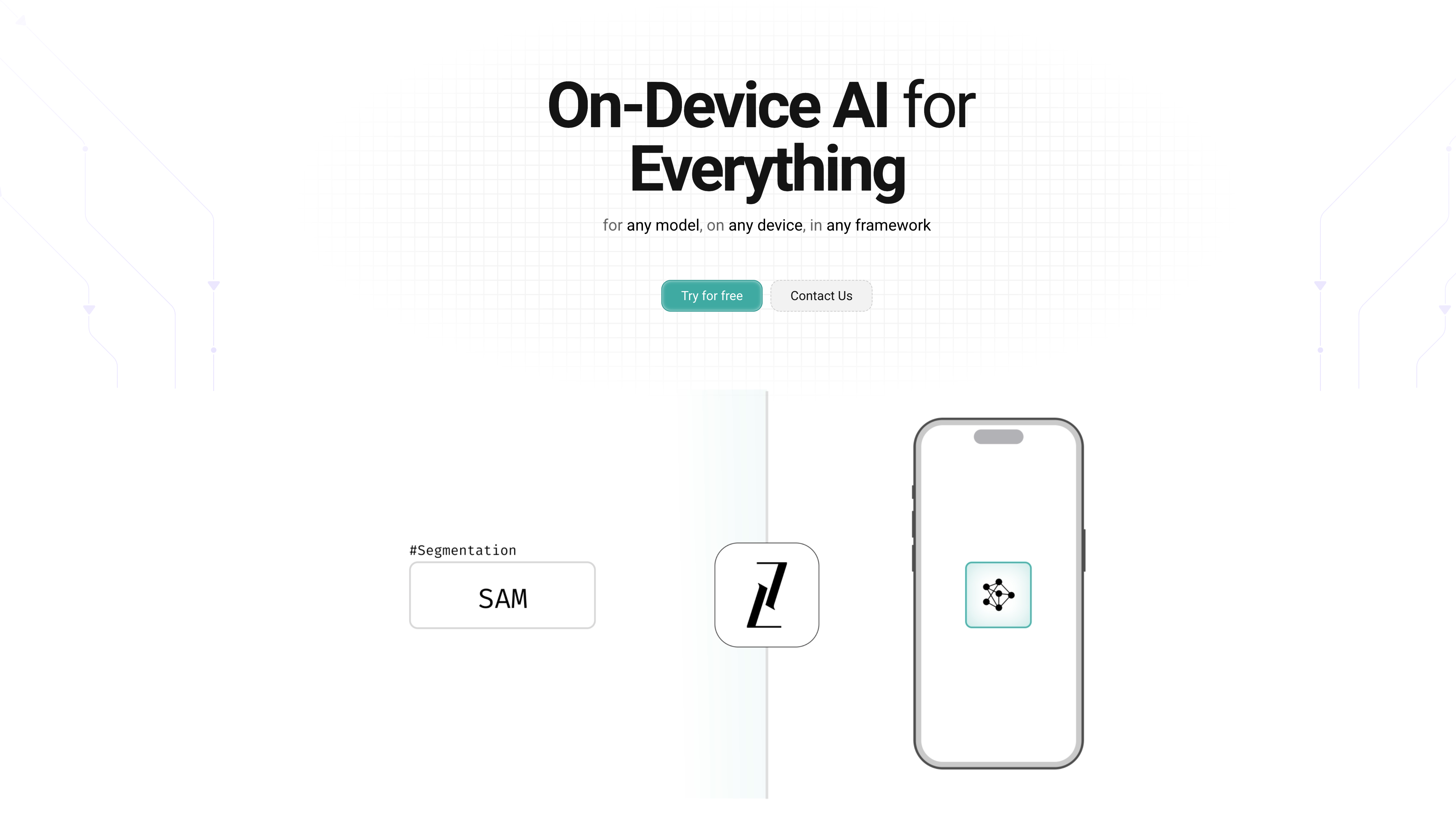
ZETIC | On-Device AI for Everything - for any model, on any device, in any framework
Built by ex-Qualcomm AI Engineer. Automate on-device AI deployment with full NPU optimization. Benchmark on 100+ physical devices and ship in hours with just 3 lines of code.
Reproducible Execution Environment (REE) | Tech | Gensyn
Run AI model inference in a machine-agnostic environment where the same model and inputs produce the same outputs across supported hardware.

Introduction - How to Write an Inference Engine
A zero-to-hero guide to Muse Glimmer on Apple Metal, kvpack, and disaggregated NVFP4 prefill.

Gemma 4: Byte for byte, the most capable open models
Gemma 4: our most intelligent open models to date, purpose-built for advanced reasoning and agentic workflows.


Gemma 3n model overview | Google AI for Developers
Gemma 3n is a generative AI model optimized for use in everyday devices, such as phones, laptops, and tablets. This model includes innovations in parameter-efficient processing, including Per-Layer Embedding (PLE) parameter caching and a MatFormer model architecture that provides the flexibility to reduce compute and memory requirements. These models feature audio input handling, as well as text and visual data.