


The following is an excerpt from Volume One of Fanfare for the Future, titled Occupy Theory and authored by Michael Albert of the U.S. and Mandisi Majavu
Oakland, the Last Refuge of Radical America (Published 2012)
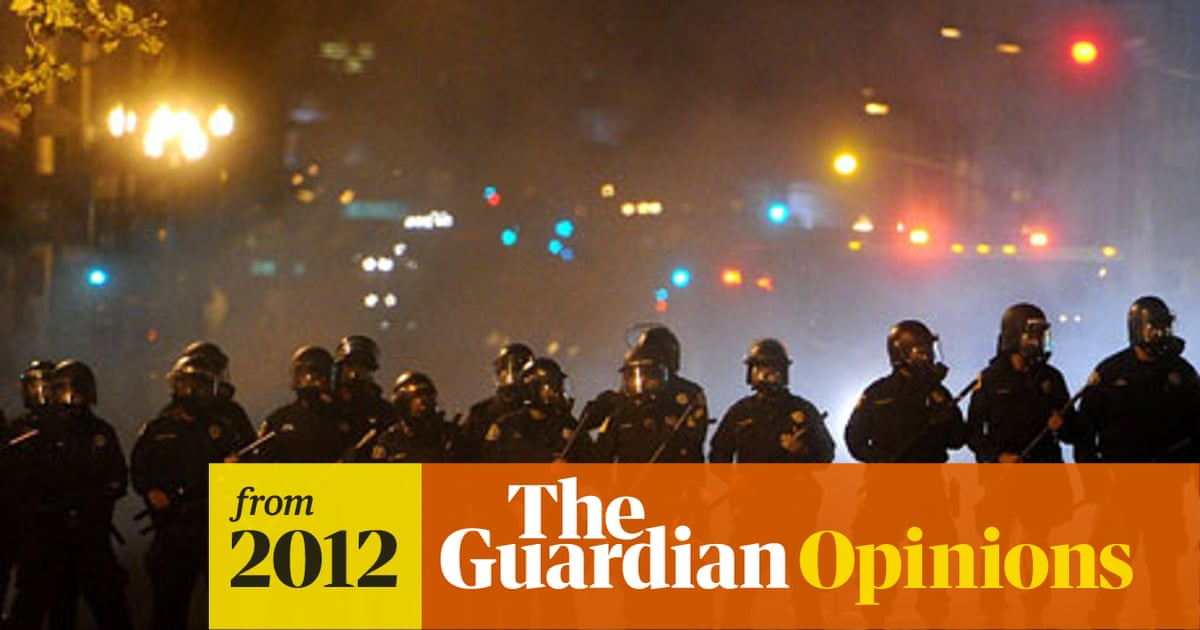
The Occupy movement is still wreaking havoc in Oakland, the world capital of anticapitalism.

The Ecology of Freedom: The Emergence and Dissolution o…
"The very notion of the domination of nature by man ste…

Computational Public Space
Chapters — Intro, Communal computing, This presentation, Physicality — Globalization, Centrally-planned, Isolating, Private property, Surveillance, Consumption, Hidden — Summary, Outline
When Riot Cops Are Not Enough
In When Riot Cops Are Not Enough, sociologist Mike King examines the policing, and broader political repression, of the Occupy Oakland movement. King’s active and daily participation in that movement provides a unique insider perspective to illustrate how the Oakland police and city administrators lost the ability to effectively control the movement.

"Collective Power: Patterns for a Self-Organized Future by Ted J. Rau" [english edition] (ebook) - Sociocracy For All
by Ted Rau Preorder Ebook

Revealed: how the FBI coordinated the crackdown on Occupy | Naomi Wolf
Naomi Wolf: New documents prove what was once dismissed as paranoid fantasy: totally integrated corporate-state repression of dissent
Imperialism | The Paper Pilot
The Paper Pilot's digital garden of thoughts on philosophy, politics, and sociology
David Ellerman: Neo-Abolitionism: Towards Abolishing the Institution of Renting Persons/Wage Slavery
The Pre-emption of Resistance: Occupy Oakland and the Evolution of State Power
Author(s): Behbehanian, Laleh | Advisor(s): Burawoy, Michael B | Abstract: This dissertation aims to contribute to our understanding of contemporary state strategies targeting social movements by examining the case of Occupy Oakland. Emphasizing how state strategies, both tactical and discursive, dynamically evolve through their iterative relation to movement strategies, it presents a detailed empirical account that is disaggregated into three “moments”, each of which are characterized by the predominance of a distinct state strategic repertoire. The objective is to highlight an underlying transformation through which the state’s strategies evolve from being highly reactive, indiscriminate and vulnerable to spectacularization to becoming increasingly pre-emptive, targeted and discursively buttressed.The first “moment” commences with the movement’s occupation of Oscar Grant Plaza. Faced with Occupy Oakland’s highly disruptive tactics and its firm rejection of any forms of negotiation or cooperation with City officials, the state resorts to a strategy of Naked Coercion (reactive, indiscriminate violence that is highly vulnerable to spectacularization) which backfires and results in an internationally televised disaster on the evening of October 25th. This creates an extraordinary window of opportunity for the movement, dramatically increasing public support and enabling it to undertake the first general strike in the U.S. since 1946. This fuels a process of adaptation as the struggle proceeds into the second “moment”, and the state shifts to a strategy of Targeted Repression that is increasingly pro-active, targeted and discursively buttressed so as to diminish the danger of its spectacularization. The new strategy succeeds in permanently dislodging the occupation of Oscar Grant Plaza, as well as criminalizing the tactic of occupation and excising it from movement’s repertoire. Still unsatisfied with the repression it had achieved, in the third and final “moment” the state introduces a strategy of Pre-emptive Neutralization that is pre-emptively oriented, targeted at high “risk” populations and discursively buttressed by powerful spectacles of “risk”. This enables a thorough incapacitation of the movement – fully neutralizing its potential for collective action by rendering Occupiers a target population that could no longer even publicly assemble without inciting highly militarized police responses that were now pre-emptively justified by the risk of “violence” they collectively posed.

Who Rules Oakland? : Indybay
The Oakland Chamber of Commerce and other business lobbies in the East Bay have recently pressured government officials to crack down on Occupy Oakland. Furthermore, they have popularized a narrative portraying Occupy as "harmful to local business." We critically examine ruling class networks of shared ownership, governance, and political advocacy impacting communities in Oakland by revealing links between the directors and executives of major corporations that are members in the Oakland Chamber of Commerce. In subsequent parts to this series we will provide more detailed information about the directors and executives of these companies, and provide an analysis of their social cohesion, profit-driven collusion, and political influence. More broadly, we will explore networks and institutions of economic and political power in the Bay Area.

Capitalist Realism and the Eviction of Culture: Notes from Ljubljana
I’d like to thank everyone who came out to Nova pošta last Thursday evening to my lecture on Mark Fisher’s Capitalist Realism, recently translated into Slovenian by Pika Golob and Nina …

Governable Spaces: Democratic Design for Online Life – Writings and rehearsals by Nathan Schneider
Read the free, open access editionBuy: Amazon, Bookshop, Narrow Gauge Book Co-op, UC Press
On liberty
Introductory -- Of the liberty of thought and discussion -- Of individuality, as one of the elements of well-being -- Of the limits to the authority of society over the individual -- Applications; Book, leather; Explanatory note by H.E. Barker attached; 18

Decentralization enables permissionless innovation
I’ve just started reading Inventing the Internet by Janet Abbate. The opening chapters are great, narrating Paul Baran’s efforts at RAND to design a nationwide communication network. Baran had one design goal for this network—survivability. Specifically, survivability in the face of nuclear catastrophe.

The Missing Institution: A Global Dividend System for the Age of Transformative AI — Digitalist Papers
How do we share prosperity in society if work no longer sits at the center of people’s lives? In this essay, Anna Yelizarova explores one provocative possibility: a “global dividend.” If transformative AI shows little respect for national borders, with effects that spill across countries, then we ne

How the Elite rigged Society (and why it’s falling apart) | David Brooks