In the current era of information abundance, transforming vast amounts of unstructured data into structured, machine-readable knowledge remains one of the most significant challenges in artificial intelligence. Knowledge Graphs (KGs) have emerged as the cornerstone technology for this transformation Zhao et al. (2024), providing the semantic backbone for applications ranging from search engines and question answering Wu et al. (2024); Chen et al. (2024c); Zong et al. (2024); Sun et al. (2024b) to recommendation systems Lyu et al. (2024) and complex reasoning tasks Li et al. (2024b). Yet despite their critical importance, current KG construction approaches remain hampered by an inherent paradox: they require predefined schemas created by domain experts, which fundamentally limits their scalability, adaptability, and domain coverage.
Knowledge Graphs
In this article, we provide a comprehensive introduction to knowledge graphs, which have recently garnered significant attention from both industry and academia in scenarios that require exploiting diverse, dynamic, large-scale collections of data. After some opening remarks, we motivate and contrast various graph-based data models, as well as languages used to query and validate knowledge graphs. We explain how knowledge can be represented and extracted using a combination of deductive and inductive techniques. We conclude with high-level future research directions for knowledge graphs.
KARMA: Leveraging Multi-Agent LLMs for Automated Knowledge Graph Enrichment
Maintaining comprehensive and up-to-date knowledge graphs (KGs) is critical for modern AI systems, but manual curation struggles to scale with the rapid growth of scientific literature. This paper presents KARMA, a novel framework employing multi-agent large language models (LLMs) to automate KG enrichment through structured analysis of unstructured text. Our approach employs nine collaborative agents, spanning entity discovery, relation extraction, schema alignment, and conflict resolution that iteratively parse documents, verify extracted knowledge, and integrate it into existing graph structures while adhering to domain-specific schema. Experiments on 1,200 PubMed articles from three different domains demonstrate the effectiveness of KARMA in knowledge graph enrichment, with the identification of up to 38,230 new entities while achieving 83.1% LLM-verified correctness and reducing conflict edges by 18.6% through multi-layer assessments.
Introducing the Knowledge Graph: things, not strings
We hope this will give you a more complete picture of your interest, provide smarter search results, and pique your curiosity.

Chive's knowledge graph - Chive
How Chive's community-governed knowledge graph replaces hardcoded categories with a portable, extensible vocabulary.
Orrery, a Knowledge Graph That Adapts to Its Corpus
Orrery is our open-source knowledge graph that gets deeper as you feed it: domains that hit critical mass earn their own custom extraction specs, agents get an API, and humans get a galaxy. The whole …

WikiKV: Schema-Evolving Path-Indexed Storage for Hierarchical Knowledge Navigation
LLM-curated hierarchical knowledge bases, namely a tree-structured wiki whose nodes summarize an underlying corpus, have become a dominant substrate for retrieval-augmented applications, yet their storage layer is still treated as an implementation detail. This workload is hierarchical, query-intensive, and continuously evolving, and no existing storage model natively captures all three properties at once. We present WikiKV, a path-indexed key-value storage model purpose-built for this workload, comprising three components: (i) a data-driven schema that bootstraps the hierarchy via Intent-Anchored Schema Induction and refines it through Continuous Evolution Operators; (ii) a consistency protocol for the path-indexed storage model that precludes partial-read observations under concurrent offline rewrites without read-path locking; and (iii) a budgeted navigation operator whose search-accelerated routing reduces the expected number of LLM-assisted descent steps from d to O(1) while preserving anytime semantics with progressively refined answers. We evaluate WikiKV through real-world deployment for the WeChat Official Account AI Assistant and benchmark it against diverse baselines on the AuthTrace dataset, where it achieves balanced low per-operator latency across four query operators against relational, graph, and FS backends, and reaches 63.2% end-to-end answer correctness, exceeding multiple RAG baselines, with the gap widening on low- and high-fan-in multi-document questions. Ablation study further confirms the effectiveness of WikiKV's components.

Zep: A Temporal Knowledge Graph Architecture for Agent Memory
We introduce Zep, a novel memory layer service for AI agents that outperforms the current state-of-the-art system, MemGPT, in the Deep Memory Retrieval (DMR) benchmark. Additionally, Zep excels in more comprehensive and challenging evaluations than DMR that better reflect real-world enterprise use cases. While existing retrieval-augmented generation (RAG) frameworks for large language model (LLM)-based agents are limited to static document retrieval, enterprise applications demand dynamic knowledge integration from diverse sources including ongoing conversations and business data. Zep addresses this fundamental limitation through its core component Graphiti—a temporally-aware knowledge graph engine that dynamically synthesizes both unstructured conversational data and structured business data while maintaining historical relationships. In the DMR benchmark, which the MemGPT team established as their primary evaluation metric, Zep demonstrates superior performance (94.8% vs 93.4%). Beyond DMR, Zep’s capabilities are further validated through the more challenging LongMemEval benchmark, which better reflects enterprise use cases through complex temporal reasoning tasks. In this evaluation, Zep achieves substantial results with accuracy improvements of up to 18.5% while simultaneously reducing response latency by 90% compared to baseline implementations. These results are particularly pronounced in enterprise-critical tasks such as cross-session information synthesis and long-term context maintenance, demonstrating Zep’s effectiveness for deployment in real-world applications.
MainPage8
The InfoCentral project has historically been focused more heavily upon the symbolic (human-meaningful) side of AI. This included derivatives of Semantic Web and related knowledge representation research, which were dependent on human effort to curate and categorize structured data. The symbolic approach to AI has largely lost the race to the neuro/neuro-symbolic (opaque vectors, statistical) side of AI research, notably the success of the Large Language Model (LLM) paradigm. Due to its faculties with natural language, remarkably little human involvement is needed to infer structure and meaning from traditional (mostly unstructured) information. As such, some of the approaches previously explored in the InfoCentral project have lost relevance. That said, LLM-based tools can perhaps help us finish the symbolic side of the grand AI project, by doing the tedious work that humans were reluctant to do! It has long been theorized that a combination of approaches will ultimately provide the most robust and performant systems, able to work with messy transient unstructured information while also building networks of verifiable persistent structured information that both humans and machines can cross-verify. This may prove useful in both ensuring that future AI systems remain aligned to human goals and values and that inevitable abuses and failures can be easily recovered from. To that end, some research results of this project may be re-usable in a new context.
Higher-Order Knowledge Representations for Agentic Scientific Reasoning
Scientific inquiry requires systems-level reasoning that integrates heterogeneous experimental data, cross-domain knowledge, and mechanistic evidence into coherent explanations. While Large Language Models (LLMs) offer inferential capabilities, they often depend on retrieval-augmented contexts that lack structural depth. Traditional Knowledge Graphs (KGs) attempt to bridge this gap, yet their pairwise constraints fail to capture the irreducible higher-order interactions that govern emergent physical behavior. To address this, we introduce a methodology for constructing hypergraph-based knowledge representations that faithfully encode multi-entity relationships. Applied to a corpus of ≈\approx 1,100 manuscripts on biocomposite scaffolds, our framework constructs a global hypergraph of 161,172 nodes and 320,201 hyperedges, revealing a scale-free topology (power law exponent ≈\approx 1.23) organized around highly connected conceptual hubs. This representation prevents the combinatorial explosion typical of pairwise expansions and explicitly preserves the co-occurrence context of scientific formulations. We further demonstrate that equipping agentic systems with hypergraph traversal tools, specifically using node-intersection constraints, enables them to bridge semantically distant concepts. By exploiting these higher-order pathways, the system successfully generates grounded mechanistic hypotheses for novel composite materials, such as linking cerium oxide to PCL scaffolds via chitosan intermediates. This work establishes a “teacherless” agentic reasoning system where hypergraph topology acts as a verifiable guardrail, accelerating scientific discovery by uncovering relationships obscured by traditional graph methods.
Triple Pattern Fragments: a Low-cost Knowledge Graph Interface for the Web
Does this article spark your interest? Then we should work together!
Why LLM Wiki? 🧠 Future Of Knowledge For Agentic AI & Humans
Santiago on Twitter / X
Knowledge graphs for representing information are unbeatable.After this, you will never build a RAG system without knowledge graphs.It will take you five lines of code to build a knowledge graph with your data.I recorded a video to show you how you can do this.I used… pic.twitter.com/1jQ6Gejczq— Santiago (@svpino) September 26, 2025

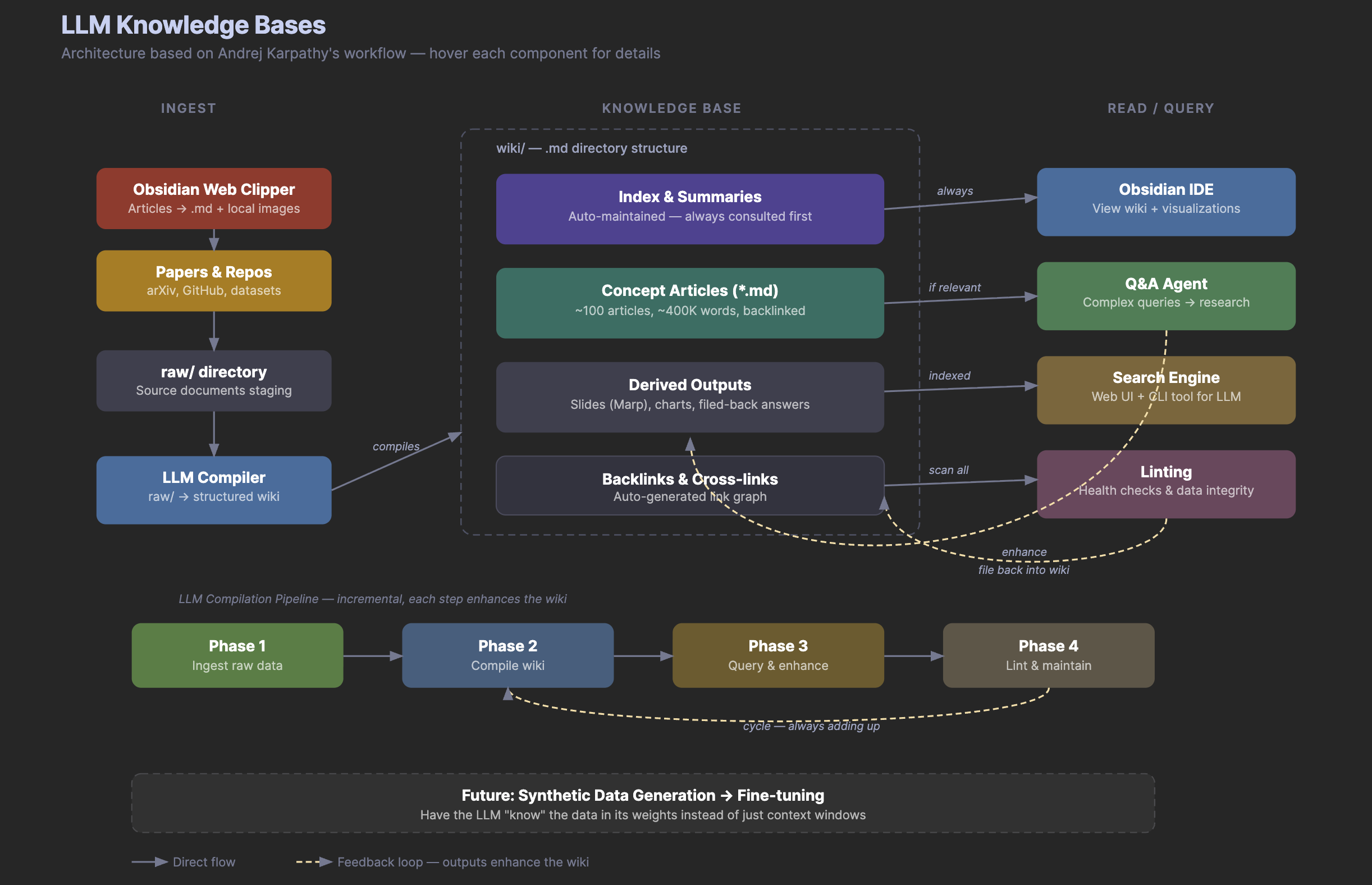
LLM Knowledge Bases
A visual breakdown of Andrej Karpathy's approach to building personal knowledge bases powered by LLMs. Learn the 4-phase pipeline: ingest, compile, query, and maintain - with an interactive architecture diagram.
DevReal: Simple Knowledge Graphs with Outlines, neo4j, and Modal, Cameron Pfiffer
Wikimedia, the commons, and the new AI knowledge loop. – Open Future
This paper examines the ongoing structural transformation of the knowledge ecosystem and proposes a new approach for Wikimedia to prevent it from becoming a