

So far, many of the projects in the ATProtocol ecosystem have focused on bringing parity—making projects that replicate our existing tools and platforms, but with the affordances of the protocol instead. That's cool and we need to do that, but I think we can go much farther, and take this opportunity to challenge some of the biggest assumptions of what the modern internet is for, who builds it, and how we interact with it. This talk is in conversation with several of the talks from last year, and in I'll argue that we'll never get away from skeuomorphism until we've fundamentally changed the definition of what "the social internet" means in the first place.
Why I'm betting on ATProto (and why you should, too)
Social media was supposed to connect us, but most of it has turned into ads, division, and loneliness. I'm betting on ATProto as a way to fix that, and not just for developers. Whether you're a scientist, journalist, or just someone who wants the internet to feel human again, I think ATProto matters for you too.
ATProto ideas
If AT Protocol becomes “a meaningful layer of the web” — even if it’s only tens of millions of users — then the winning ideas probably won’t only be futuristic...
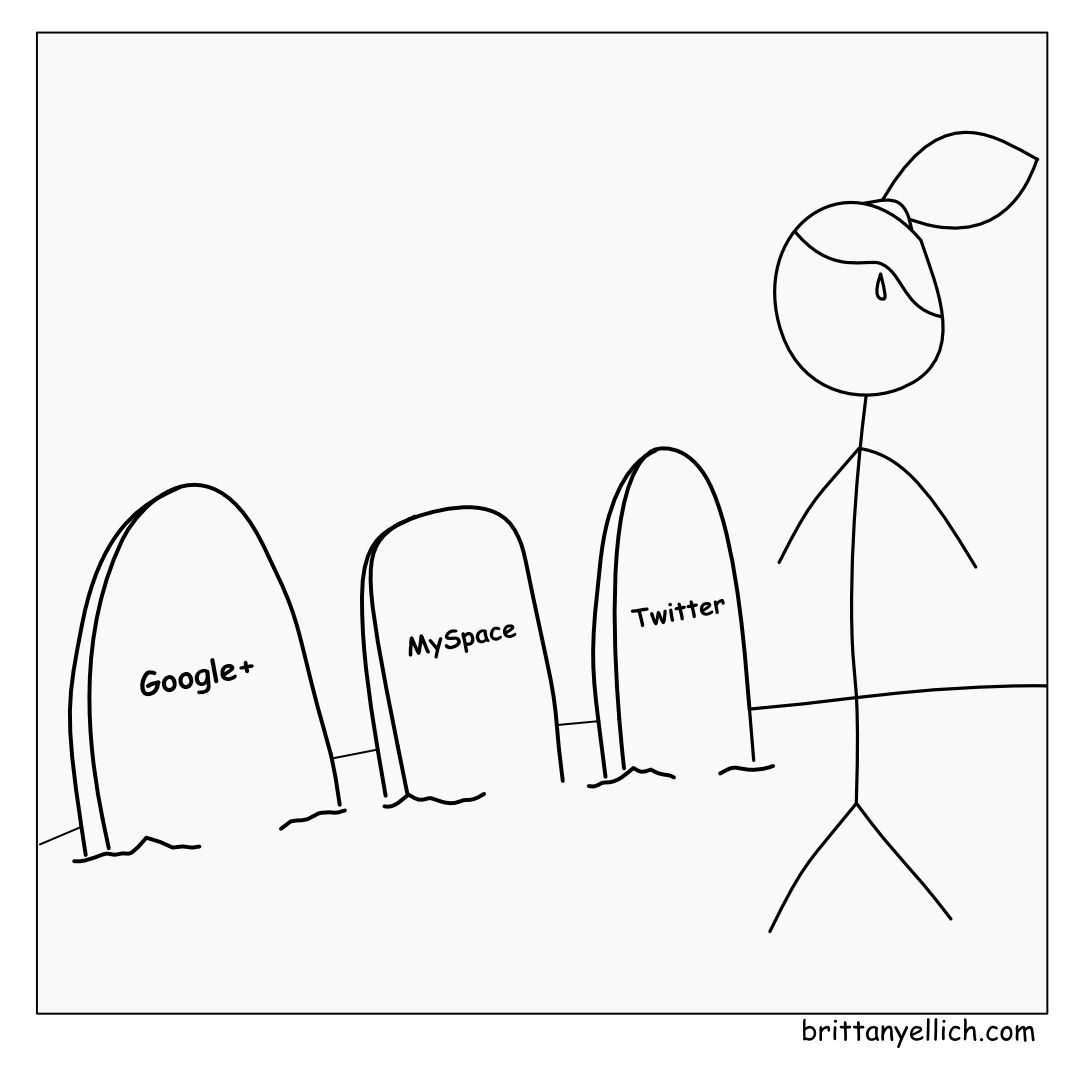
Why I'm betting on ATProto (and why you should, too) — Brittany Ellich
Social media was supposed to connect us, but most of it has turned into ads, division, and loneliness. I'm betting on ATProto as a way to fix that, and not just for developers. Whether you're a scientist, journalist, or just someone who wants the internet to feel human again, I think ATProto matters for you too.

Where Does Community Live?
ActivityPub and ATProto both promise to rebuild social life online, but they answer the question of where community actually forms in fundamentally different ways. Protocol design is institutional design, and right now those institutions are being built.

Social Media Is Now Parasocial Media
When practitioners used the term “social media” to describe the internet tools that emerged in the mid-aughts, they were giving a name to the kinds of platforms and protocols that allowed people to socialize with friends and communities of interest by using digital technologies. Twenty years later, users of social media are far more likely to scroll than post – and the content that they consume is often strategically produced and algorithmically curated. In this essay, I argue that the very essence of social media has changed. To more effectively interrogate what we are witnessing, we need to stop presuming that these tools are “social media” and begin recognizing that they are now “parasocial media.” Doing so raises new questions about digitally mediated sociality, not to mention the politics and governance of these platforms.

The Internet Transition
The Internet is allowing us to build a richer, more complex society but the way in which we Internet today is failing to support the governance systems that a more complex world requires. I take a look at why these issues are related, try to develop an intuition for a way forward, and point at the emerging field that is coming together to build that future.

The Internet Transition
The Internet is allowing us to build a richer, more complex society but the way in which we Internet today is failing to support the governance systems that a more complex world requires. I take a look at why these issues are related, try to develop an intuition for a way forward, and point at the emerging field that is coming together to build that future.
The one and future internet
The internet has become inextricably entangled into our economies, cultural and social lives. We stand on the brink of the next technological revolution, in which the internet of things transforms ...

bnewbold.net
Bluesky released early documentation for the "AT Protocol" (atproto) a few weeks ago, and I've been noodling around with it. Technically, it strikes an appealing balance between rigid cryptographically signed content-addressable storage on the one hand, and familiar web-friendly schemas and integrations on the other. But at an ecosystem level, there are already a bunch of existing open social media projects. Does atproto bring anything interesting to the table? How might it fit in compared to other similar protocols?
Collective knowledge foraging in trail-based social networks beyond feeds
Sharing insights about moving beyond feeds from building Semble, a community knowledge garden built on the AT Protocol. The World Wide Web is called a web for good reason. We navigate this web of interconnected websites by clicking hyperlinks and opening new tabs in tools called browsers. This kind of browsing experience is defined by its open-endedness and interwoveness; every website we visit becomes a step along a path. With the rise of social media, we lost touch with this vast trail network. Rather than creating a social web where our trails got woven onto a shared map, they were instead paved over by information superhighways: the algorithmic feeds. Hyper-scaled social media platforms reduced the vast web of interconnected pages into a stripped down ad-ridden and attention-extracting monoculture. Our online experiences became reduced to the flick of a finger, the doom scroll. With the rise of open social protocols, like ATProto, we have an opportunity to leave these misaligned profit-driven and ad-based feeds behind and rediscover the magic of shared knowledge trails. what might that look like? In this lightning talk I’ll share insights and lessons my team and I have learned from building [Semble](https://semble.so/), a community knowledge garden built on ATProto. Semble is an open social network based on knowledge trails rather than feeds. I’ll explore what trail-based social networks of the future could look like, grounded in features and use-cases we’ve uncovered while building Semble. In the transition from feeds back to trails, we aim to co-create an open social web that centres the value of human attention and sparks a new era of collective wisdom. This lightning talk is an invitation to co-create this future together. It will similar to a prior [lightning talk](https://www.youtube.com/watch?v=ptOMKK1lC4Q) we gave at ATmosphereConf 2026, adapted for DWeb Camp. Recorded at DWeb Camp 2026, Open Social Space, 2026-07-10. Schedule entry: https://talx.dod.ngo/dwebcamp-2026/talk/TA3NY7/
I am very excited about AT Protocol
AT Protocol (atproto) is the right mix of useful, practical, personal, and fun. I think it could save the internet.

Some of us in the ActivityPub world feel jealous of AtProto’s success (like me). But more decentralization is a win for everyone. With Bridgy from @anew.social connecting protocols, this isn’t competition, it’s momentum. We’re stronger together, so let’s build the social web humanity deserves 🚀
The web was always social Diving into the idea of bridging different social networks and protocols like ATproto and ActivityPub to enhance the web. Looking back at my personal web journey, from Web 2.0 to now, emphasizing that building connections... herve.bzh/the-web-was-always-social/
The web was always social
herve.bzhI'm building on atproto because I think that a single social network has essentially no shot of dethroning the current tech monopolies. But an open ecosystem of interoperating apps is so infinitely more interesting than legacy social that it seems almost inevitable it will win

Ronen Tamari
Can everyone building on atproto please answer this question? 😇
being utopian about the web is very 90s but this is like everything people dreamed the web would be. I need to read more about atproto asap overreacted.io/open-social/

Cosmik Network
Semble alpha is now open! ✨ Check it out at semble.so More details in our leaflet pub! (link in next post > )
How is the emerging post-platforms internet like the early days of blogging? @gruber.foo sat down with @jimray.bsky.team to go long on this question, with a few other digressions along the way. atproto.com/off-protocol/2026-09-11-make-…

Make Your Own Thing - AT Protocol
atproto.com


