

Juliet Shen from ROOST joins the show to talk through the Coop 1.0 release, what open-source trust and safety unlocks for new builders, and where AI actually belongs in moderation
AI Slopageddon and the OSS Maintainers
AI slop is ripping up the social contract between maintainers and contributors essential to open source development. Practitioners have been repeatedly assured that AI would supercharge their communities, but so far that hasn’t been the case. Just look at what happened last month. Mitchell Hashimoto’s Ghostty implemented a zero-tolerance policy where submitting bad AI-generated code

Zen and the Art of Open Source Maintenance | Fabricated Technobloggle | Daryl Ducharme | Offprint
AI promises frictionless creation, but real software is maintenance—greasy hands, patience, and stripped screws. As panic over synthetic slop rises, how do we protect the open commons without locking the door against the next generation of self-taught builders?
✨🙌 AI that helps communities thrive on their own terms
Open protocols + AI-enabled coding = building what we need for ourselves
✨🙌 AI that helps communities thrive on their own terms
Open protocols + AI-enabled coding = building what we need for ourselves
mp | Coding Alone
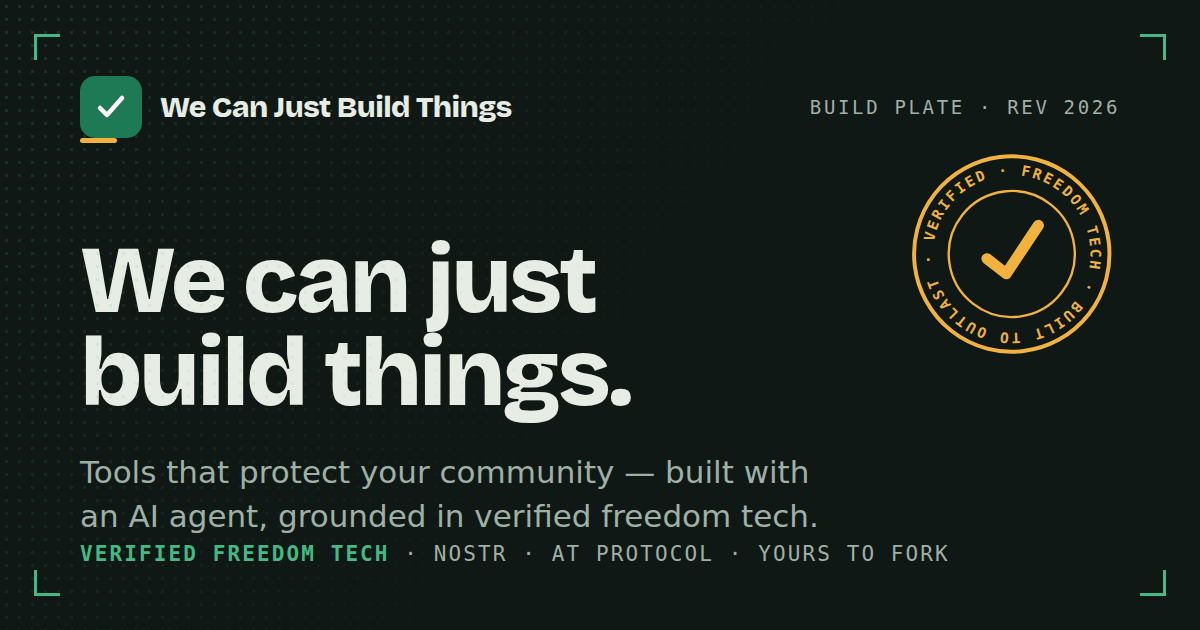
In which I show how, over the last few years, the world has rapidly moved from open-source software being produced and maintained by online communities, to software projects being built and maintained in isolation. By single developers, with ever-decreasing input from others. AI coding tools are now dramatically accelerating movement away from code as a collective endeavour to "coding alone". I conclude by describing how such progression need not be considered inevitable. Every step has reflected the collective influence of countless individual human decisions. The fate of open-source software communities is still determined by us.
We Can Just Build Things
Build the tools your community needs — production-grade, privacy-respecting freedom tech, made with an AI agent and grounded in a verified, values-aligned catalog (Nostr, AT Protocol, and beyond).
Introducing the Agent Governance Toolkit: Open-source runtime security for AI agents | Microsoft Open Source Blog
Discover how the Microsoft Agent Governance Toolkit brings policy, identity, and reliability to autonomous AI agent systems.
AI Contribution Policies
Ready-to-use AI contribution policies for open source projects.
Reframing “Open Source AI” with Meredith Whittaker: AI Impact Summit 2026
“Wait, not like that”: Free and open access in the age of generative AI
The real threat isn’t AI using open knowledge — it’s AI companies killing the projects that make knowledge free

Mozilla’s Inaugural ‘State of Open Source AI’ Report Is Here | The Mozilla Blog
Open source AI has crossed a threshold. For years the debate has centered around whether open models could ever compete with closed ones. This is no longer
Measuring the Impact of Early-2025 AI on Experienced Open-Source...
Despite widespread adoption, the impact of AI tools on software development in the wild remains understudied. We conduct a randomized controlled trial (RCT) to understand how AI tools at the...

Alex Komoroske (Common Tools)
AI creates asymmetric pressure on Open Source
How Open Source communities can adapt to AI-generated contributions without overwhelming Open Source maintainers

"AI makes it cheaper to contribute to Open Source, but it's not making life easier for maintainers. More contributions are flowing in, but the burden of evaluating them still falls on the same small group of people. That asymmetric pressure risks breaking maintainers." also relevant to slop science
