

Human knowing in perspectival encyclopedicity
Knowledge doesn't just accumulate. It develops between people. - Marginalia
Announcing Assemblage, the visual builder for Semble.so collections
Knowledge representation and reasoning
xxix, 381 p. : 24 cm; Includes bibliographical references (p. 349-375) and index

Introducing the Knowledge Graph: things, not strings
We hope this will give you a more complete picture of your interest, provide smarter search results, and pique your curiosity.

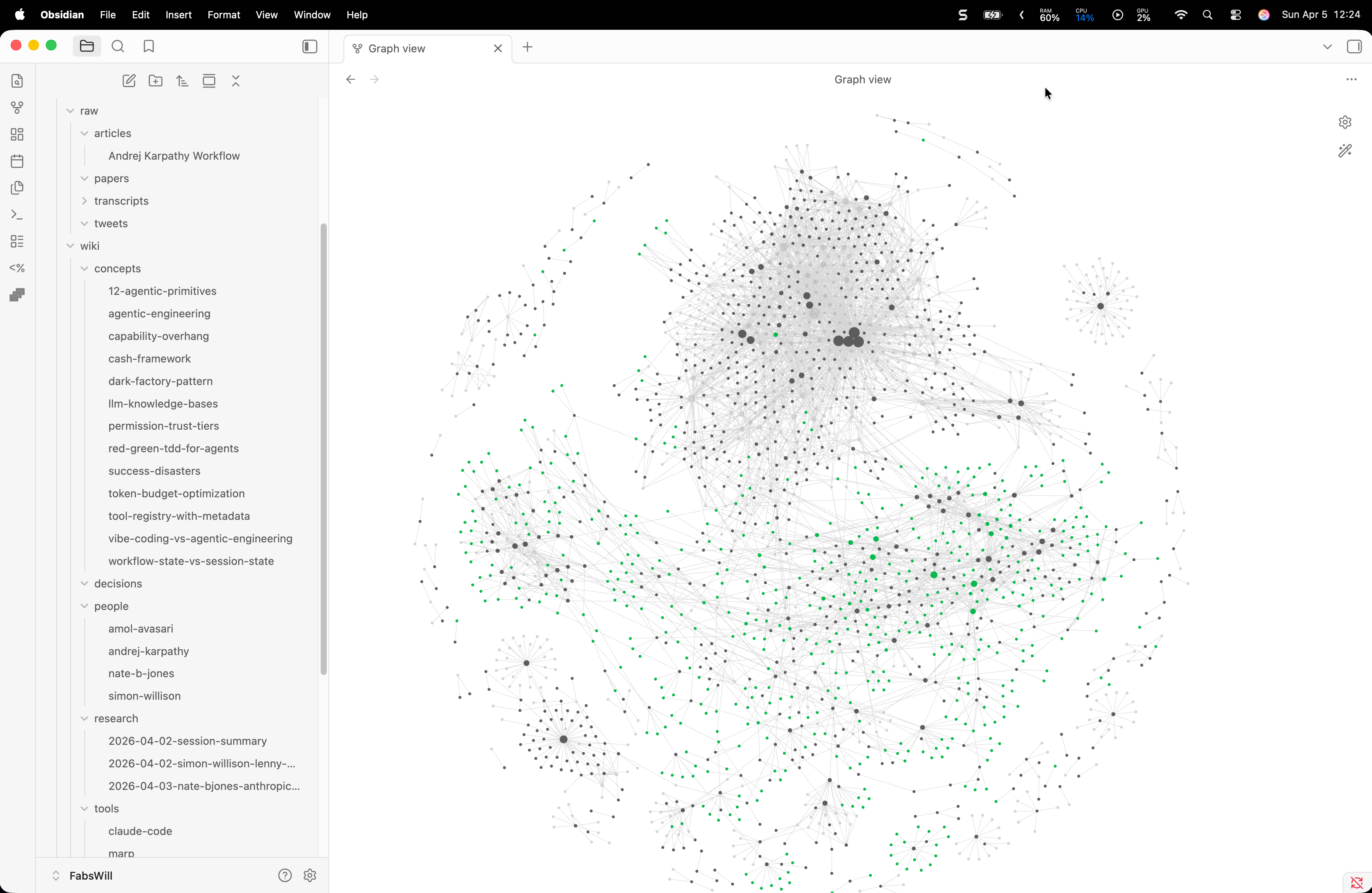
I Built a Knowledge Base That Writes Itself. Here Is What Andrej Karpathy Got Right.
Andrej Karpathy posted about using LLMs to build personal knowledge bases. I took his workflow, wired it into my Obsidian vault with Claude Code, and within an hour had 21 cross-linked wiki articles compiled from YouTube transcripts. Here is how it works and why it matters.
Ontology-Driven Observability: Building an End-to-End Knowledge Graph at Netflix Scale
Prasanna Vijayanathan, Renzo Sanchez-Silva

Centipedia — The Agentic Encyclopedia
Knowledge synthesized by AI agents from human-curated citations on the AT Protocol.
Searching for explanations: How the Internet inflates estimates of internal knowledge.
Wikimedia, the commons, and the new AI knowledge loop. – Open Future
This paper examines the ongoing structural transformation of the knowledge ecosystem and proposes a new approach for Wikimedia to prevent it from becoming a
Santiago on Twitter / X
Knowledge graphs for representing information are unbeatable.After this, you will never build a RAG system without knowledge graphs.It will take you five lines of code to build a knowledge graph with your data.I recorded a video to show you how you can do this.I used… pic.twitter.com/1jQ6Gejczq— Santiago (@svpino) September 26, 2025

Halupedia: An AI-Generated Wikipedia-Style Encyclopedia of Fabricated Knowledge and Absurd AI Fabulation - BizTech Weekly
Analysis of Halupedia’s AI-driven on-demand encyclopedia model reveals real-time, non-persistent article generation that simulates authoritative references through fabricated citations and internal “canon” consistency, highlighting challenges in provenance, hallucination, moderation, and the evolving trade-offs between novelty-driven engagement and information integrity in generative AI systems.
AutoSchemaKG: Autonomous Knowledge Graph Construction through Dynamic Schema Induction from Web-Scale Corpora
In the current era of information abundance, transforming vast amounts of unstructured data into structured, machine-readable knowledge remains one of the most significant challenges in artificial intelligence. Knowledge Graphs (KGs) have emerged as the cornerstone technology for this transformation Zhao et al. (2024), providing the semantic backbone for applications ranging from search engines and question answering Wu et al. (2024); Chen et al. (2024c); Zong et al. (2024); Sun et al. (2024b) to recommendation systems Lyu et al. (2024) and complex reasoning tasks Li et al. (2024b). Yet despite their critical importance, current KG construction approaches remain hampered by an inherent paradox: they require predefined schemas created by domain experts, which fundamentally limits their scalability, adaptability, and domain coverage.
Chive's knowledge graph - Chive
How Chive's community-governed knowledge graph replaces hardcoded categories with a portable, extensible vocabulary.
Orrery, a Knowledge Graph That Adapts to Its Corpus
Orrery is our open-source knowledge graph that gets deeper as you feed it: domains that hit critical mass earn their own custom extraction specs, agents get an API, and humans get a galaxy. The whole …

Transforming Wikipedia into an accurate cultural knowledge quiz
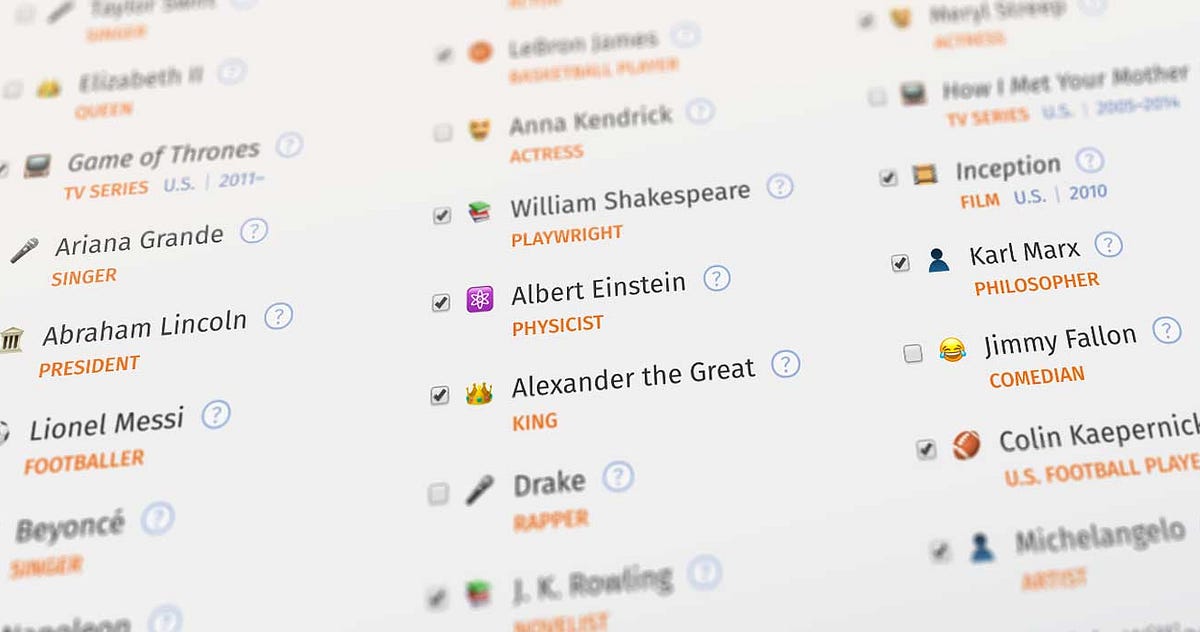
Building “Test Your Culture” by taking the world’s largest encyclopedia… and combining it with data science
this is what I am *TALKING* about. I'm sure I'm late but this is such a cool idea from @semble.so. Collections are not new but mapping the specific kind of relationship between two things?? And this is publicly usable shared knowledge? Social knowledge as a service, beautiful.

taurean
to be fair we are also getting that from projects, I am just greedy and want to see even more. For example with @germnetwork.com, E2EE messaging is not new but multiple sub-identities in one inbox is. Show us something weird and new if/when you adopt an existing experience but for atproto.
Ever thought we acquire generalizable knowledge by discarding details and compressing our experiences? In a new BBS paper, @sabinasloman.bsky.social and I argue otherwise, proposing a novel way of studying human learning inspired by double descent in ML. Disagree? Propose a commentary by May 15 :)
