


Post-publication peer review (PPPR) is transforming how the life sciences community evaluates published manuscripts and data. Unsurprisingly, however, PPPR is experiencing growing pains, and some elements of the process distinct from standard pre-publication review remain controversial. I discuss the rapid evolution of PPPR, its impact, and the challenges associated with it.
Peer Review at the Crossroads
Peer review has long been regarded as a cornerstone of scholarly communication, ensuring high quality and credibility of published research. Although academic journals trace their origins back three centuries, the procedures for evaluating submissions, particularly peer review, have undergone continuous evolvement. Peer review’s formal institutionalization in the mid-20th century represents a significant, yet natural, phase in this ongoing transformation of scholarly communication. By the early 21st century, there emerged an opinion that the conventional model of peer review faces systematic challenges, including inefficiency, bias, and institutional inertia. The study aims to synthesize the evolution, practices, and outcomes of both conventional and innovative peer review models in scholarly publishing. Through a mixed-methods approach combining interpretative literature review and process modeling (Business Process Model and Notation –BPMN), it identifies four frameworks: pre-publication peer review, registered reports, modular publishing, and the Publish-Review-Curate (PRC) model. While the PRC model, which integrates preprints with post-publication review, demonstrates advantages in transparency and accessibility, no single approach emerges as universally ideal. The choice of model depends on disciplinary context, resource availability, and institutional priorities. The analysis underscores the need for adaptable platforms that enable hybrid workflows, balancing rigor with inclusivity. Future research must address empirical gaps in evaluating these innovations, particularly their long-term impact on equity and epistemic norms.
Guest Post - Do we need (r)evolution in peer review? - The Scholarly Kitchen
Whether peer review needs revolution or evolution may be the wrong question. The more pressing one is whether the academic community is prepared to let scientific ideas be published, contested, and refined in public, rather than behind closed doors.

A New Paradigm for Scientific Publishing, Peer Review, and Impact Assessment
Scientific publishing and peer review have evolved little in three centuries, while the demands placed on them have grown profoundly. The growing role of artificial intelligence has underscored deep, systemic shortcomings of an aging system that has largely evaded innovation, a system whose origins are appallingly closer to the invention of the printing press than to the internet. We can do better – much better. This article is intended as the beginning of a communal experiment: a living document that critically reviews the modern academic publishing and peer-review system and presents a concrete framework to address what bibliometrics experts¹ have characterized as "the pervasive misapplication of indicators to the evaluation of scientific performance". Building on the Leiden Manifesto, DORA, and a body of scholarship spanning many disciplines and decades, we present a community-governed, non-profit platform organized around three trust-weighted impact factors, for articles, authors, and reviewers, with full algorithmic transparency, an open development log, and structural decoupling of credibility scoring from content moderation and from monetization. We invite the community to discuss, critique, and help shape it.
Open Evaluation: A Vision for Entirely Transparent Post-Publication Peer Review and Rating for Science
The two major functions of a scientific publishing system are to provide access to and evaluation of scientific papers. While open access (OA) is becoming a reality, open evaluation (OE), the other side of coin, has received less attention. Evaluation steers the attention of the scientific community and thus the very course of science. It also influences the use of scientific findings in public policy. The current system of scientific publishing provides only journal prestige as an indication of the quality of new papers and relies on a non-transparent and noisy pre-publication peer review process, which delays publication by many months on average. Here I propose an OE system, in which papers are evaluated post-publication in an ongoing fashion by means of open peer review and rating. Through signed ratings and reviews, scientists steer the attention of their field and build their reputation. Reviewers are motivated to be objective, because low-quality or self-serving signed evaluations will negatively impact their reputation. A core feature of this proposal is a division of powers between the accumulation of evaluative evidence and the analysis of this evidence by paper evaluation functions (PEFs). PEFs can be freely defined by individuals or groups (e.g. scientific societies) and provide a plurality of perspectives on the scientific literature. Simple PEFs will use averages of ratings, weighting reviewers (e.g. by H-factor) and rating scales (e.g. by relevance to a decision process) in different ways. Complex PEFs will use advanced statistical techniques to infer the quality of a paper. Papers with initially promising ratings will be more deeply evaluated. The continual refinement of PEFs in response to attempts by individuals to influence evaluations in their own favor will make the system ungameable. OA and OE together have the power to revolutionize scientific publishing and usher in a new culture of transparency, constructive criticism, and collaboration.

Research Integrity and Peer Review
Research Integrity and Peer Review is an open access journal led by a renowned Editorial Board and occupying a unique niche in the field as the only journal ...
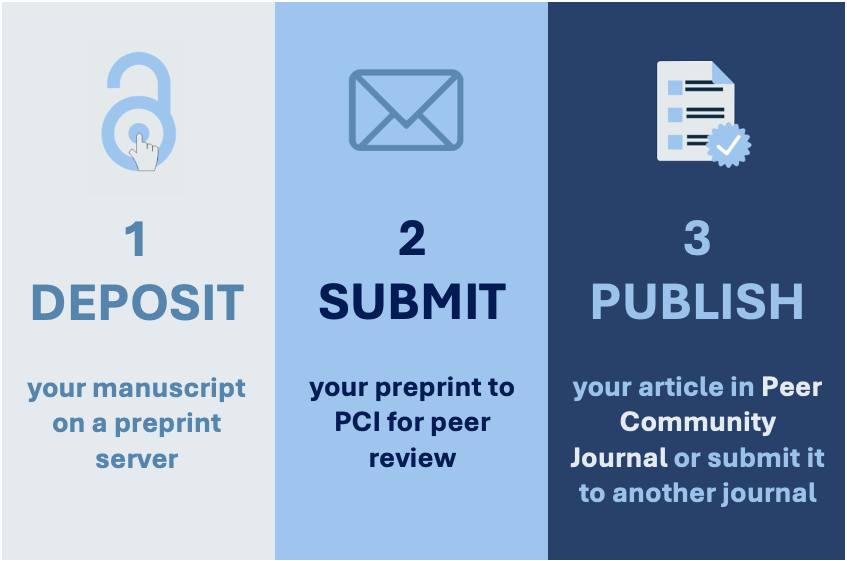
Peer Community In - free peer review & validation of preprints of articles
PCI is a non-profit open science organization of scientists to evaluate, recommend and publish research preprints in free open access
Post-publication critique at top-ranked journals across scientific disciplines: a cross-sectional assessment of policies and practice
Journals exert considerable control over letters, commentaries and online comments that criticize prior research (post-publication critique). We assessed policies (Study One) and practice (Study Two) related to post-publication critique at 15 top-ranked journals in each of 22 scientific disciplines ( N = 330 journals). Two-hundred and seven (63%) journals accepted post-publication critique and often imposed limits on length (median 1000, interquartile range (IQR) 500–1200 words) and time-to-submit (median 12, IQR 4–26 weeks). The most restrictive limits were 175 words and two weeks; some policies imposed no limits. Of 2066 randomly sampled research articles published in 2018 by journals accepting post-publication critique, 39 (1.9%, 95% confidence interval [1.4, 2.6]) were linked to at least one post-publication critique (there were 58 post-publication critiques in total). Of the 58 post-publication critiques, 44 received an author reply, of which 41 asserted that original conclusions were unchanged. Clinical Medicine had the most active culture of post-publication critique: all journals accepted post-publication critique and published the most post-publication critique overall, but also imposed the strictest limits on length (median 400, IQR 400–550 words) and time-to-submit (median 4, IQR 4–6 weeks). Our findings suggest that top-ranked academic journals often pose serious barriers to the cultivation, documentation and dissemination of post-publication critique.

Making sense of preprints by adding context – The Publish Your Reviews initiative - LSE Impact
Improving scientific publishing is often framed as an issue of openness and speed and less often as one of context. In this post, Ludo Waltman and Jessica Polka make the case for a more contextualised approach to open access publishing and preprinting, and introduce the Publish Your Reviews initiative. Launched today by ASAPbio, the initiative

You can just review things: A digital ethnography of informal peer review
Across scholarly communities, manuscripts face similar evaluative rituals: editors invite experts to privately assess submissions through formal peer reviews. This closed, loosely structured, and...

A Claude skill for pre-submission peer review
Open-source skill to use Claude + Consensus for pre-submission mock peer review backed by citations to published, peer-reviewed literature.

ASAPbio - Accelerating Science And Publication In Biology
A scientist-driven nonprofit accelerating discovery by promoting innovation and transparency in life science communication through preprints and open peer review.

PREreview: Open preprint reviews. For all researchers.
Introducing COSIG: The Collection of Open Science Integrity Guides
Investigating the integrity of published scientific papers is key to the scientific process, but the necessary knowledge is in short supply. We present COSIG, an open collection of meta-scientific guides enabling anyone to perform forensic peer review.
What’s the best platform for post publication peer review? @pubpeer.com ?

