Learn how our threat model and security architecture help teams run agents safely in GitHub Actions.
Securing CI/CD in an agentic world: Claude Code Github action case | Microsoft Security Blog
Microsoft Threat Intelligence identified a prompt injection pathway in Claude Code GitHub Action that allowed access to workflow secrets under specific conditions. This research examines the attack chain, responsible disclosure process, Anthropic's mitigation, and guidance for securing AI-powered CI/CD workflows.
AgentScan - GitHub Automation Detector
An open experiment in detecting automation patterns on GitHub
Entire Launches Distributed Git Network for the Agent Era
Five months after the largest seed round in developer-tools history, Entire is reimagining version control for agent-scale development, allowing developers to mirror GitHub repositories on a fast, independent Git network built for agents.
We won’t need to know
Two states of the agentic workflow: barebones architecture, and problems too complex to scrape.

How to Deploy AI Agents for Safety
Agent experience: How to design products that agents can actually use — WorkOS
What engineers and founders need to know about designing APIs, tools, and interfaces for agent-driven workflows
The 2025 AI Agent Index: Documenting Technical and Safety Features of Deployed Agentic AI Systems
Agentic AI systems are increasingly capable of performing professional and personal tasks with limited human involvement. However, tracking these developments is difficult because the AI agent ecosystem is complex, rapidly evolving, and inconsistently documented, posing obstacles to both researchers and policymakers. To address these challenges, this paper presents the 2025 AI Agent Index. The Index documents information regarding the origins, design, capabilities, ecosystem, and safety features of 30 state-of-the-art AI agents based on publicly available information and email correspondence with developers. In addition to documenting information about individual agents, the Index illuminates broader trends in the development of agents, their capabilities, and the level of transparency of developers. Notably, we find different transparency levels among agent developers and observe that most developers share little information about safety, evaluations, and societal impacts. The 2025 AI Agent Index is available online at https://aiagentindex.mit.edu

The 2025 AI Agent Index: Documenting Technical and Safety Features of Deployed Agentic AI Systems
Agentic AI systems are increasingly capable of performing professional and personal tasks with limited human involvement. However, tracking these developments is difficult because the AI agent ecosystem is complex, rapidly evolving, and inconsistently documented, posing obstacles to both researchers and policymakers. To address these challenges, this paper presents the 2025 AI Agent Index. The Index documents information regarding the origins, design, capabilities, ecosystem, and safety features of 30 state-of-the-art AI agents based on publicly available information and email correspondence with developers. In addition to documenting information about individual agents, the Index illuminates broader trends in the development of agents, their capabilities, and the level of transparency of developers. Notably, we find different transparency levels among agent developers and observe that most developers share little information about safety, evaluations, and societal impacts. The 2025 AI Agent Index is available online at https://aiagentindex.mit.edu
I use AI for security work - Tilmon Edwards
A brief introduction to how one might start to think about deploying AI agents into mission-critical applications.
CrabTrap: Secure Agents in Production
CrabTrap is an LLM-as-a-judge HTTP proxy to secure agents in production. It intercepts and audits AI agent requests in real time. Try it on GitHub now.
The 2025 AI Agent Index Documenting Technical and Safety Features of Deployed Agentic AI Systems
Agentic AI systems are increasingly capable of performing professional and personal tasks with limited human involvement. However, tracking these developments is difficult because the AI agent ecosystem is complex, rapidly evolving, and inconsistently documented, posing obstacles to both researchers and policymakers. To address these challenges, this paper presents the 2025 AI Agent Index. The Index documents information regarding the origins, design, capabilities, ecosystem, and safety features of 30 state-of-the-art AI agents based on publicly available information and email correspondence with developers. In addition to documenting information about individual agents, the Index illuminates broader trends in the development of agents, their capabilities, and the level of transparency of developers. Notably, we find different transparency levels among agent developers and observe that most developers share little information about safety, evaluations, and societal impacts. The 2025 AI Agent Index is available online at https://aiagentindex.mit.edu.
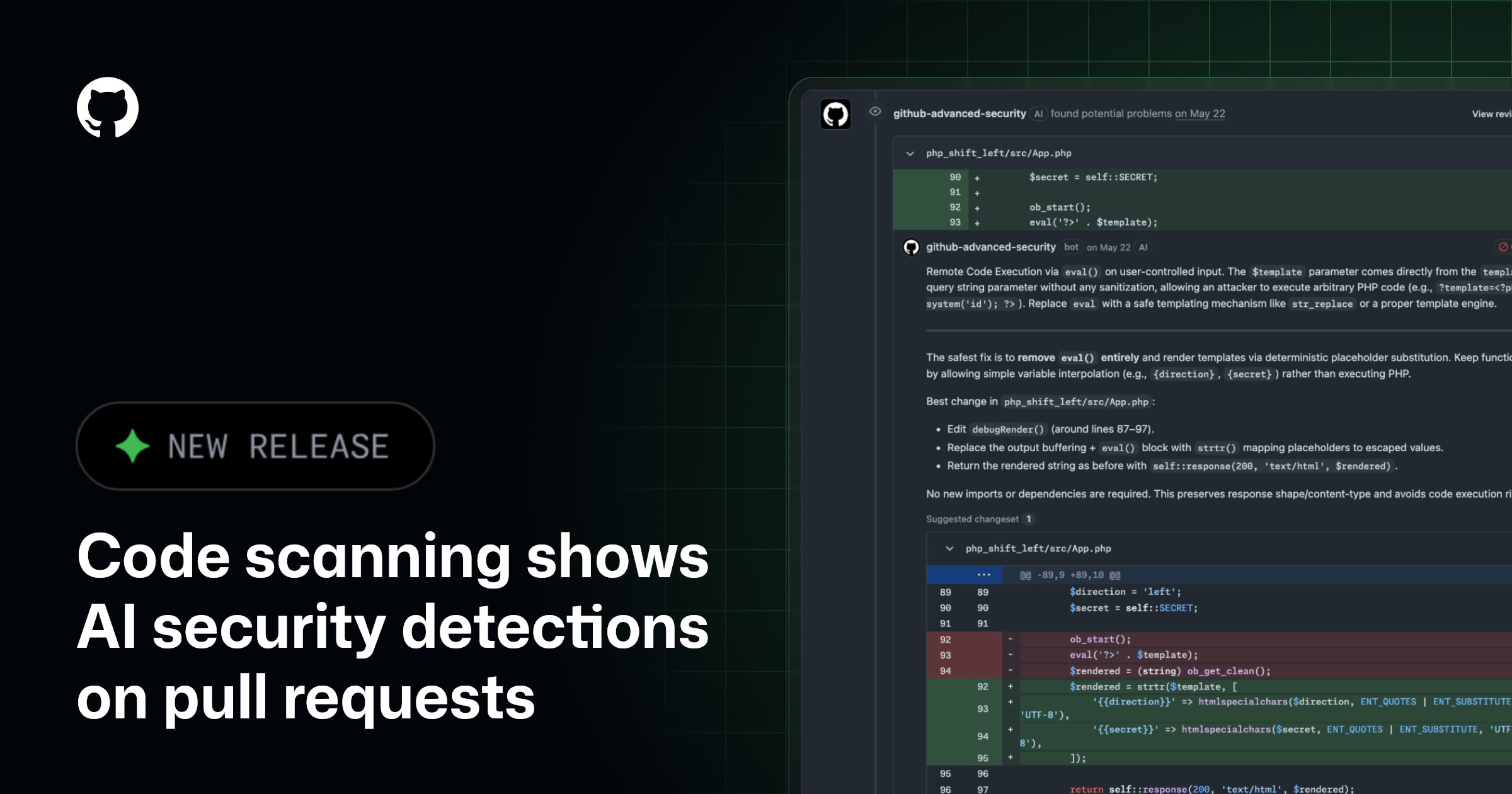
Code scanning shows AI security detections on pull requests - GitHub Changelog
GitHub code scanning now surfaces AI-powered security detections directly on pull requests, expanding vulnerability coverage to languages and frameworks not currently supported by CodeQL. These detections help teams identify and…
iamenochchirima/estack
Agent skills for reliable autonomous software engineering workflows.
agentOS — A faster, lighter, cheaper alternative to sandboxes
A portable open-source operating system for agents. Stateful runtime, universal agent interface, and secure code execution. One SDK, deploy anywhere.

Project Perception | Microsoft Security
Project Perception brings agentic security to life with AI agents, multi-agent workflows, and agentic defense. Unlock more with Microsoft Security.
GitHub MCP Exploited: Accessing private repositories via MCP
We showcase a critical vulnerability with the official GitHub MCP server, allowing attackers to access private repository data. The vulnerability is among the first discovered by Invariant's security analyzer for detecting toxic agent flows.