

A CLI tool to convert your codebase into a single LLM prompt with source tree, prompt templating, and token counting.
msllrs/relay
A macOS menu bar app that lets you build rich LLM prompts by combining files, clipboard captures, and voice notes.
Copyrightability of LLM-generated code: Can we license “vibe code” into Free Software? - FSFE
The use of large language models (“LLMs”) has exploded in recent years, including in the generation of source code. But even as their usage gains popularit...

Aider - AI Pair Programming in Your Terminal
Aider lets you pair program with LLMs to start a new project or build on your existing codebase.
Prompts are code, .json/.md files are state
Treating LLMs as shitty general purpose computers we program with natural language. Because throwing shit at the wall wasn't working anymore.

LLMON: An LLM-native Markup Language to Leverage Structure and Semantics at the LLM Interface
Textual Large Language Models (LLMs) provide a simple and familiar interface: a string of text is used for both input and output. However, the information conveyed to an LLM often has a richer structure and semantics, which is not conveyed in a string. For example, most prompts contain both instructions ("Summarize this paper into a paragraph") and data (the paper to summarize), but these are usually not distinguished when passed to the model. This can lead to model confusion and security risks, such as prompt injection attacks. This work addresses this shortcoming by introducing an LLM-native mark-up language, LLMON (LLM Object Notation, pronounced "Lemon"), that enables the structure and semantic metadata of the text to be communicated in a natural way to an LLM. This information can then be used during model training, model prompting, and inference implementation, leading to improvements in model accuracy, safety, and security. This is analogous to how programming language types can be used for many purposes, such as static checking, code generation, dynamic checking, and IDE highlighting. We discuss the general design requirements of an LLM-native markup language, introduce the LLMON markup language and show how it meets these design requirements, describe how the information contained in a LLMON artifact can benefit model training and inference implementation, and provide some preliminary empirical evidence of its value for both of these use cases. We also discuss broader issues and research opportunities that are enabled with an LLM-native approach.

Provisional Guidance for Users of LLM-Based Code Generators
available intuition for avoiding big risks

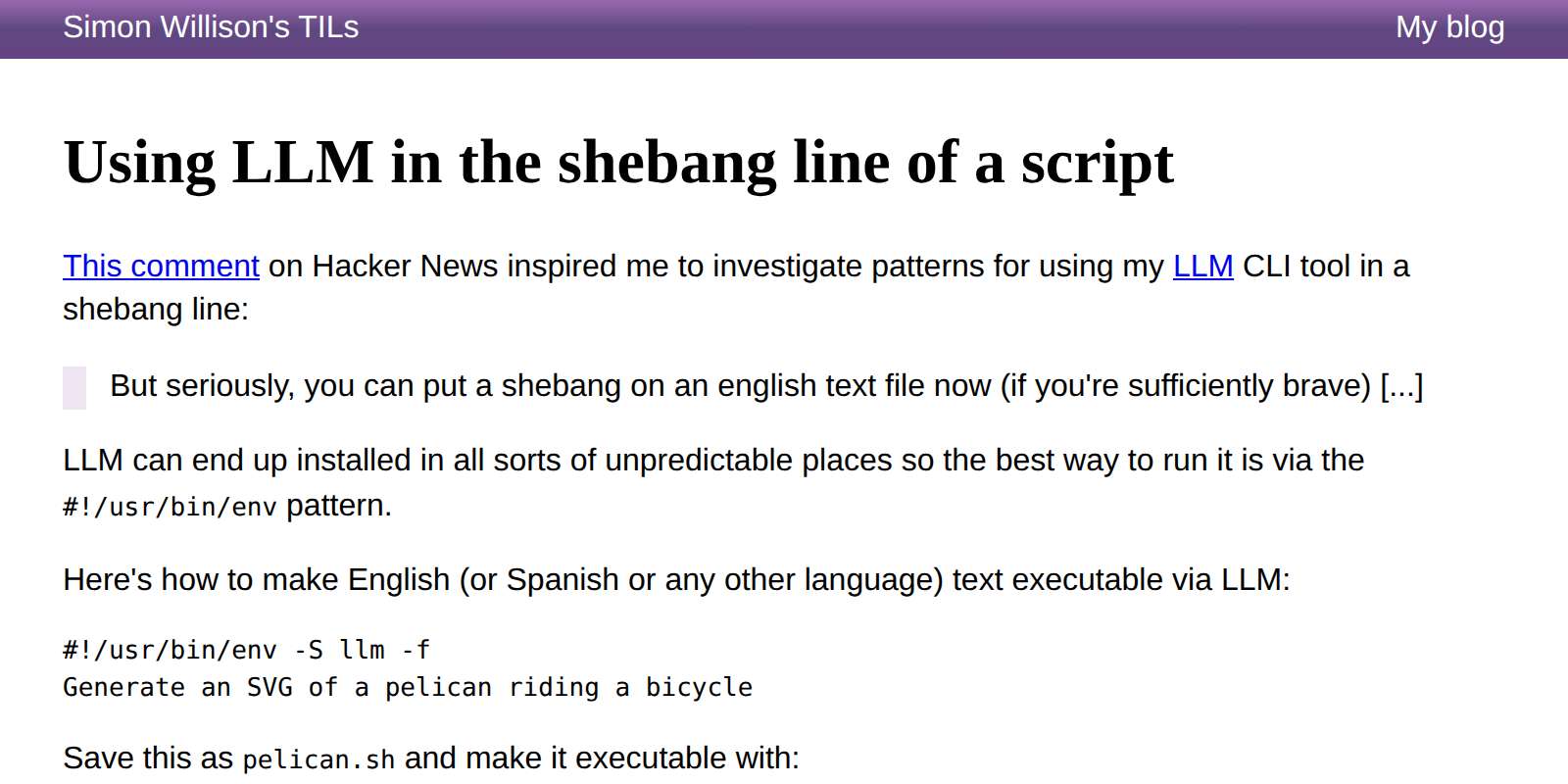
Using LLM in the shebang line of a script
This comment on Hacker News inspired me to investigate patterns for using my LLM CLI tool in a shebang line:
Here’s how I use LLMs to help me write code
Online discussions about using Large Language Models to help write code inevitably produce comments from developers who’s experiences have been disappointing. They often ask what they’re doing wrong—how come some …
steve.prophet on Twitter / X
so get smart about how you generate code... example token analysis of compilation output.model generates DSL / intermediate format, compiler turns it into actual runtime code.need to only generate 796 tokens to deploy 8,265 tokens.10x+ token difference (!!) https://t.co/LAAPjFX9Sc pic.twitter.com/zMoOrWb6yf— steve.prophet (@nilslice) March 18, 2026

Magicoder: Empowering Code Generation with OSS-Instruct
We introduce Magicoder, a series of fully open-source (code, weights, and data) Large Language Models (LLMs) for code that significantly closes the gap with top code models while having no more...
prompts/.clinerules/temporal-memory-bank.md at main · cline/prompts
Library of prompts from the Cline community. Contribute to cline/prompts development by creating an account on GitHub.
https://svelte.dev/docs/llms
We support the llms.txt convention for making documentation available to large language models and the applications that make use of them.
Translating non-trivial codebases with Claude
I don’t think it’s [me writing about LLMs] likely to happen anytime soon: I prefer to write about things that I’m excited about.
prime-radiant-inc/engineering-notebook
CLI tool that ingests Claude Code sessions, generates LLM summaries, and serves a browsable engineering journal
Training Large Language Models with Interpreter Feedback using WebAssembly
A fast, local, and secure approach to training LLMs for code with WebAssembly and interpreter-based rewards

LLM Session Manager — Manage all your agents in one terminal | partyline
Manage all your agents in one terminal. Browse, search, and resume Claude Code, Codex, and Gemini sessions across your projects. Free, local, no account.