

Coding Agent Adaptation Lets a 9B LLM Outperform 10x Larger Models on Aider Polyglot Benchmark
Best LLM for Coding 2026 | AI Coding Model Rankings & Benchmarks
Which AI model writes the best code? We rank every major LLM — open and closed source — across SWE-bench, HumanEval, LiveCodeBench, and Terminal-Bench coding benchmarks. Compare the best LLMs for coding, software engineering, and programming.

Qwen3-Coder: Agentic Coding in the World
GITHUB HUGGING FACE MODELSCOPE DISCORD Today, we’re announcing Qwen3-Coder, our most agentic code model to date. Qwen3-Coder is available in multiple sizes, but we’re excited to introduce its most powerful variant first: Qwen3-Coder-480B-A35B-Instruct — a 480B-parameter Mixture-of-Experts model with 35B active parameters which supports the context length of 256K tokens natively and 1M tokens with extrapolation methods, offering exceptional performance in both coding and agentic tasks. Qwen3-Coder-480B-A35B-Instruct sets new state-of-the-art results among open models on Agentic Coding, Agentic Browser-Use, and Agentic Tool-Use, comparable to Claude Sonnet 4.
Running local models is good now
Local agentic coding has gotten great over the past few months
OpenCode Zen | A curated set of reliable optimized models for coding agents
OpenCode - The open source coding agent.
Open Coding Agents: Fast, accessible coding agents that adapt to any repo | Ai2
SERA is the first in our family of Open Coding Agents, achieving state-of-the-art performance at low cost.
Andrej Karpathy on Twitter / X
A few random notes from claude coding quite a bit last few weeks.Coding workflow. Given the latest lift in LLM coding capability, like many others I rapidly went from about 80% manual+autocomplete coding and 20% agents in November to 80% agent coding and 20% edits+touchups in…— Andrej Karpathy (@karpathy) January 26, 2026
Introducing Mods: Enabling Agents to Self-Improve through Harness-Level Adaptation
We’re introducing Mods to Letta Code — an agent-friendly way to extend and adapt the Letta Code harness.
Open-Source Agentic Inference Benchmark | InferenceX
Compare AgentX, InferenceX's long-context, multi-turn coding scenario, with fixed-sequence AI inference across chips and frameworks. Public NVIDIA and AMD runs update when configurations change.
Scaling long-running autonomous coding · Cursor
We've been experimenting with running coding agents autonomously for weeks at a time.
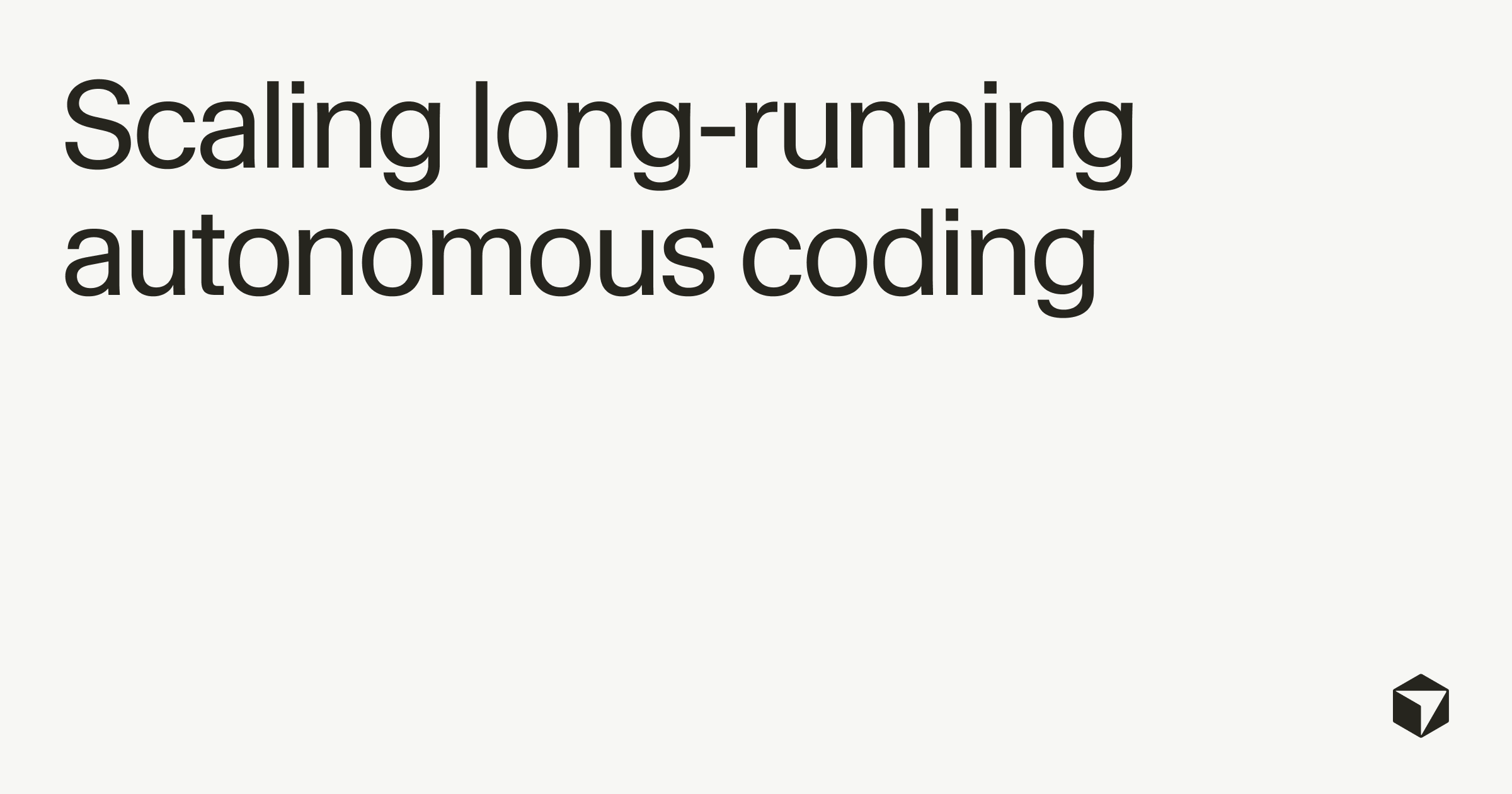
Prime Agent: A self-improving RLM agent
Prime Agent is our open-source, self-improving coding harness built around two abstractions: the Recursive Language Model (RLM) and the Continual Harness. With Opus 5, it achieves 95.5% on ARC-AGI-3, surpassing the reported human expert baseline.
Designing agentic loops
Coding agents like Anthropic’s Claude Code and OpenAI’s Codex CLI represent a genuine step change in how useful LLMs can be for producing working code. These agents can now directly …
How to Build an Agent
Building a fully functional, code-editing agent in less than 400 lines.

Rethinking the Value of Agent-Generated Tests for LLM-Based Software Engineering Agents
Large Language Model (LLM) code agents increasingly resolve repository-level issues by iteratively editing code, invoking tools, and validating candidate patches. In these workflows, agents often write tests on the fly, a paradigm adopted by many high-ranking agents on the SWE-bench leaderboard. However, we observe that GPT-5.2, which writes almost no new tests, can even achieve performance comparable to top-ranking agents. This raises the critical question: whether such tests meaningfully improve issue resolution or merely mimic human testing practices while consuming a substantial interaction budget.
SlopCodeBench: Benchmarking How Coding Agents Degrade Over Long-Horizon Iterative Tasks
Software development is iterative, yet agentic coding benchmarks overwhelmingly evaluate single-shot solutions against complete specifications. Code can pass the test suite but become progressively harder to extend. Recent iterative benchmarks attempt to close this gap, but constrain the agent’s design decisions too tightly to faithfully measure how code quality shapes future extensions. We introduce SlopCodeBench, a language-agnostic benchmark comprising 20 problems and 93 checkpoints, in which agents repeatedly extend their own prior solutions under evolving specifications that force architectural decisions without prescribing internal structure. We track two trajectory-level quality signals: verbosity, the fraction of redundant or duplicated code, and structural erosion, the share of complexity mass concentrated in high-complexity functions. No agent solves any problem end-to-end across 11 models; the highest checkpoint solve rate is 17.2%. Quality degrades steadily: erosion rises in 80% of trajectories and verbosity in 89.8%. Against 48 open-source Python repositories, agent code is 2.2x more verbose and markedly more eroded. Tracking 20 of those repositories over time shows that human code stays flat, while agent code deteriorates with each iteration. A prompt-intervention study shows that initial quality can be improved, but it does not halt degradation. These results demonstrate that pass-rate benchmarks systematically undermeasure extension robustness, and that current agents lack the design discipline iterative software development demands.
SlopCodeBench: Benchmarking How Coding Agents Degrade Over Long-Horizon Iterative Tasks
Software development is iterative, yet agentic coding benchmarks hide design issues through their single-shot setup. Recent iterative benchmarks attempt to remedy this but heavily constrain an agent's design decision space, making it impossible to faithfully measure how their decisions shape future extensions. We introduce SlopCodeBench, a benchmark of 36 problems and 196 checkpoints where agents repeatedly extend their own solutions. Unlike prior iterative benchmarks, our evolving specifications demand architectural decisions but leave internal structure to the agent. We measure two forms of degradation: structural erosion (concentrated complexity) and verbosity (redundant code). Evaluating 15 coding agents across open and closed models, we find that no agent fully solves any problem end-to-end, and the best agent passes 14.8% of checkpoints. Quality degrades across checkpoints, with structural erosion rising in 77% of trajectories and verbosity in 75.5%. Compared to 473 open-source Python repositories, agent code is 2.3x more verbose and 2.0x more eroded, and the human repositories degrade less often and by smaller margins across their git histories. Explicit quality guidance reduces initial verbosity and erosion by up to a third, without affecting degradation rates. SlopCodeBench provides the first measurement of code degradation under iterative extension, revealing that agents pass checkpoints while producing code that erodes and bloats with each turn.

AI Agents: Key Concepts and How They Overcome LLM Limitations
An AI agent is an autonomous software entity that is often used to augment a large language model. Here's what developers need to know.
