

I knew it was this way but it's really hitting me today how much the Open Source movement and copyright maximalism supplanted the idea of free software, and again how much the Free Software movement turned from a close ideological cousin of the remix and open culture movement into a culture of legalism. At the same time, copyright law itself has been extended to be near-immortal copyrights rather than brief monopolies to spur creation by enabling profit from creating works.
The Rules of Open Source No Longer Apply | Built In
When free software first gained traction, the world looked very different.

Open Source is Not Enough
by James Halliday // The open source movement has fundamentally changed how software gets written. But in the process, corporations have been given a vast gift of free labor.
Why Open Source Misses the Point of Free Software - GNU Project - Free Software Foundation
The terms “free software” and “open source” stand for almost the same range of programs. However, they say deeply different things about those programs, based on different values. The free software movement campaigns for freedom for the users of computing; it is a movement for freedom and justice. By contrast, the open source idea values mainly practical advantage and does not campaign for principles. This is why we do not agree with open source, and do not use that term.
Katerina Marchán (@zkat@toot.cat)
Open source maintainers of major projects (hi) are not ready to accept and talk about how the cultural insistence on permissive licensing is just straight up labor exploitation taking advantage of our addiction to popularity (also hi). We’re doing this to ourselves too, you know.
It’s time to rethink Open Source
Why developers give away valuable work for free — and what can be done to take that money back.

History of free and open-source software
The history of free and open-source software begins at the advent of computer software in the early half of the 20th century. In the 1950s and 1960s, computer operating software and compilers were delivered as a part of hardware purchases without separate fees. At the time, source code—the human-readable form of software—was generally distributed with the software, providing the ability to fix bugs or add new functions. Universities were early adopters of computing technology. Many of the modifications developed by universities were openly shared, in keeping with the academic principles of sharing knowledge, and organizations sprung up to facilitate sharing.

Time for Net Giants to Pay Fairly for the Open Source on Which They Depend | Linux Journal
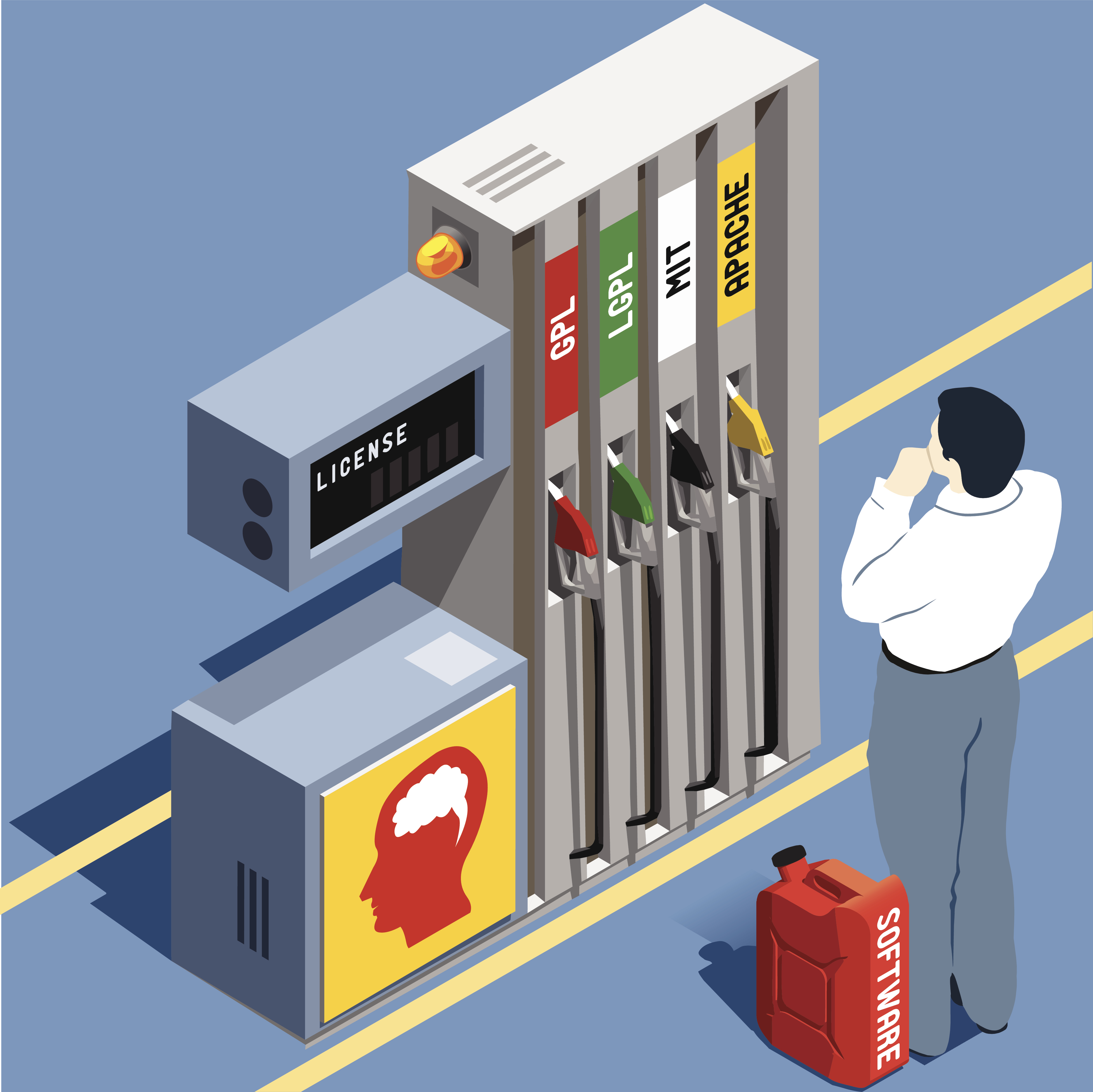
Licensing lies at the heart of open source. Arguably, free software began with the publication of the GNU GPL in 1989. And since then, open-source projects are defined as such by virtue of the licenses they adopt and whether the latter meet the Open Source Definition. The continuing importance of licensing is shown by the periodic flame wars that erupt in this area. Recently, there have been two such flarings of strong feelings, both of which raise important issues.
Open source is 20: How it changed programming and business forever
"The reward of victory is often another set of battles."
How open-source software took over the world | TechCrunch
It was just five years ago that there was an ample dose of skepticism from investors about the viability of open source as a business model. Fast-forward to today and we’ve witnessed the growing excitement in the space.
The emerging economic paradigm of Open Source
The following commentary is part of First Monday's Special Issue #2: Open Source. Open Source developers have, perhaps without conscious intent, created a new and surprisingly successful economic paradigm for the production of software. Examining that paradigm can answer a number of important questions. It's not immediately obvious how Open Source [1] works economically. Probably the worst consequence of this lack of understanding is that many people don't understand how Open Source could be economically sustainable, and some may even feel that its potential negative effect upon the proprietary software industry is an overall economic detriment. Fortunately, if you look more deeply into the economic function of software in general, it's easy to establish that Open Source is both sustainable and of tremendous benefit to the overall economy. Open Source can be explained entirely within the context of conventional open-market economics. Indeed, it turns out that it has much stronger ties to the phenomenon of capitalism than you may have appreciated.
One Startup's Heretical Plan to Turn Open Source Code Into Cash
With a new kind of license, open sourcers are trying to strike a balance between getting paid and preserving their values.

Sorting out the Ethical Licensing Mess
Software developers who give the world, for free, usage rights to the code they write often use open source licenses to make this gift legally explicit. These free usage rights (and then some) are …

Toward Copyleft Equality for All
I would not have imagined even two years ago that expansion of copyleft would become such an issue of interest in software freedom licensing. Historically and for good reason, addition of new forms of copyleft clauses has moved at a steady pace. The early 2000s brought network services clauses (such as that in the Affero GPL), which hinged primarily on requiring provision of source to network-remote users. Affero GPL implemented this via copyright-controlled permission of modification. These licenses began as experiments, and were not approved by some license certification authorities until many years later.

AI and the Destruction of the Creative Commons
The balance of software copyright protection and openness has always been fraught with minutiae and detail that bores all but the most nerdy of pedants. Yet, through much effort and 40 years of debate we had reached an equilibrium. Now AI has thrown that out the window.
