

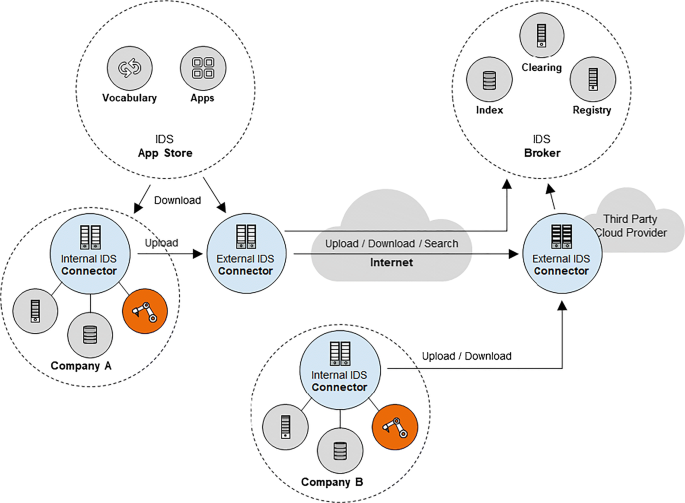
The paper presents the findings from a 3-year single-case study conducted in connection with the International Data Spaces (IDS) initiative. The IDS represents a multi-sided platform (MSP) for secure and trusted data exchange, which is governed by an institutionalized alliance of different stakeholder organizations. The paper delivers insights gained during the early stages of the platform’s lifecycle (i.e. the platform design process). More specifically, it provides answers to three research questions, namely how alliance-driven MSPs come into existence and evolve, how different stakeholder groups use certain governance mechanisms during the platform design process, and how this process is influenced by regulatory instruments. By contrasting the case of an alliance-driven MSP with the more common approach of the keystone-driven MSP, the results of the case study suggest that different evolutionary paths can be pursued during the early stages of an MSP’s lifecycle. Furthermore, the IDS initiative considers trust and data sovereignty more relevant regulatory instruments compared to pricing, for example. Finally, the study advances the body of scientific knowledge with regard to data being a boundary resource on MSPs.
A Polycentric Governance Lens on Data Infrastructures
Funding policies for data infrastructure promote open data sharing to drive positive social impact. However, concerns regarding the long-term management of data within and across distributed infrastructures can hinder data sharing. We draw upon the concept of polycentric governance to demonstrate how collaborative practices of data curation, in preparing and maintaining data for (future) sharing, provide a solid foundation for understanding data governance within data infrastructures. Based on a qualitative case study of a distributed ecological network, we investigate the conditions under which data are managed as a shared resource by local actors to ensure the long-term (re)usability of data. We contribute to CSCW by conceptualising data curation as a complex form of governance practice with multiple centres of decision-making, each of which operates with some degree of autonomy in data infrastructures. A polycentric governance lens on data infrastructures advances the CSCW conception of data curation as a collective governance practice that can cultivate a data democracy culture within and across organisations, empower individuals to be accountable for their data, and foster a mindset shift toward decentralised data governance.

Data Mesh Architecture: Interoperability, Co-Operation, and Co-Regulation
This paper examines the emergence of data mesh architectures and data intermediaries as key components in emerging data economies. It explores how data mesh arc

A Polycentric Governance Lens on Data Infrastructures
Computer Supported Cooperative Work (CSCW) - Funding policies for data infrastructure promote open data sharing to drive positive social impact. However, concerns regarding the long-term management...
Stuck in the middleware with you: the challenges of capitalizing a market-oriented approach to platform governance
T1 - Stuck in the middleware with you: the challenges of capitalizing a market-oriented approach to platform governance
A Practical Framework for Applying Ostrom’s Principles to Data Commons Governance
How do stakeholders govern themselves? What drives their endeavour? How do they make decisions? How do they make sure conflict does not tear them apart? The answers to these questions will look different for every data commons. Learn more in this week's data governance blog.

Better Deal for Data - Practical Data Governance for the Social Sector
Better Deal for Data - practical data governance for the social sector.
Sovereignty and Landscape | Simon Wardley | 15 comments
X : What is digital sovereignty? Me : I was asked that question by some friends within Government at the beginning of this month. I know some have been working on the idea, which is very encouraging, but I gave my tuppence worth of a definition. "Digital sovereignty is a country's ability to make its own decisions about the technology it uses, the data it creates, and how digital systems work in service of its people rather than being forced to accept choices made by other entities. This requires continuous situational awareness of the economic and technological landscape to anticipate changes, maintain strategic advantage, and shape international digital norms. Digital sovereignty is achieved through strategic control over critical digital assets and relationships, extending from public sector systems to the broader digital ecosystem affecting citizens and economic interests." The key is choice. You are sovereign if you retain the ability to make your own decisions rather than being forced to accept the decisions of others. This doesn't mean you need to own the entire tech stack, or all the data but you do need to maintain control over critical assets and relationships. This can be achieved by many means not just by conflict with others but through co-operation and collaboration (i.e. all the forms of competition matter). You also can consciously compromise, accepting some loss of sovereignty in one space to gain sovereignty in another. Anyway, I quite like the Mike Bracken description https://lnkd.in/eFjzcAdr "Digital sovereignty is the agency and capacity of any organisation to make intelligent, informed choices to shape its digital future by design". I used to do a lot of work on sovereignty many years ago, so if you want to know more about my view and how to achieve this, well I have a series of hopefully useful but somewhat introductory posts. Sovereignty and Landscape https://lnkd.in/eku2X_Ea Societal versus Market benefit https://lnkd.in/eXxkCv-K Whose interests are you serving? https://lnkd.in/eAgHS5wc | 15 comments on LinkedIn

Open North – Building trust in data, for the common good
Open North is a not-for-profit organization dedicated to advancing the common good. Working alongside governments and civic-minded organizations of all sizes, we provide data expertise to enhance decision-making, drive innovation, optimize public and civic services, and address society's most pressing challenges. Our work focuses on building the capacity of organizations to make better decisions about managing their data so that it is useful, actionable, secure, and trustworthy throughout its entire lifecycle.
Privacy as EU Tech advantage - The LeafPlaza Blog
Online crime loves legal massive data collection, grey systems, and jurisdictional gaps. Privacy-first design can actually reduce crime exposure and build trust in digital services. It is also central to the EU's tech autonomy: build systems aligning with European rights and risk models. Do not rely on foreign platforms or copy outside practices that might go against the EU values and needs.
Modular Politics: Toward a Governance Layer for Online Communities
Governance in online communities is an increasingly high-stakes challenge, and yet many basic features of offline governance legacies--juries, political parties, term limits, and formal debates, to name a few--are not in the feature-sets of the software most community platforms use. Drawing on the paradigm of Institutional Analysis and Development, this paper proposes a strategy for addressing this lapse by specifying basic features of a generalizable paradigm for online governance called Modular Politics. Whereas classical governance typologies tend to present a choice among wholesale ideologies, such as democracy or oligarchy, Modular Politics would enable platform operators and their users to build bottom-up governance processes from computational components that are modular and composable, highly versatile in their expressiveness, portable from one context to another, and interoperable across platforms. This kind of approach could implement pre-digital governance systems as well as accelerate innovation in uniquely digital techniques. As diverse communities share and connect their components and data, governance could occur through a ubiquitous network layer. To that end, this paper proposes the development of an open standard for networked governance.

Your platform is not an ecosystem
Another day, another exhortation to join an “ecosystem” that’s anything but. I could pick a hundred examples, but one that recently caught my eye was an ad placed in the Financial Times by the Singapore stock exchange, SGX Group, promising “multiple growth avenues, one trusted ecosystem”. SGX wants companies to list on its exchange rather than, say, the Hong Kong one which has more or less the same exclusive offer. SGX promises “access (to) Asia through our trusted ecosystem anchored in Singapore.” Ecosystems can be a lot of things. ‘Trusted’, by which they mean centrally policed to achieve defined, lower-risk outcomes, is not one of them. Calling built environments ‘ecosystems’ is common everywhere from financial services to supply chains to – quite a stretch, here – a retirement living complex. But it’s most often used in the tech world to describe the relations between software, services and hardware typically owned by a single company. For example, it’s how Google describes everything that hangs off the Android operating system. These kinds of proprietary and deterministic architectures are called ecosystems so often that we’ve stopped noticing. And that’s kind of the point. We need to start seeing this metaphor again, and what it’s hiding in plain sight. But first, a reminder of what an ecosystem actually is.
Position paper: persistent identifiers in research infrastructure policy - Crossref
PIDs have become central to national and international open research strategies, but identifiers alone cannot deliver the connected, open record that researchers, institutions, funders, publishers, and policymakers depend on. Effective research infrastructure rests on three interdependent elements: open, persistent identifiers; rich, open, and linked metadata; and the sustainable governance and resilient operation of the organisations involved. Crossref urges policymakers to evaluate all three together.

Identity is the Platform
This is the talk I gave at Mindtrek in Tampere, Finland. Slides are available here: http://factoryjoe.com/blog/2009/10/01/identity-is-the-platform/
\x5bSIG\x5d Data Governance: Data Organisation
Data Organisation Foundational Structures of Asset Governance Key Value Pairs 3 infrastructure Git Wiki Service management Ben Koo, Tim Bansemer, Jared Cordon May 25, 2021 HDX Thread 5: ICT Awareness and Competency in Data Governance

Digital Sovereignty Made in Europe | EU Alternatives Directory
Discover GDPR-compliant, EU-based alternatives to popular digital services. Find European cloud, analytics, and dev tools with guaranteed data residency.
Collective Bargaining in the Information Economy Can Address AI-Driven Power Concentration
This position paper argues that there is an urgent need to restructure markets for the information that goes into AI systems. Specifically, producers of information goods (such as journalists, researchers, and creative professionals) need to be able to collectively bargain with AI product builders in order to receive reasonable terms and a sustainable return on the informational value they contribute. We argue that without increased market coordination or collective bargaining on the side of these primary information producers, AI will exacerbate a large-scale "information market failure" that will lead not only to undesirable concentration of capital, but also to a potential "ecological collapse" in the informational commons. On the other hand, collective bargaining in the information economy can create market frictions and aligned incentives necessary for a pro-social, sustainable AI future. We provide concrete actions that can be taken to support a coalition-based approach to achieve this goal. For example, researchers and developers can establish technical mechanisms such as federated data management tools and explainable data value estimations, to inform and facilitate collective bargaining in the information economy. Additionally, regulatory and policy interventions may be introduced to support trusted data intermediary organizations representing guilds or syndicates of information producers.