

My work lies at the intersection of technology and the solidarity economy. I’m passionate about strengthening the digital commons, in which people control and steward communication technologies as collective goods.
Social Media and Tech Solidarity.pdf
Cyber-Marx: Cycles and circuits of struggle in high technology capitalism - Nick Dyer-Witheford
The complete text of Nick Dyer-Witheford's 1999 book, which provides an analysis of information-age capitalism and the movements currently dissolving it. In PDF format.

Commons Network
Digital Commons are not only about digital technology, but also about the economy, how it is organised and who it benefits. Digital Commons represent a democratic practice, with shared ownership, thus initiating a shift away from centralised (private or state) management of technology and towards democratisation of digital infrastructure. In this way Digital Commons help guard and reinforce such public values as democracy, self-determination and sovereignty. In the first explainer we put forward how this shift offers numerous opportunities for the Netherlands, or any country that takes Digital Commons seriously. Read the explainer

The Digital Life Collective
The Digital Life Collective is an enabler. If you think we should be doing something we're not currently doing, we're here to help you and your project make the change you want to see in the world.
Digital Locality
The Paper Pilot's digital garden of thoughts on philosophy, politics, and sociology. Reading time: ~10 minute read | Published: Nov 21, 2024 | Updated: Aug 3, 2026

Plurality
A book by E. Glen Weyl, Audrey Tang and the Plurality Community exploring how technology can support and strengthen democracy.
Digital Commons: Our Shared Right to Knowledge and Culture
As the volume of cultural and scientific works produced and available on the internet continues to expand, the question of freedom to consult and use this immense ‘digital commons’ is becoming a critical one, particularly as cutting off access could entail serious consequences for education, cultural exchange, and even the health of European citizens.

Lambda Land | Book Review: Technopoly
In Technopoly: The Surrender of Culture to Technology, Neil Postman argues that our infatuation with technology has insidiously eroded our culture. We gain much through technology, but it comes at a price; all too often we are blind to that price. This book seeks to call attention to the costs of a technology-focused society. I felt this poignantly because I, as a technology worker, know what that infatuation feels like.
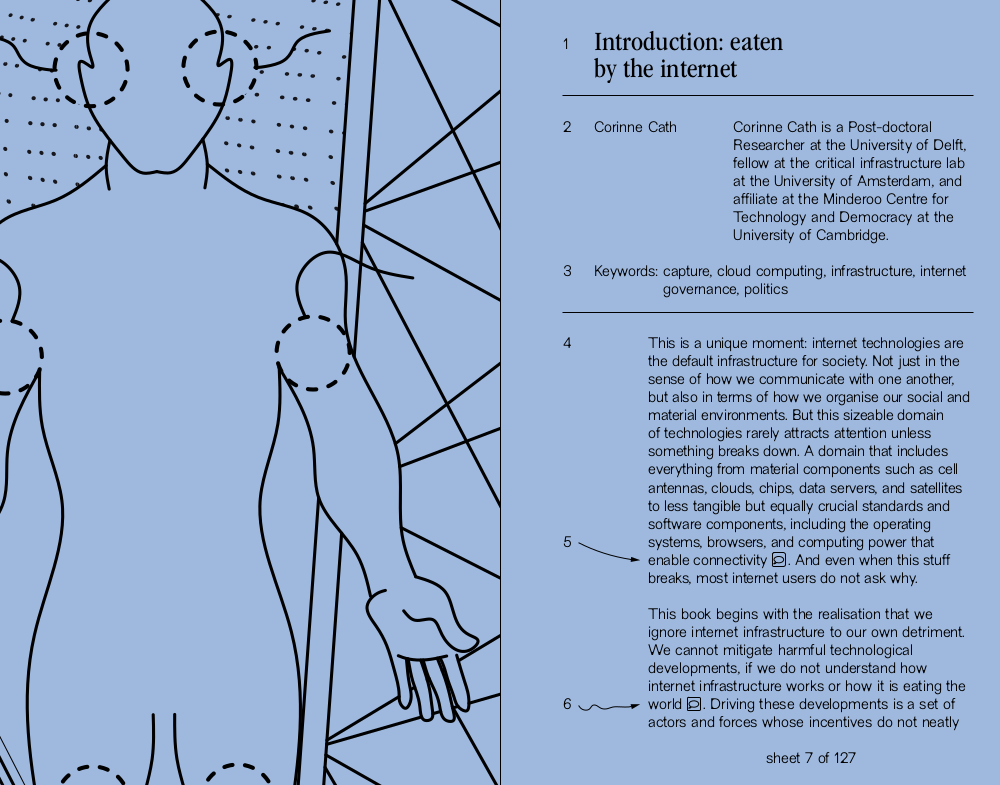
Eaten by the Internet
This book makes internet infrastructure visible as a force of political power, which is transforming the social world, from the bottom up—through fifteen chapters contributed by a global set of researchers, activists, and techies. We are living a unique moment: internet technologies are the default infrastructure for society, not just how we communicate but also how we organise our social life, politics, and economy, all the way down to our material environments, like cities. Our world is eaten by the internet. This means that those who control the internet control the bounds of public speech, economic production, social cohesion, and politics, making its infrastructure a core political terrain in the networked age. The book’s chapters cover a wide set of topics, spanning from the global politics of content moderation by internet infrastructure to the colonialism inherent in the race to plug the moon, from the harms wrought by blockchain companies in rural America to the particularities of online censorship across Asia. The chapters take on thorny topics, discussing power consolidation in the advertisement and cloud industry, the role of internet infrastructure in the war in Ukraine, and tech’s environmental impact—amongst others. In doing so, this book roots contemporary technology debates in the politics of internet infrastructure and urges us to ask how can we ensure our infrastructures sustain us, rather than consume us?
Empowering Users, Not Overlords: Overcoming Digital Helplessness
Disclosure: I’m on the board of Bluesky, so feel free to take as many grains of salt as you want in reading it, though all of it applies equally to other decentralized social media ecosys…

Institute of Network Cultures | Ben Grosser: Planning the Exodus from Platform Realism
Thinking about the current state of platforms, I’m reminded of Mark Fisher’s articulation of capitalist realism, the idea that we don’t imagine or build alternatives to capitalism because we can no longer envision a world without it. Big tech, in a few short years, has managed to instill within the public a similar state of platform realism. So many are unable to imagine how global communication, media, search, etc. could ever function without the platforms. Despite a growing malaise, it’s become difficult for many to consider a world without big tech platforms as a viable conception of the future.

The Case for a Public Social Media Platform - JSTOR Daily
Artist and writer Joshua Citarella explores why corporate platforms corrode democracy—and what a postal-service-style digital commons could do differently.

Joe Bak-Coleman
I’m a computational social scientist whose research explores how collectives make decisions in the face of uncertainty, focusing on the impact of digital technologies on collective behavior.

Is Digital Campaigning Dead?
The Commons is an online library for the change makers of the world and for those interested in social change, activism, organising, advocacy and justice.

Bryan (they/them)


Thanks so much to @rpg.actor for joining me for my read of "Coalition Politics: Turning the Century"! I hope you'll watch the video, because I think this message is crucial for folks on here to listen to & learn from if we are to try & make the open social web something durable & transformative.

Bryan (they/them)'s video on Streamplace
stream.place