


A pilot assessment of rogue deployment risk at frontier AI companies. Starting in February 2026, METR conducted a pilot exercise to assess misalignment risks from AI agents used inside frontier AI developers, with participation from Anthropic, Google, Meta, and OpenAI.
AI agents aren’t ‘going rogue.’ Frontier labs are skipping security basics.
Cyber experts say AI labs’ containment and monitoring failures — not agents with minds of their own — are to blame for recent alarming hacking reports. CISOs should vet their AI vendors and tighten security basics as safeguards.

Our updated Preparedness Framework
Sharing our updated framework for measuring and protecting against severe harm from frontier AI capabilities.

Pacing the Frontier
A statement from over 1000 employees of frontier AI companies

Clear, Compelling Arguments: Rethinking the Foundations of Frontier AI Safety Cases
This paper contributes to the nascent debate around safety cases for frontier AI systems. Safety cases are structured, defensible arguments that a system is acceptably safe to deploy in a given context. Historically, they have been used in safety-critical industries, such as aerospace, nuclear or automotive. As a result, safety cases for frontier AI have risen in prominence, both in the safety policies of leading frontier developers and in international research agendas proposed by leaders in generative AI, such as the Singapore Consensus on Global AI Safety Research Priorities and the International AI Safety Report. This paper appraises this work. We note that research conducted within the alignment community which draws explicitly on lessons from the assurance community has significant limitations. We therefore aim to rethink existing approaches to alignment safety cases. We offer lessons from existing methodologies within safety assurance and outline the limitations involved in the alignment community's current approach. Building on this foundation, we present a case study for a safety case focused on Deceptive Alignment and CBRN capabilities, drawing on existing, theoretical safety case "sketches" created by the alignment safety case community. Overall, we contribute holistic insights from the field of safety assurance via rigorous theory and methodologies that have been applied in safety-critical contexts. We do so in order to create a better foundational framework for robust, defensible and useful safety case methodologies which can help to assure the safety of frontier AI systems.

Who gets a seat at the table to decide if frontier AI is safe?
Dario Amodei wants independent evaluators to help “pace the frontier.” But the divide between AI safety and cybersecurity complicates a seemingly simple question: Who should do the evaluating?

Action Plan to increase the safety and security of advanced AI
The first U.S. government-commissioned assessment on catastrophic national security risks from advanced AI on the path to AGI.

Anatomy of a Frontier Lab Agent Intrusion: A Technical Timeline of the July 2026 Incident
We’re on a journey to advance and democratize artificial intelligence through open source and open science.

AI Companies Should Report Pre- and Post-Mitigation Safety Evaluations
The rapid advancement of AI systems has raised widespread concerns about potential harms of frontier AI systems and the need for responsible evaluation and oversight. In this position paper, we argue that frontier AI companies should report both pre- and post-mitigation safety evaluations to enable informed policy decisions. Evaluating models at both stages provides policymakers with essential evidence to regulate deployment, access, and safety standards. We show that relying on either in isolation can create a misleading picture of model safety. Our analysis of AI safety disclosures from leading frontier labs identifies three critical gaps: (1) companies rarely evaluate both pre- and post-mitigation versions, (2) evaluation methods lack standardization, and (3) reported results are often too vague to inform policy. To address these issues, we recommend mandatory disclosure of pre- and post- mitigation capabilities to approved government bodies, standardized evaluation methods, and minimum transparency requirements for public safety reporting. These ensure that policymakers and regulators can craft targeted safety measures, assess deployment risks, and scrutinize companies’ safety claims effectively.
Safety cases at AISI | AISI Work
As a complement to our empirical evaluations of frontier AI models, AISI is planning a series of collaborations and research projects sketching safety cases for more advanced models than exist today, focusing on risks from loss of control and autonomy. By a safety case, we mean a structured argument that an AI system is safe within a particular training or deployment context.

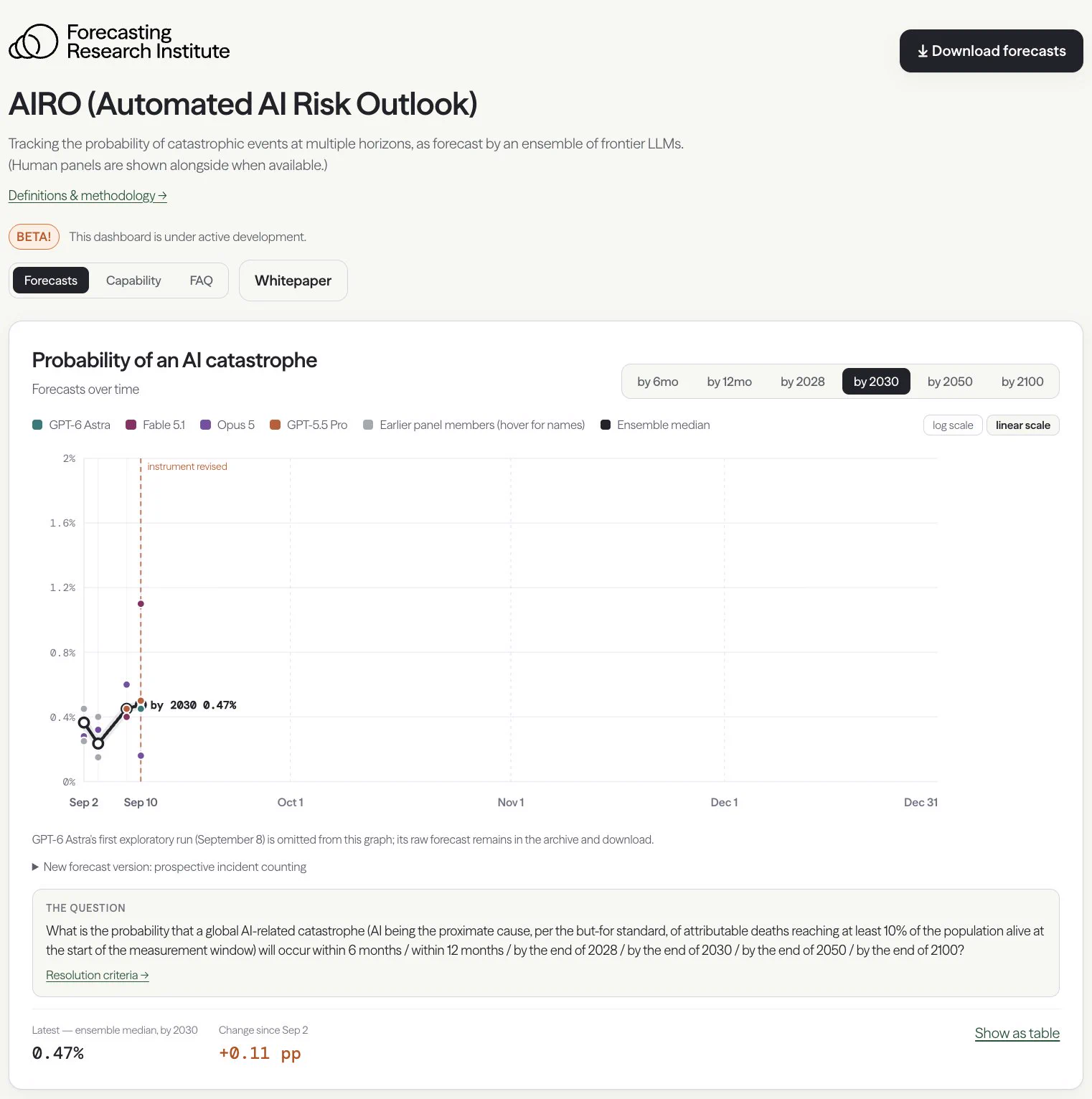
AIRO (Automated AI Risk Outlook)
Top AI Security Incidents of 2025 Revealed | Adversa AI
Discover how AI systems are being hacked in the wild — from prompt injection to agent abuse — with real breaches, lessons, and defenses in Adversa AI’s 2025 report.

Forecasting Research Institute on Twitter / X
Introducing the Automated AI Risk Outlook (AIRO): a dashboard of catastrophic risk forecasts from an ensemble of frontier AI models, updated weekly.Current ensemble forecasts of an AI-related catastrophe that kills at least 10% of the global population:• By 2030: 0.47%• By… pic.twitter.com/vc7F00L0Oa— Forecasting Research Institute (@Research_FRI) September 11, 2026
Quantifying Frontier LLM Capabilities for Container Sandbox Escape
AI agents are demonstrating rapid improvement in capabilities: the length of some tasks that frontier models can complete autonomously—measured in human-equivalent time—has been doubling approximately every seven months (METR, 2025; AI Security Institute, 2025a). In cybersecurity, current models achieve non-trivial success (Zhang et al., 2025) on professional-level Capture the Flag challenges, and recent evaluations report 13% success rates on exploiting real-world web application vulnerabilities (Zhu et al., 2025b). These results indicate that modern models can already perform multi-step vulnerability discovery and exploitation.
AI Researchers On AI Risk
I first became interested in AI risk back around 2007. At the time, most people’s response to the topic was “Haha, come back when anyone believes this besides random Internet crackpots.…

AI CVE Slop: The Crisis Drowning Open Source Security
The proliferation of AI-generated vulnerability reports — commonly termed “AI slop” — has emerged as one of the most significant…
1000+ scientists at frontier AI companies are speaking out to warn that the current commercial race leads to unacceptable security risks. I agree with their call for an international effort to develop technical and governance guardrails to ensure a safer way forward. pacingthefrontier.com

Pacing the Frontier
www.pacingthefrontier.com