

The Simple Macroeconomics of AI
This paper evaluates claims about large macroeconomic implications of new advances in AI. It starts from a task-based model of AI’s effects, working through aut

AI FOR EPISTEMICS & COORDINATION
Civilization and technology have radically improved the human condition. Nonetheless, the world sometimes goes in directions which essentially nobody would prefer — e.g., nuclear arms races, unexpected financial crashes, predatory marketing, or ubiquitous political misinformation.
Why We Fear AI: On the Interpretation of Nightmares — Common Notions Press
Industry insiders Hagen Blix and Ingeborg Glimmer dive into the dark, twisted world of AI to demystify the many nightmares we have about it. They combine expertise in cognitive science and machine learning with political and economic analyses to cut through the hype and technobabble to show how fears about AI reflect different economic realities.

Will AI Destroy the Economy? (According to Economists: No.) | AI Reality Check | Cal Newport
Import AI 452: Scaling laws for cyberwar; rising tides of AI automation; and a puzzle over gDP forecasting
How much could AI revolutionize the economy?

Meredith Whittaker on Twitter / X
Now that even Goldman, Sequoia, and other major investors are calling it, it's good to remember that the shakiness of the AI market, and the mismatch between capex and ROI, has been clear for a long time to those of us who look closely at the political economy of AI. https://t.co/dLLNAcW5Sn— Meredith Whittaker (@mer__edith) July 30, 2024
Companies That Replaced Humans With AI Are Realizing Their Mistake
As AI agents have yet to pay for themselves, more and more executives are waking up to the sloppy reality of AI hype.

AI May Be Atrophying Our Brains, Professor Warns
AI may soon ruin our ability to make decisions for ourselves — an outcome that would be, one expert warns, "catastrophic."
The Era of Judgment
Evidence from the frontier labs of how AI will extend human productivity

Taking AI Welfare Seriously
In this report, we argue that there is a realistic possibility that some AI systems will be conscious and/or robustly agentic in the near future. That means that the prospect of AI welfare and moral patienthood, i.e. of AI systems with their own interests and moral significance, is no longer an issue only for sci-fi or the distant future. It is an issue for the near future, and AI companies and other actors have a responsibility to start taking it seriously. We also recommend three early steps that AI companies and other actors can take: They can (1) acknowledge that AI welfare is an important and difficult issue (and ensure that language model outputs do the same), (2) start assessing AI systems for evidence of consciousness and robust agency, and (3) prepare policies and procedures for treating AI systems with an appropriate level of moral concern. To be clear, our argument in this report is not that AI systems definitely are, or will be, conscious, robustly agentic, or otherwise morally significant. Instead, our argument is that there is substantial uncertainty about these possibilities, and so we need to improve our understanding of AI welfare and our ability to make wise decisions about this issue. Otherwise there is a significant risk that we will mishandle decisions about AI welfare, mistakenly harming AI systems that matter morally and/or mistakenly caring for AI systems that do not.

An Economy of AI Agents
In the coming decade, artificially intelligent agents with the ability to plan and execute complex tasks over long time horizons with little direct oversight from humans may be deployed across the economy. This chapter surveys recent developments and highlights open questions for economists around how AI agents might interact with humans and with each other, shape markets and organizations, and what institutions might be required for well-functioning markets.
For years, they warned AI could kill all humans. Now people are listening.
A doomsaying community once on the periphery of the tech industry has gained influence, as AI “agents” perform amazing and alarming feats.

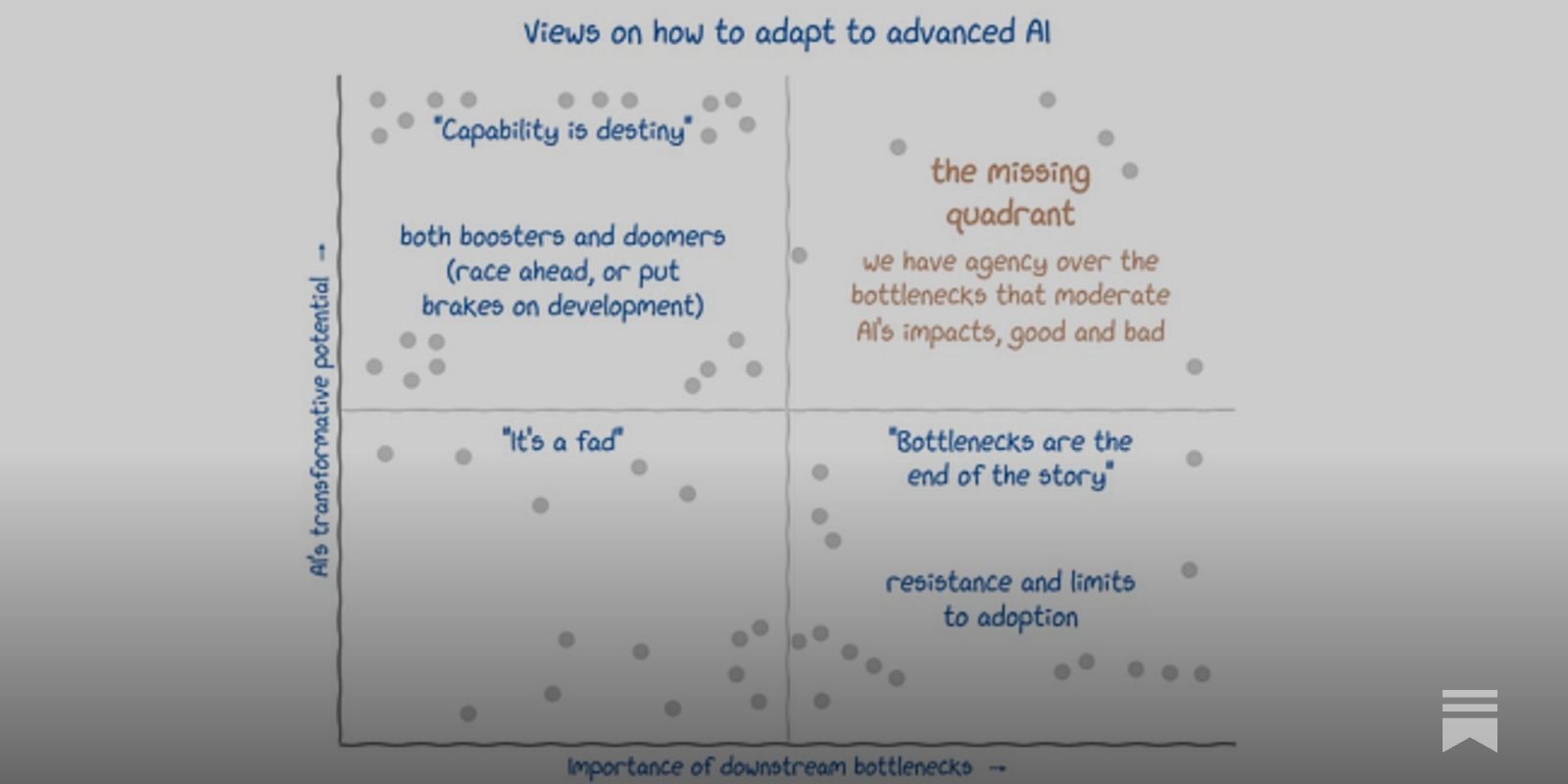
The missing quadrant in responses to AI
Announcing STABL: Societal Transformation and AI Bottlenecks Lab
The ecology of AI risk
Understanding the risk from applications of artificial intelligence (AI) is a critical part of creating AI governance strategies. Building on the idea of studying AI using ecological and evolutionary perspectives, we propose a novel approach for assessing risk from AI using indicators derived from theoretical ecology models. We illustrate our methods by deriving 3 indicators from population and ecosystem models originating from theoretical ecology. We conclude with a discussion of limitations of our analysis and considerations for improving AI governance policy.
AI is probably not a bubble
AI companies have revenue, demand, and paths to immense value
AI is probably not a bubble
AI companies have revenue, demand, and paths to immense value

On the economics of AI.