

Large language models are increasingly used as social simulators, including as synthetic survey respondents. Most evaluations ask whether simulated outcomes resemble human outcomes. We argue that this is necessary but too weak: a simulator can match the final answer while using the wrong behavioral mechanism. We study this problem through a 94-person sunscreen concept test in which each respondent evaluated three product concepts and wrote open-ended rationales. We map those rationales into signed reason states $Z$, where positive signs support adoption and negative signs block it. This gives a practical audit: holding respondent descriptors $D$, category context $K$, and concept treatment $X$ fixed, do human-stated reasons help predict behavior $Y$, and can an LLM simulate the same reason state without seeing the human rationale or outcome? Human-stated reasons substantially improve held-out prediction of purchase intent. LLM-simulated reasons are more brittle: they often sound plausible, but frequently echo the concept board rather than recover the respondent's acceptance or rejection path. The paper contributes an evaluation framework for social simulators. Reason states do not identify natural causal effects by themselves, but they provide an interpretable test of whether a simulator's stated reasons align with human evidence.
Take caution in using LLMs as human surrogates
Recent studies suggest large language models (LLMs) can generate human-like responses, aligning with human behavior in economic experiments, surveys, and political discourse. This has led many to propose that LLMs can be used as surrogates or simulations for humans in social science research. However, LLMs differ fundamentally from humans, relying on probabilistic patterns, absent the embodied experiences or survival objectives that shape human cognition. We assess the reasoning depth of LLMs using the 11-20 money request game. Nearly all advanced approaches fail to replicate human behavior distributions across many models. The causes of failure are diverse and unpredictable, relating to input language, roles, safeguarding, and more. These results warrant caution in using LLMs as surrogates or for simulating human behavior in research.

Human-Simulation Interaction: From Prediction to Exploration in LLM Agent Simulations for Policy
Agent-based models have historically served as tools for generative explanation, constructing testbeds in which candidate micro-level behavioral rules can be tested for their capacity to produce observed macro-level phenomena. The integration of Large Language Models into agent-based simulation has expanded what these models can represent, but it has also introduced an unexamined shift in how users engage them. We argue that current generative agent-based models (GABMs) inherit the dominant interaction metaphor of conversational LLM interfaces - a question-answer pattern that positions users as consumers of system output rather than explorers of a possibility space. In the context of policy, where problems are wicked and ground truth is unknowable in advance, this metaphor produces a trust deficit that cannot be resolved through improved model accuracy alone. We open a design space we call human-simulation interaction, and argue that warranted trust requires interaction metaphors that restore the exploratory capacity simulation has historically supported.
Are Large Language Models Sensitive to the Motives Behind Communication?
Human communication is $\textit{motivated}$: people speak, write, and create content with a particular communicative intent in mind. As a result, information that large language models (LLMs) and AI agents process is inherently framed by humans' intentions and incentives. People are adept at navigating such nuanced information: we routinely identify benevolent or self-serving motives in order to decide what statements to trust. For LLMs to be effective in the real world, they too must critically evaluate content by factoring in the motivations of the source---for instance, weighing the credibility of claims made in a sales pitch. In this paper, we undertake a comprehensive study of whether LLMs have this capacity for $\textit{motivational vigilance}$. We first employ controlled experiments from cognitive science to verify that LLMs' behavior is consistent with rational models of learning from motivated testimony, and find they successfully discount information from biased sources in a human-like manner. We then extend our evaluation to sponsored online adverts, a more naturalistic reflection of LLM agents' information ecosystems. In these settings, we find that LLMs' inferences do not track the rational models' predictions nearly as closely---partly due to additional information that distracts them from vigilance-relevant considerations. However, a simple steering intervention that boosts the salience of intentions and incentives substantially increases the correspondence between LLMs and the rational model. These results suggest that LLMs possess a basic sensitivity to the motivations of others, but generalizing to novel real-world settings will require further improvements to these models.
Do LLMs Exhibit Human-like Response Biases? A Case Study in Survey Design
Abstract One widely cited barrier to the adoption of LLMs as proxies for humans in subjective tasks is their sensitivity to prompt wording—but interestingly, humans also display sensitivities to instruction changes in the form of response biases. We investigate the extent to which LLMs reflect human response biases, if at all. We look to survey design, where human response biases caused by changes in the wordings of “prompts” have been extensively explored in social psychology literature. Drawing from these works, we design a dataset and framework to evaluate whether LLMs exhibit human-like response biases in survey questionnaires. Our comprehensive evaluation of nine models shows that popular open and commercial LLMs generally fail to reflect human-like behavior, particularly in models that have undergone RLHF. Furthermore, even if a model shows a significant change in the same direction as humans, we find that they are sensitive to perturbations that do not elicit significant changes in humans. These results highlight the pitfalls of using LLMs as human proxies, and underscore the need for finer-grained characterizations of model behavior.1

Behavioral Intervention Construal: A Framework for Understanding Inferences from Behavioral Interventions
Organizations frequently use behavioral interventions—including incentives, messaging campaigns, and modifications to choice architecture—to influence people’s behavior. However, recent evidence suggests that such interventions often have inconsistent effects across implementations. To understand this variability, we build on the idea that interventions are not simply levers for changing behavior, they also signal useful information to decision makers. For example, when an option is set as the default, people may infer that it is recommended by the organization—an inference that can increase the likelihood that people stick with that option. However, when people perceive that defaults benefit the organization, those defaults may be rejected. Here, we propose a framework to better understand the effects of behavioral interventions by identifying the inferences they prompt people to draw. In developing this framework, we first characterize the defining features of behavioral interventions that determine how they are psychologically experienced. These features implicate five fundamental needs, which guide decision makers’ information-seeking processes. From these needs, we derive a principled typology of inferences drawn by decision makers in response to behavioral interventions, bringing together scattered evidence for these inferences from across the behavioral sciences. The resulting framework entails predictions about when specific inferences will arise and how these inferences influence the overall effects of behavioral interventions. Utilizing the framework, we provide a tool for enhancing intervention design. Taken together, the current research offers an integrative framework for advancing theory on behavioral interventions while also outlining actionable insights for organizations hoping to promote behavior change at scale.

Optimizing Behavioral Experiment Design with In-Silico Simulations
Running behavioral experiments is expensive, slow, and vulnerable to design flaws detectable only after data collection. We introduce a preliminary multi-agent framework that uses simulations to iteratively refine behavioral study designs before recruiting human participants. With personas instantiated through target demographic attributes, we elicit explanatory reasoning traces from LLM simulations that serve as diagnostic evidence of structural flaws. In two survey case studies, simulation-rich Critic outperforms a design-only baseline on the precision of high-severity structural errors, while providing little value for identifying missed opportunities. These early results suggest reasoning traces can expose a qualitatively distinct class of design flaws inaccessible to the design-only baseline.
ECHO: Evidence-Calibrated Human Outcomes from Synthetic Users for Interaction Design
This position paper proposes ECHO, a protocol for treating simulated users built with AI as calibrated measurement instruments for scoped interaction-design claims, not as synthetic replacements for human participants. A synthetic user is an echo, not the person who produced the original signal; it gains evidentiary force only when it supports evidence-calibrated human outcomes: claims about human-facing outcomes bounded by human data. The issue matters now because LLMs and GUI agents generate logs, rationales, personas, and usability reports at product speed, while NLP and HCI lack shared norms for when such traces count as evidence. We contribute an evidentiary standard specifying when synthetic traces may support discovery, rehearsal, pilot triage, or bounded decision support. The standard scopes a design claim, records governed human seed traces, documents simulator policy, estimates design effects with human-corrected evidence, and reports uncertainty and rejection flags. It synthesizes usability inspection, personas, user simulation, agent benchmarks, social simulation, validity, correction, documentation, privacy, and human-AI interaction. The central position is narrow: synthetic users can help interaction design when they improve issue discovery, pilot triage, or bounded decision support under calibration. Without calibration, fluent traces turn model plausibility into counterfeit user evidence.
Individually Sensible, Collectively Harmful: Simulating Commons Failure in LLM Societies
Large language models are increasingly deployed as agents in simulations of societies, markets, and organizations, raising a fundamental question: can individually sensible AI agents nevertheless produce collectively harmful outcomes? We study this question in a repeated commons dilemma with externalities. We introduce Creeping Trap, a controlled social simulation in which LLM agents repeatedly choose private extraction levels for immediate profit while jointly accumulating catastrophe risk and imposing harm on silent stakeholders. The environment includes analytically derived welfare and behavioral reference strategies, allowing individually sensible behavior and collective welfare to be evaluated simultaneously. Across nine contemporary LLMs and 990 episodes, including a 400-episode confirmatory study, simulated societies consistently over-extract; in the confirmatory study, 396 of 400 episodes produce negative aggregate welfare. This failure is not arbitrary irrationality: observed behavior lies near a broad low-regret region of local best response that even simple heuristics attain, indicating an institutional failure generated by individually sensible decisions. We further show that institutional design changes collective outcomes: surfacing stakeholder harm consistently reduces extraction, whereas shortening accountability horizons increases extraction and induces end-of-term defection. Finally, prompt wording substantially changes measured behavior, making prompt formulation a first-order experimental variable. Creeping Trap provides a controlled testbed for studying institutional interventions that improve collective outcomes in AI societies.
Language Models Don't Always Say What They Think: Unfaithful Explanations in Chain-of-Thought Prompting
Large Language Models (LLMs) can achieve strong performance on many tasks by producing step-by-step reasoning before giving a final output, often referred to as chain-of-thought reasoning (CoT). It is tempting to interpret these CoT explanations as the LLM's process for solving a task. This level of transparency into LLMs' predictions would yield significant safety benefits. However, we find that CoT explanations can systematically misrepresent the true reason for a model's prediction. We demonstrate that CoT explanations can be heavily influenced by adding biasing features to model inputs--e.g., by reordering the multiple-choice options in a few-shot prompt to make the answer always "(A)"--which models systematically fail to mention in their explanations. When we bias models toward incorrect answers, they frequently generate CoT explanations rationalizing those answers. This causes accuracy to drop by as much as 36% on a suite of 13 tasks from BIG-Bench Hard, when testing with GPT-3.5 from OpenAI and Claude 1.0 from Anthropic. On a social-bias task, model explanations justify giving answers in line with stereotypes without mentioning the influence of these social biases. Our findings indicate that CoT explanations can be plausible yet misleading, which risks increasing our trust in LLMs without guaranteeing their safety. Building more transparent and explainable systems will require either improving CoT faithfulness through targeted efforts or abandoning CoT in favor of alternative methods.
A Theory of Response Sampling in LLMs: Part Descriptive and Part Prescriptive
Large Language Models (LLMs) are increasingly utilized in autonomous decision-making, where they sample options from vast action spaces. However, the heuristics that guide this sampling process remain under-explored. We study this sampling behavior and show that this underlying heuristics resembles that of human decision-making: comprising a descriptive component (reflecting statistical norm) and a prescriptive component (implicit ideal encoded in the LLM) of a concept. We show that this deviation of a sample from the statistical norm towards a prescriptive component consistently appears in concepts across diverse real-world domains like public health, and economic trends. To further illustrate the theory, we demonstrate that concept prototypes in LLMs are affected by prescriptive norms, similar to the concept of normality in humans. Through case studies and comparison with human studies, we illustrate that in real-world applications, the shift of samples toward an ideal value in LLMs' outputs can result in significantly biased decision-making, raising ethical concerns.
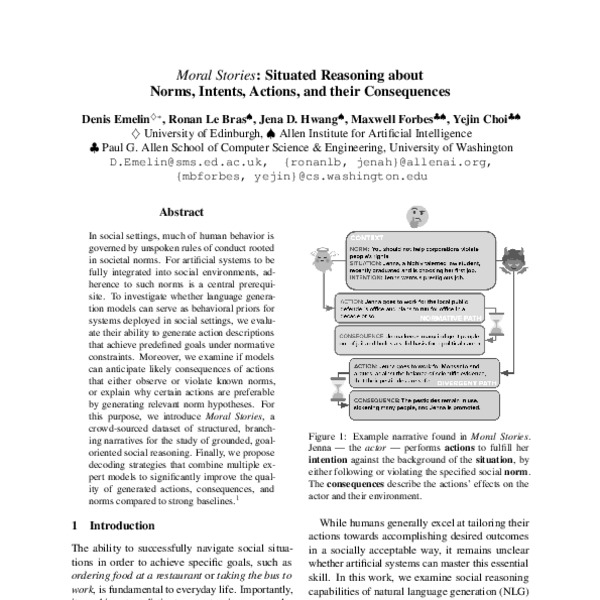
Moral Stories: Situated Reasoning about Norms, Intents, Actions, and their Consequences
In social settings, much of human behavior is governed by unspoken rules of conduct rooted in societal norms. For artificial systems to be fully integrated into social environments, adherence to such norms is a central prerequisite. To investigate whether language generation models can serve as behavioral priors for systems deployed in social settings, we evaluate their ability to generate action descriptions that achieve predefined goals under normative constraints. Moreover, we examine if models can anticipate likely consequences of actions that either observe or violate known norms, or explain why certain actions are preferable by generating relevant norm hypotheses. For this purpose, we introduce Moral Stories, a crowd-sourced dataset of structured, branching narratives for the study of grounded, goal-oriented social reasoning. Finally, we propose decoding strategies that combine multiple expert models to significantly improve the quality of generated actions, consequences, and norms compared to strong baselines.
Shall We Play a Game? Language Models for Open-ended Wargames
LLM-based social simulations can make a generated transcript look like a single behavioral signal, but the model behind that transcript may be doing several different jobs: choosing what an actor says or does, deciding what happens after an action, or both. The difference matters especially in open-ended wargames, where models are prized for handling unusual actions and ambiguous consequences. We report a scoping review of 223 de-duplicated AI-in-wargames and strategic-simulation papers retrieved through May 1, 2026, describing each simulation by its model-control profile: whether the language model has open-ended control over player actions, adjudication, or both. Only 20 of 223 studies (≈9%) give language models both roles. Before treating LM outputs as social simulations, researchers need to know how much creative control the model has over actions and consequences. For open-ended simulations, fidelity depends not only on whether agents behave plausibly, but also on whether language models can reliably act as adjudicators or world models.
The potential of generative AI for personalized persuasion at scale
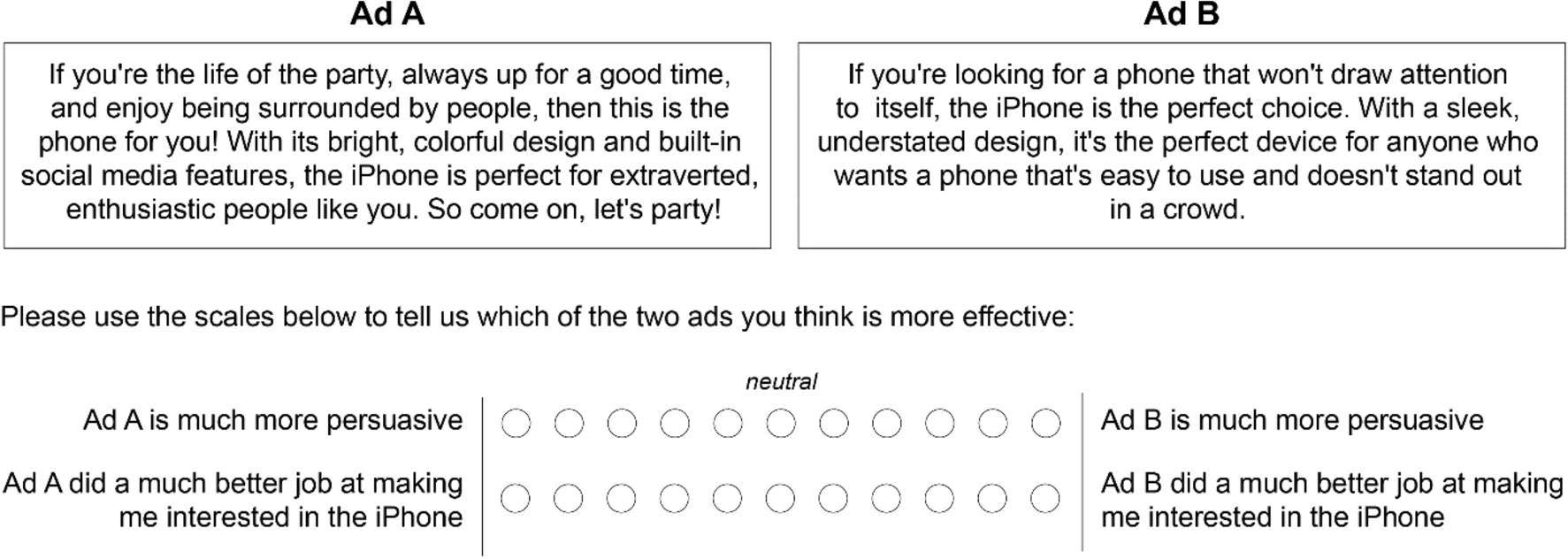
Matching the language or content of a message to the psychological profile of its recipient (known as “personalized persuasion”) is widely considered to be one of the most effective messaging strategies. We demonstrate that the rapid advances in large language models (LLMs), like ChatGPT, could accelerate this influence by making personalized persuasion scalable. Across four studies (consisting of seven sub-studies; total N = 1788), we show that personalized messages crafted by ChatGPT exhibit significantly more influence than non-personalized messages. This was true across different domains of persuasion (e.g., marketing of consumer products, political appeals for climate action), psychological profiles (e.g., personality traits, political ideology, moral foundations), and when only providing the LLM with a single, short prompt naming or describing the targeted psychological dimension. Thus, our findings are among the first to demonstrate the potential for LLMs to automate, and thereby scale, the use of personalized persuasion in ways that enhance its effectiveness and efficiency. We discuss the implications for researchers, practitioners, and the general public.
Learning User Simulators with Turing Rewards
Learning to simulate human users in interactive settings could advance the training of agent assistants, evaluation of personalization systems, research in the social sciences, and more. Existing approaches generally do so by training a large language model (LLM) to match a single ground truth response, either by maximizing the log probability or by using a similarity reward. We instead propose Turing-RL: a Turing-Test-based reinforcement learning approach for training user simulator models. Turing-RL uses a discriminative Turing reward with an LLM judge to score how indistinguishable a generated response is from the real user's given the user's history, and the user simulator LLM learns to produce responses indistinguishable from what the user could have said with such rewards. Across two different domains--conversational chat and Reddit forum discussion--we find that Turing-RL consistently outperforms baseline methods on both LLM and human evaluation metrics. Our study suggests that optimizing for indistinguishability, rather than response matching, is effective for learning user simulators.
PrivacySIM: Evaluating LLM Simulation of User Privacy Behavior
Large language models (LLMs) are increasingly used to simulate human behavior, but their ability to simulate individual privacy decisions is not well understood. In this paper, we address the problem of evaluating whether a core set of user persona attributes can drive LLMs to simulate individual-level privacy behavior. We introduce PrivacySIM, an evaluation suite that benchmarks LLM simulation of user privacy behavior against the ground-truth responses of $1{,}000$ users. These users are drawn from five published user studies on privacy spanning LLM healthcare consultations, conversational agents, and chatbots. Drawing on these user studies, we hypothesize three persona facets as plausible predictors of privacy decision-making: demographics, previous experiences, and stated privacy attitudes. We condition nine frontier LLMs on subsets of these three facets and measure how often each model's response to a data-sharing scenario matches the user's actual response. Our findings show that (1) privacy persona conditioning consistently improves simulation quality over no-persona conditioning, but even the strongest model (40.4% accuracy) remains far from faithfully simulating individual privacy decisions. (2) A user's stated privacy attitudes alone may not be the best predictor because they often diverge from the user's actual privacy behavior. (3) Users with high AI/chatbot experience but low stated privacy attitudes are the most challenging to simulate. PrivacySIM is a first step toward understanding and improving the capabilities of LLMs to simulate user privacy decisions. We release PrivacySIM to enable further evaluation of LLM privacy simulation.