


Over the past decade, the rise of the Internet has enabled the emergence of surprising new forms of collective intelligence. Examples include Google, Wikipedia,
Beyond the Individual: Understanding the Evolution of Collective Intelligence
This chapter outlines the evolution of collective intelligence, starting from its ancient roots and concluding with modern digital platforms. It discusses intelligence theories, project examples, and the impact of technology on collaborative efforts. Key focuses include the role of the internet and online communities in boosting our collective IQ, with a particular emphasis on Douglas Engelbart's contributions and the open-source movement, as exemplified by Linux's development. The chapter examines how digital transformation has facilitated new forms of community and knowledge sharing, significantly influencing fields such as management, decision-making, and organizational learning. Various scholars and their definitions of CI are discussed, including Pierre Lévy's vision of universally distributed intelligence and the concept of swarm intelligence in biological sciences. We then move on to practically implemented CI projects, exploring crowdsourcing as a manifestation of CI in business and social projects and examining possibilities of harnessing the wisdom of crowds for problem-solving and innovation. The chapter concludes with a presentation of the current state of collective intelligence academic research.

How large language models can reshape collective intelligence
Collective intelligence underpins the success of groups, organizations, markets and societies. Through distributed cognition and coordination, collectives can achieve outcomes that exceed the capabilities of individuals—even experts—resulting in improved accuracy and novel capabilities. Often, collective intelligence is supported by information technology, such as online prediction markets that elicit the ‘wisdom of crowds’, online forums that structure collective deliberation or digital platforms that crowdsource knowledge from the public. Large language models, however, are transforming how information is aggregated, accessed and transmitted online. Here we focus on the unique opportunities and challenges this transformation poses for collective intelligence. We bring together interdisciplinary perspectives from industry and academia to identify potential benefits, risks, policy-relevant considerations and open research questions, culminating in a call for a closer examination of how large language models affect humans’ ability to collectively tackle complex problems.
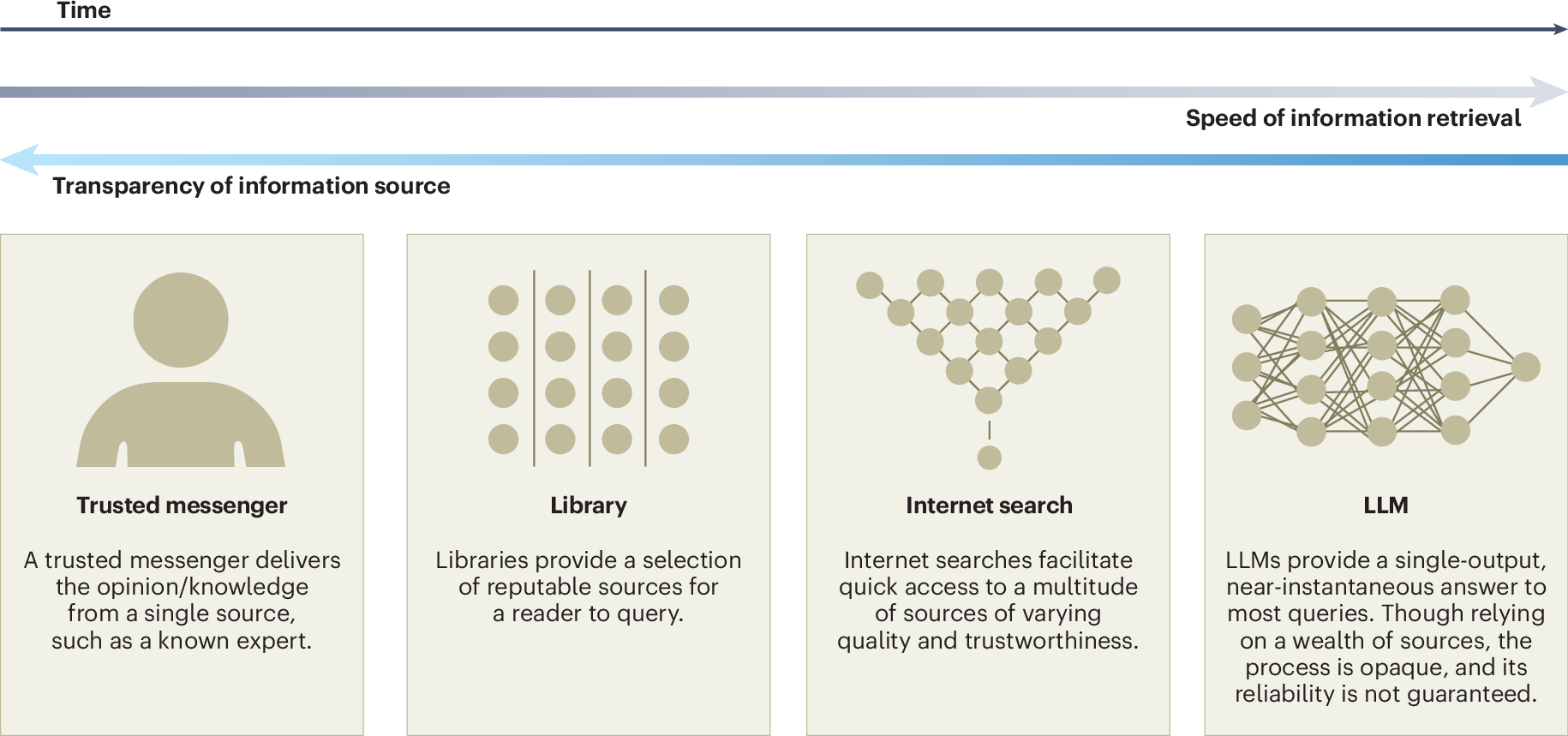
How large language models can reshape collective intelligence
Collective intelligence underpins the success of groups, organizations, markets and societies. Through distributed cognition and coordination, collectives can achieve outcomes that exceed the capabilities of individuals—even experts—resulting in improved accuracy and novel capabilities. Often, collective intelligence is supported by information technology, such as online prediction markets that elicit the ‘wisdom of crowds’, online forums that structure collective deliberation or digital platforms that crowdsource knowledge from the public. Large language models, however, are transforming how information is aggregated, accessed and transmitted online. Here we focus on the unique opportunities and challenges this transformation poses for collective intelligence. We bring together interdisciplinary perspectives from industry and academia to identify potential benefits, risks, policy-relevant considerations and open research questions, culminating in a call for a closer examination of how large language models affect humans’ ability to collectively tackle complex problems.
The network science of collective intelligence
In the last few years, breakthroughs in computational and experimental techniques have produced several key discoveries in the science of networks and human collective intelligence. This review presents the latest scientific findings from two key fields of research: collective problem-solving and the wisdom of the crowd. I demonstrate the core theoretical tensions separating these research traditions and show how recent findings offer a new synthesis for understanding how network dynamics alter collective intelligence, both positively and negatively.

The knowledge layer for collective intelligence
A portable data substrate for humans and their tools to think together.

The knowledge layer for collective intelligence
A portable data substrate for humans and their tools to think together.
The knowledge layer for collective intelligence
A portable data substrate for humans and their tools to think together.
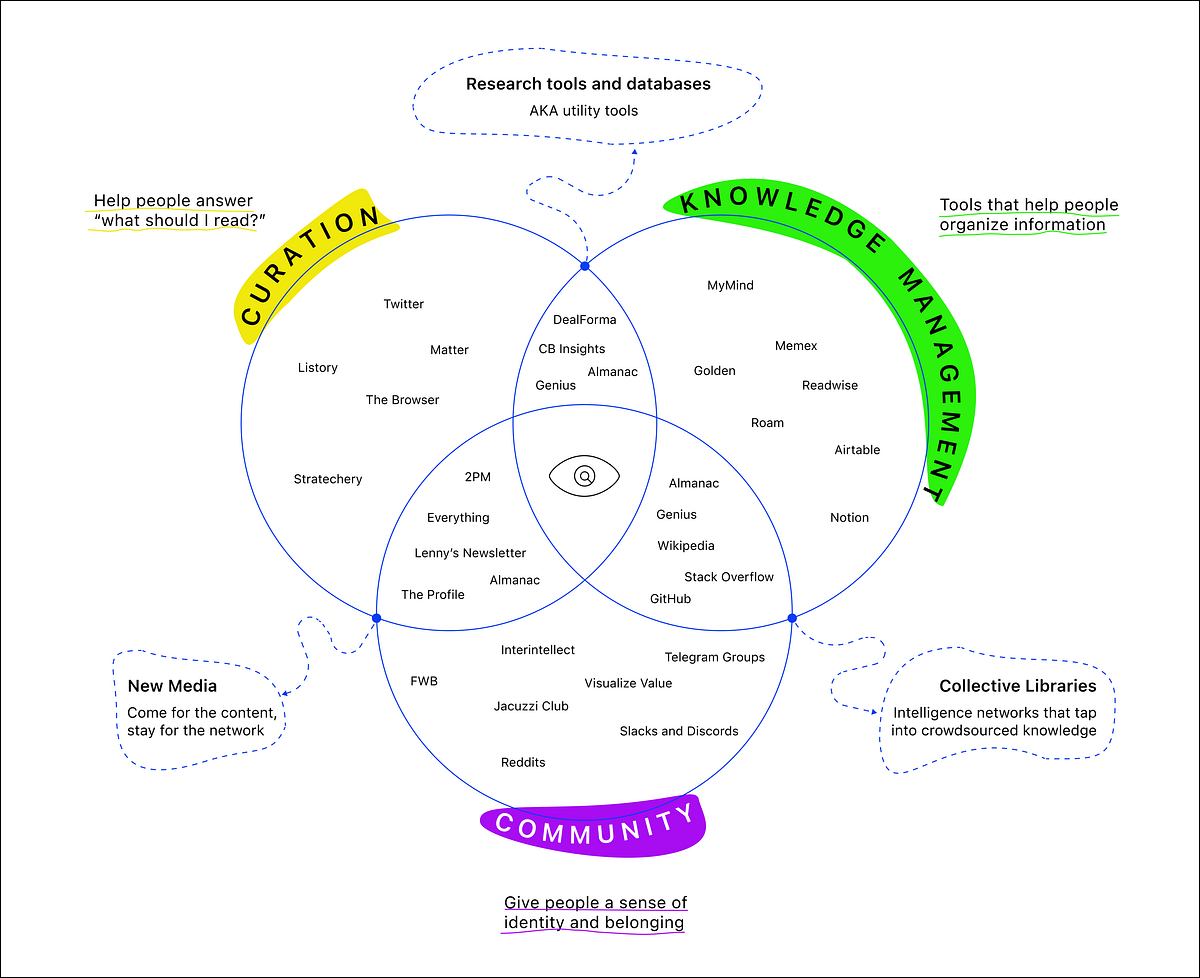
The rise of community-curated knowledge networks
The Internet put thousands of years of human thought at our fingertips, and enabled billions of people to create content. At least 2.5…
A Roadmap to Democratic AI — The Collective Intelligence Project
Our roadmap outlines concrete steps that can be taken in 2024 to build a more democratic AI ecosystem that is adaptive, accountable, processes decentralized information, provides public goods, and safeguards human wellbeing. We describe what the ecosystem could build, research, advocate for, and fun

Education for collective intelligence
Collective Intelligence (CI) is important for groups that seek to address shared problems. CI in human groups can be mediated by educational technologies. The current paper presents a framework to ...

All intelligence is collective intelligence
Author: Falandays, J. Benjamin et al.; Genre: Journal Article; Published online: 2023-04-28; Open Access; Keywords: Collective intelligence, self-organization, multicellularity, neural Darwinism, behavioral coordination, cultural evolution; Title: All intelligence is collective intelligence
Join | Mozilla Data Collective
Mozilla Data Collective is rebuilding the AI data ecosystem with communities at the centre.

Join | Mozilla Data Collective
Mozilla Data Collective is rebuilding the AI data ecosystem with communities at the centre.
The Collective Intelligence Project
We’ve launched an open, collaborative platform to build evaluations that test what matters to you. We empower a global community to create qualitative benchmarks for any domain—from medical chatbots to legal assistance. Just as Wikipedia democratized knowledge, Weval aims to democratize evaluation, ensuring that AI works for, and represents, everyone.
Network dynamics of social influence in the wisdom of crowds
Significance Since the discovery of the wisdom of crowds over 100 years ago theories of collective intelligence have held that group accuracy requires either statistical independence or informational diversity among individual beliefs. Empirical evidence suggests that allowing people to observe the beliefs of others leads to increased similarity of individual estimates, reducing independence and diversity without a corresponding increase in group accuracy. As a result, social influence is expected to undermine the wisdom of crowds. We present theoretical predictions and experimental findings demonstrating that, in decentralized networks, social influence generates learning dynamics that reliably improve the wisdom of crowds. We identify general conditions under which influence, not independence, produces the most accurate group judgments. , A longstanding problem in the social, biological, and computational sciences is to determine how groups of distributed individuals can form intelligent collective judgments. Since Galton’s discovery of the “wisdom of crowds” [Galton F (1907) Nature 75:450–451], theories of collective intelligence have suggested that the accuracy of group judgments requires individuals to be either independent, with uncorrelated beliefs, or diverse, with negatively correlated beliefs [Page S (2008) The Difference: How the Power of Diversity Creates Better Groups, Firms, Schools, and Societies ]. Previous experimental studies have supported this view by arguing that social influence undermines the wisdom of crowds. These results showed that individuals’ estimates became more similar when subjects observed each other’s beliefs, thereby reducing diversity without a corresponding increase in group accuracy [Lorenz J, Rauhut H, Schweitzer F, Helbing D (2011) Proc Natl Acad Sci USA 108:9020–9025]. By contrast, we show general network conditions under which social influence improves the accuracy of group estimates, even as individual beliefs become more similar. We present theoretical predictions and experimental results showing that, in decentralized communication networks, group estimates become reliably more accurate as a result of information exchange. We further show that the dynamics of group accuracy change with network structure. In centralized networks, where the influence of central individuals dominates the collective estimation process, group estimates become more likely to increase in error.

Collective Intelligence Research

Explorations into the idea that a group of humans is "more intelligent" than the sum of their "IQ" (i.e. "groups of individuals doing things collectively that seem intelligent")
How large language models can reshape collective intelligence

Sharing Notes about Collective Intelligence — Pop Junctions

Socially Minded Intelligence: How Individuals, Groups, and Artificial Intelligence Can Make Each Other Smarter (or Not)

Profile: Adrien Treuille

NOVA | The Wisdom of the Crowds | Season 45 | Episode 6
Mapping Citizen Science through the Lens of Human-Centered AI