


From Community Notes to Community Posts
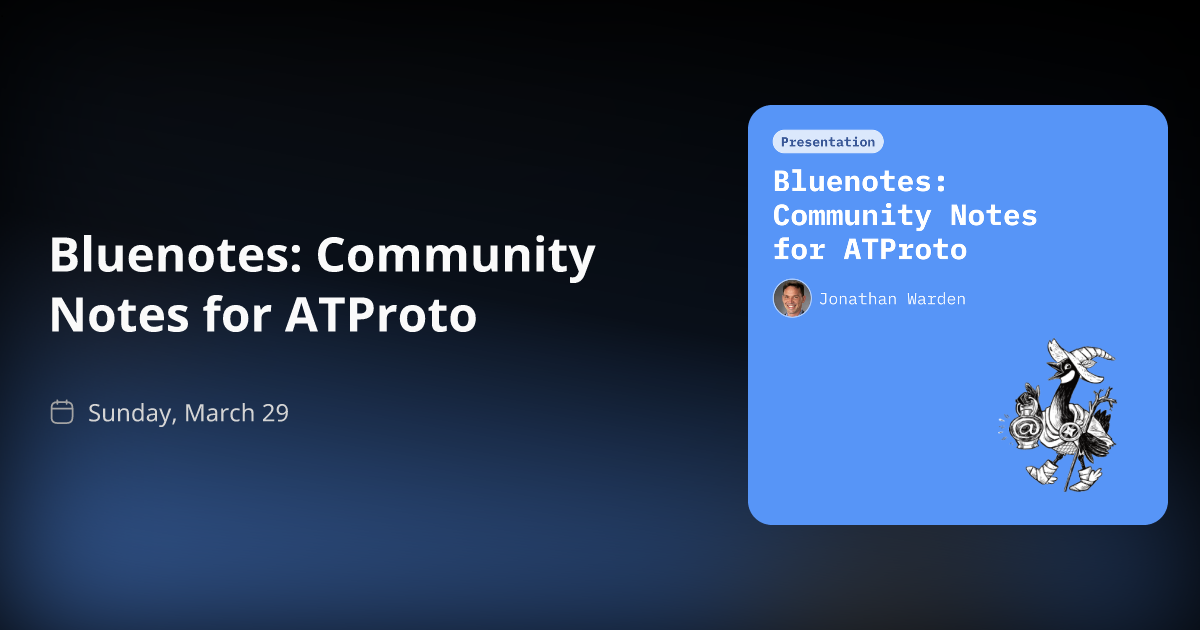
Bluenotes: Community Notes for ATProto
I'll briefly demonstrate Bluenotes, a fork of the Bluesky with Community Notes. Then I'll discuss a proposed "Open Community Notes" standard and lexicon for Community Notes on ATProto, and discuss challenges such as preserving contributor anonymity and defending against manipulation.
Triple Pattern Fragments: a Low-cost Knowledge Graph Interface for the Web
Does this article spark your interest? Then we should work together!
From Social Network to Sense Making
Santiago on Twitter / X
Knowledge graphs for representing information are unbeatable.After this, you will never build a RAG system without knowledge graphs.It will take you five lines of code to build a knowledge graph with your data.I recorded a video to show you how you can do this.I used… pic.twitter.com/1jQ6Gejczq— Santiago (@svpino) September 26, 2025

open-community-notes/004-labeling at master · johnwarden/open-community-notes
Community Notes on AT Protocol. Contribute to johnwarden/open-community-notes development by creating an account on GitHub.
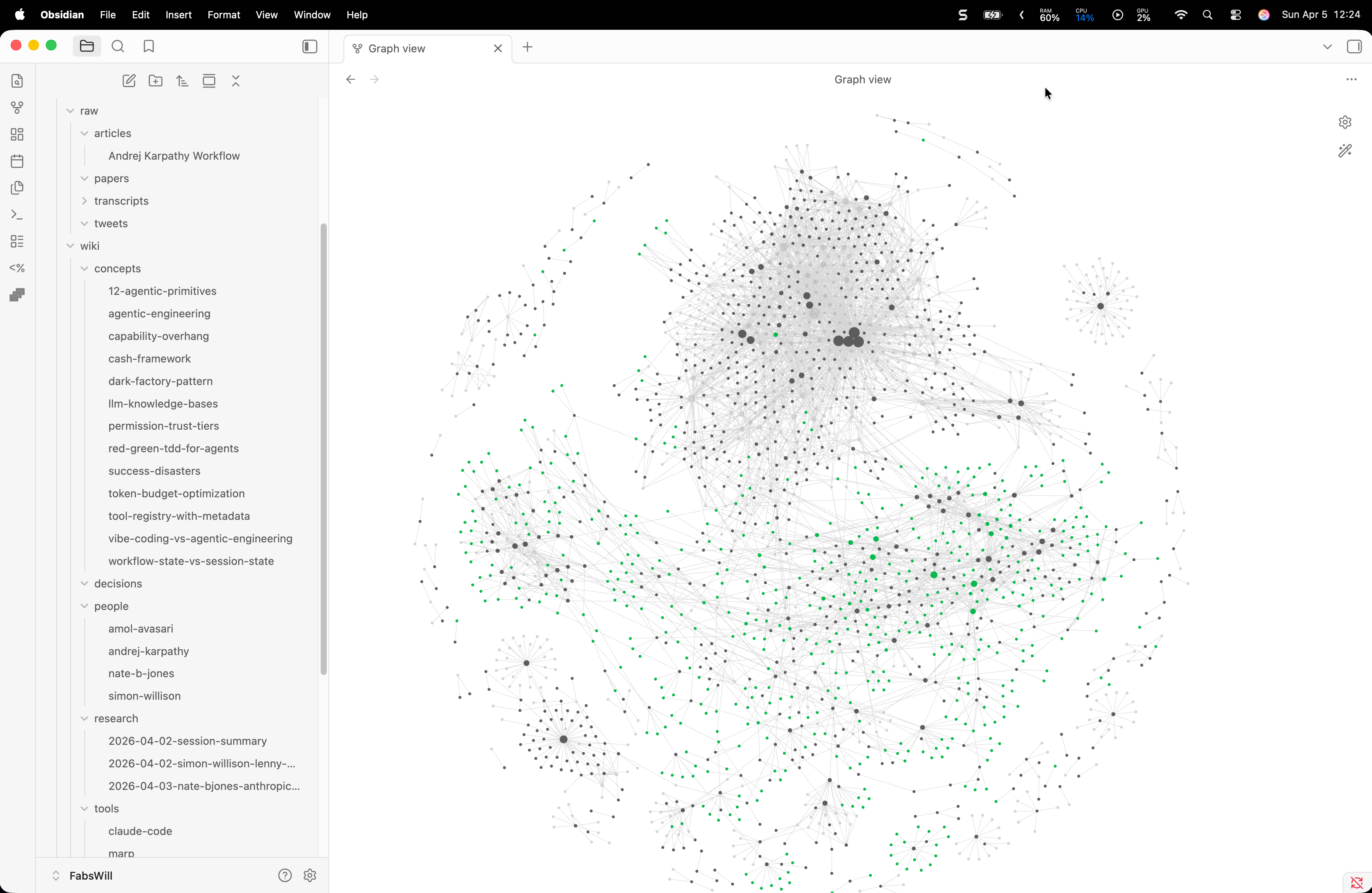
I Built a Knowledge Base That Writes Itself. Here Is What Andrej Karpathy Got Right.
Andrej Karpathy posted about using LLMs to build personal knowledge bases. I took his workflow, wired it into my Obsidian vault with Claude Code, and within an hour had 21 cross-linked wiki articles compiled from YouTube transcripts. Here is how it works and why it matters.
KARMA: Leveraging Multi-Agent LLMs for Automated Knowledge Graph Enrichment
Maintaining comprehensive and up-to-date knowledge graphs (KGs) is critical for modern AI systems, but manual curation struggles to scale with the rapid growth of scientific literature. This paper presents KARMA, a novel framework employing multi-agent large language models (LLMs) to automate KG enrichment through structured analysis of unstructured text. Our approach employs nine collaborative agents, spanning entity discovery, relation extraction, schema alignment, and conflict resolution that iteratively parse documents, verify extracted knowledge, and integrate it into existing graph structures while adhering to domain-specific schema. Experiments on 1,200 PubMed articles from three different domains demonstrate the effectiveness of KARMA in knowledge graph enrichment, with the identification of up to 38,230 new entities while achieving 83.1% LLM-verified correctness and reducing conflict edges by 18.6% through multi-layer assessments.
AutoSchemaKG: Autonomous Knowledge Graph Construction through Dynamic Schema Induction from Web-Scale Corpora
In the current era of information abundance, transforming vast amounts of unstructured data into structured, machine-readable knowledge remains one of the most significant challenges in artificial intelligence. Knowledge Graphs (KGs) have emerged as the cornerstone technology for this transformation Zhao et al. (2024), providing the semantic backbone for applications ranging from search engines and question answering Wu et al. (2024); Chen et al. (2024c); Zong et al. (2024); Sun et al. (2024b) to recommendation systems Lyu et al. (2024) and complex reasoning tasks Li et al. (2024b). Yet despite their critical importance, current KG construction approaches remain hampered by an inherent paradox: they require predefined schemas created by domain experts, which fundamentally limits their scalability, adaptability, and domain coverage.
Chive's knowledge graph - Chive
How Chive's community-governed knowledge graph replaces hardcoded categories with a portable, extensible vocabulary.
Orrery, a Knowledge Graph That Adapts to Its Corpus
Orrery is our open-source knowledge graph that gets deeper as you feed it: domains that hit critical mass earn their own custom extraction specs, agents get an API, and humans get a galaxy. The whole …

Introduction
Learn everything about Community Notes, X's open-source program to create a better-informed world.

AI Fact-Checking in the Wild: A Field Evaluation of LLM-Written Community Notes on X
Large language models (LLMs) show promising capabilities for fact-checking, yet prior work evaluates them only in controlled offline settings using benchmarks or crowdworker judgments. Success in real-world fact-checking depends also on how content is judged within a live platform environment. We present the first field evaluation of LLM fact-checking deployed on a live social media platform, testing performance directly through X Community Notes’ “AI writer” feature over a three-month period. Our LLM writer, a multi-step pipeline that handles multimodal content, conducts web and platform-native search, and writes contextual notes, was deployed to write 1,614 notes on 1,597 tweets and compared against 1,332 human-written notes on the same tweets using 108,169 ratings from 42,521 raters. Direct comparison of note-level platform outcomes is complicated by differences in submission timing and exposure between LLM and human notes; we therefore pursue two analysis strategies: a rating-level analysis modeling individual rater evaluations, and a note-level analysis that relies on common raters who rated all notes on the same post. Rating-level analysis shows that LLM notes receive more positive ratings than human notes across raters with different political viewpoints, and note-level analysis shows LLM notes achieve significantly higher helpfulness scores among common raters. Rater-provided tags suggest that people consider LLM notes to use more neutral language and cite better sources. These findings provide field evidence that LLMs can contribute broadly helpful fact-checking notes at scale, while showing that their evaluation is shaped by platform dynamics absent from controlled offline settings.
Andrej Karpathy on Twitter / X
LLM Knowledge BasesSomething I'm finding very useful recently: using LLMs to build personal knowledge bases for various topics of research interest. In this way, a large fraction of my recent token throughput is going less into manipulating code, and more into manipulating…— Andrej Karpathy (@karpathy) April 2, 2026
Community notes over papers is another example of a new kind of annotation that goes far beyond merely a "mention" and can be easily incorporated into protocol powered research ecosystems like #ATScience
