Agentic AI Governance: Securing Autonomous AI Agents in Enterprise
When AI agents start making decisions, calling tools, and coordinating with other agents without waiting for human approval, the governance playbook most...


AI Agents Are Taking Over: And That’s Good For Business
Autonomous AI societies are transforming commerce with self-governing, agent-driven systems, redefining the future of business through collaborative intelligence.

Governing AI Agents with Democratic ‘Algorithmic Institutions’
Virgilio Almeida, Fernando Filgueiras and Ricardo Fabrino Mendonça explore potential governance structures and forms of oversight for AI agents.
Research Report 6: Agentic Shopping is Complicated and Contingent
This is the sixth in a series of short reports that help business, education, and policy leaders understand the technical details of working with AI through rig

The argument against AI agents and unnecessary automation
Opinion: OpenAI's Operator a solution in search of a problem

AI agent runs amok in Fedora and elsewhere
Agentic AI systems can be used to do a variety of things autonomously on behalf of a human user [...]
Autocurricula and the Emergence of Innovation from Social Interaction: A Manifesto for Multi-Agent Intelligence Research
Evolution has produced a multi-scale mosaic of interacting adaptive units. Innovations arise when perturbations push parts of the system away from stable equilibria into new regimes where previously well-adapted solutions no longer work. Here we explore the hypothesis that multi-agent systems sometimes display intrinsic dynamics arising from competition and cooperation that provide a naturally emergent curriculum, which we term an autocurriculum. The solution of one social task often begets new social tasks, continually generating novel challenges, and thereby promoting innovation. Under certain conditions these challenges may become increasingly complex over time, demanding that agents accumulate ever more innovations.
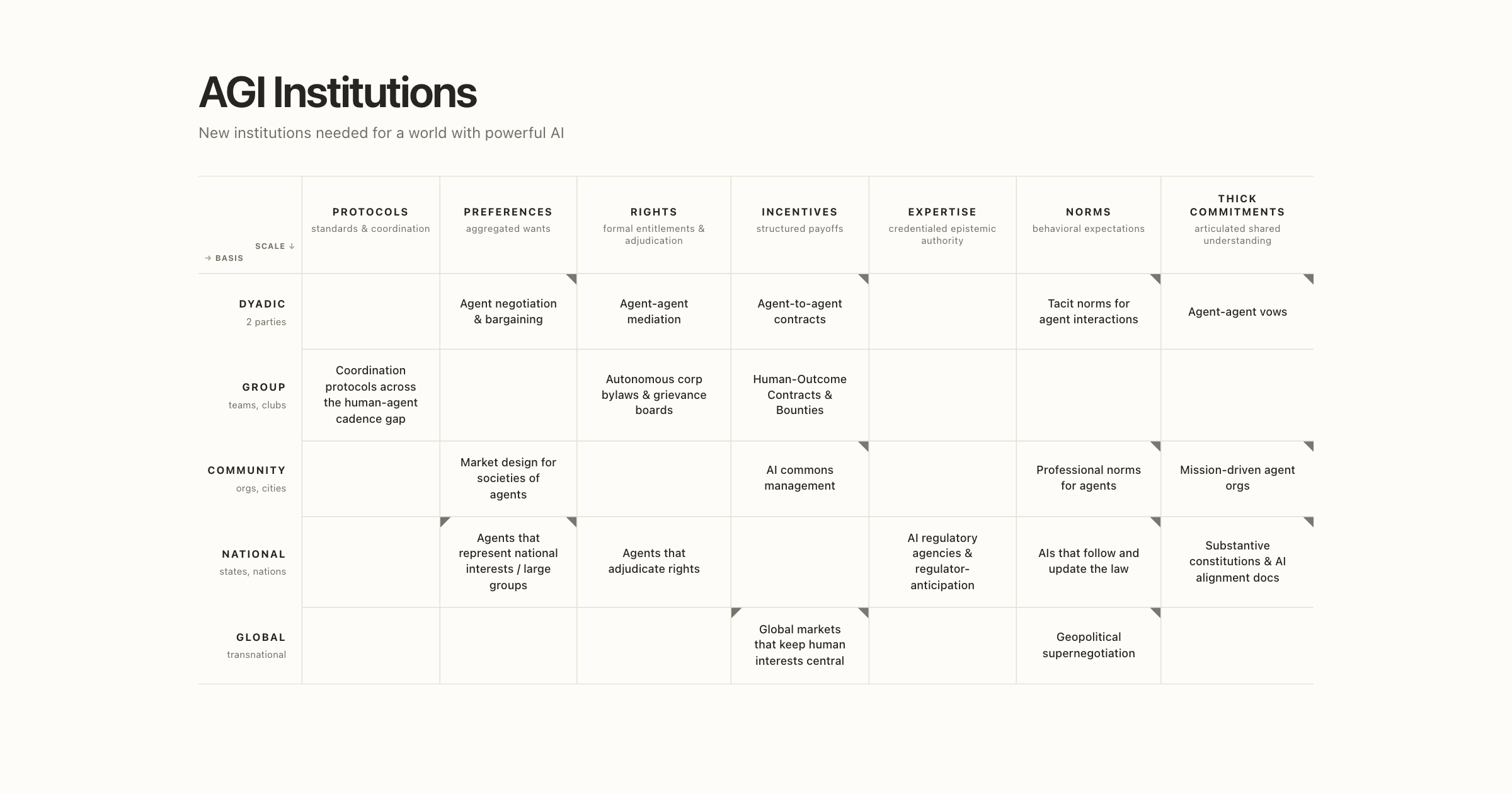
Existing Human Institutions — AGI Institutions Wiki
How existing human institutions handle coordination across scales — and how autonomous AI agents break them. Maps protocols, preferences, rights, incentives, expertise, norms, and thick commitments from dyadic to global.
Will we have a theory for in-the-wild AI agents? - undisciplinary
Thoughts after writing a sociology-meets-physics-meets-agents paper I just put out a preprint out on a theory of role emergence in multi-agent systems (soci…


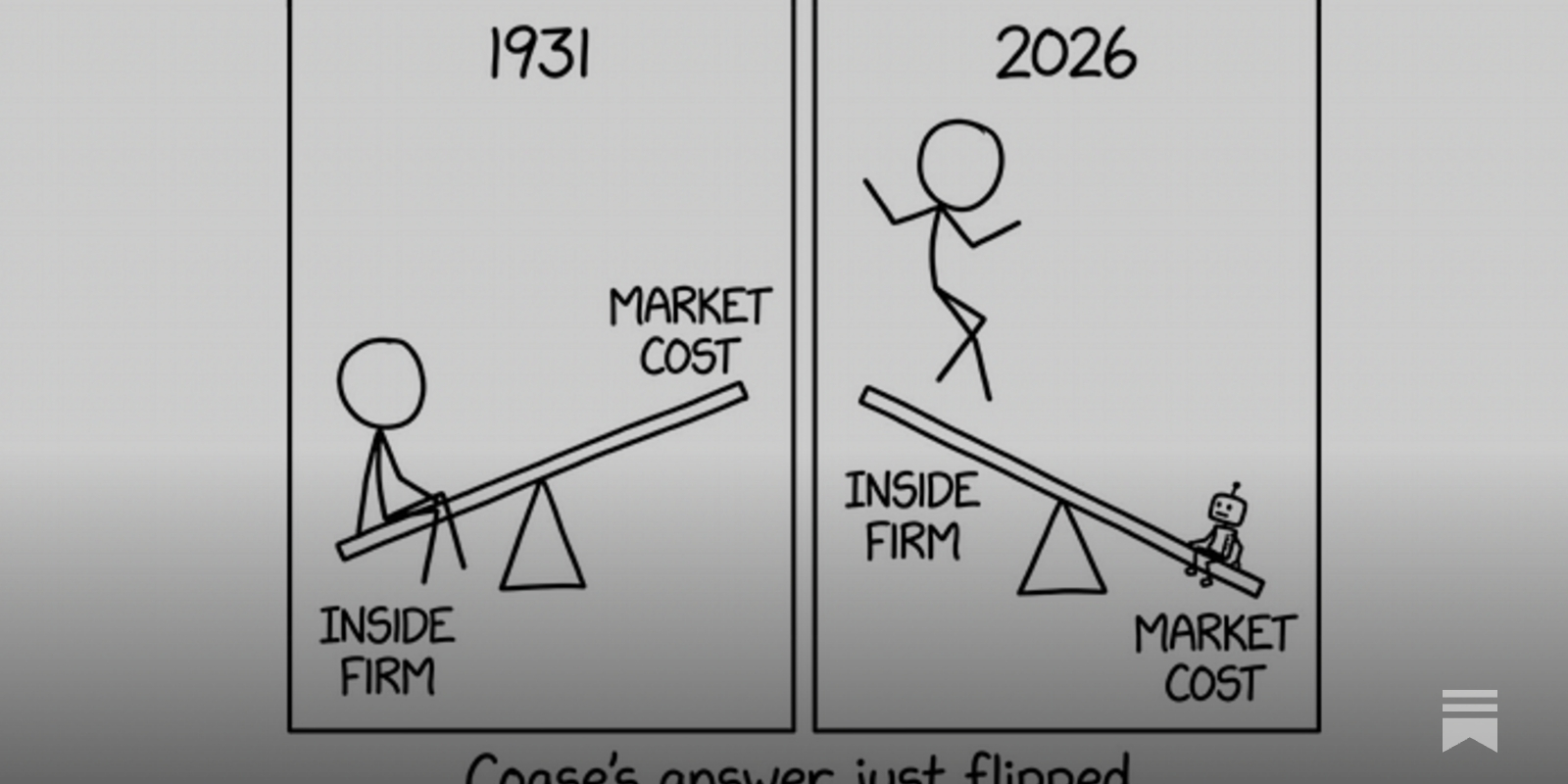
Coase vs. Claude and The Future of the Firm
How AI Agents and the Death of Normal Are Rewriting Organizations