

The balance of software copyright protection and openness has always been fraught with minutiae and detail that bores all but the most nerdy of pedants. Yet, through much effort and 40 years of debate we had reached an equilibrium. Now AI has thrown that out the window.
mp | Coding Alone
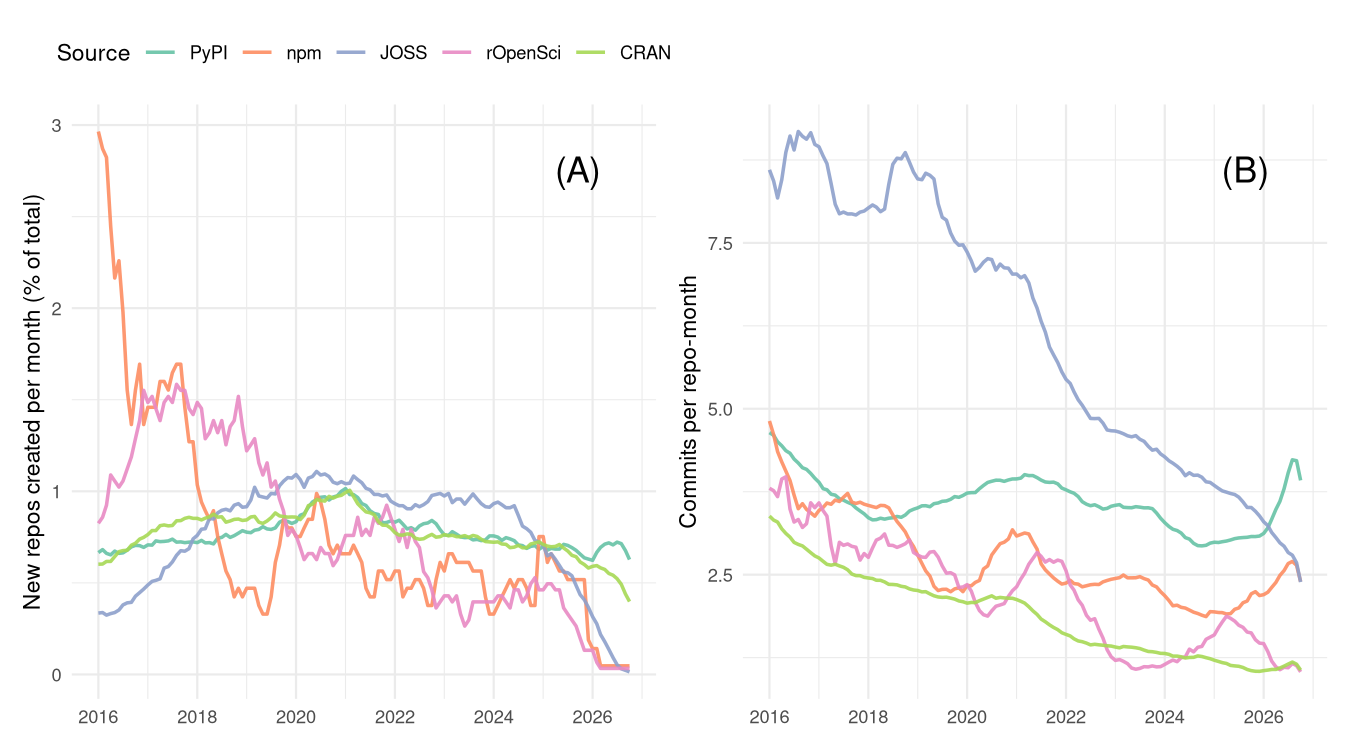
In which I show how, over the last few years, the world has rapidly moved from open-source software being produced and maintained by online communities, to software projects being built and maintained in isolation. By single developers, with ever-decreasing input from others. AI coding tools are now dramatically accelerating movement away from code as a collective endeavour to "coding alone". I conclude by describing how such progression need not be considered inevitable. Every step has reflected the collective influence of countless individual human decisions. The fate of open-source software communities is still determined by us.
AI Slopageddon and the OSS Maintainers
AI slop is ripping up the social contract between maintainers and contributors essential to open source development. Practitioners have been repeatedly assured that AI would supercharge their communities, but so far that hasn’t been the case. Just look at what happened last month. Mitchell Hashimoto’s Ghostty implemented a zero-tolerance policy where submitting bad AI-generated code
What We're No Longer Seeing: AI and the Invisible Newcomer in Open Source
How AI is absorbing the visible friction that open-source communities have always relied on to see—and welcome—newcomers.
Pluralistic: Copyright won't solve creators' Generative AI problem (09 Feb 2023)
The media spectacle of generative AI (in which AI companies' breathless claims of their software's sorcerous powers are endlessly repeated) has understandably alarmed many creative workers, a group that's already traumatized by extractive abuse by media and tech companies.
Humanity in Open Source
Thoughts on how the open source world is changing in the AI era, not always for the better.
The Arguments Against Open Source AI are Very Bad | Tom Bedor's Blog
The release of Kimi K3 has opened a fresh round of angst and confused discourse. There's a loud cohort of journalists, business leaders, and politicians arguing that open source AI is a dangerous threat. OpenAI's Dean Ball:
AI creates asymmetric pressure on Open Source
How Open Source communities can adapt to AI-generated contributions without overwhelming Open Source maintainers

Open source project contains hidden instruction for “AI” agents: delete my code
It’s no secret there’s a war going on inside the open source community, with people adopting “AI” on one side, and those that want nothing to do with it on the other. While the former are, by nature, using destructive tactics like mass website scraping, license washing, taking people’s creative works without permission, taking all the RAM and GPUs, and oh, destroying the planet, the latter have mostly stuck to fairly benign things like policies banning “AI” use, “AI” bot blockers, and the occasional honey pot mazes to trap “AI” crawlers.
Are AI Outputs Covered by Copyright Laws?
Understanding why your AI prompts are not enough to qualify for copyright protection.
Inside the Copyright Office’s Report, Copyright and Artificial Intelligence, Part 2: Copyrightability | Copyright
On January 29, 2025, the U.S. Copyright Office released Part 2 of its Report, Copyright and Artificial Intelligence. The Report addresses the legal and policy issues related to artificial intelligence (AI) and copyright, as outlined in the Office’s August 2023 notice of inquiry (NOI). Part 2: Copyrightability addresses the copyrightability of outputs created using generative …

Machine as Author: Perspectives on AI-Created Works and Copyright
Generative AI's role in creating content challenges traditional copyright frameworks, requiring a redefinition of authorship and protection criteria across different jurisdictions, as seen in the varying approaches of the U.S., EU, and China.
‘Impossible’ to create AI tools like ChatGPT without copyrighted material, OpenAI says
Pressure grows on artificial intelligence firms over the content used to train their products
The fight over downloadable AI is not really about a ban - Sensemaker
Companies want access, Anthropic wants testing, and Washington and Beijing are arguing over alleged copying.
"The forces that are now shaping AI are the same forces that turned the open internet into monopolistic platforms, converted peer-to-peer participation into precarious labor, and enclosed the digital commons. They are now threatening to capture and enclose thought itself." osf.io/preprints/socarxiv/qahd3_v1/
"AI makes it cheaper to contribute to Open Source, but it's not making life easier for maintainers. More contributions are flowing in, but the burden of evaluating them still falls on the same small group of people. That asymmetric pressure risks breaking maintainers." also relevant to slop science
