


In this classic work of women's history (winner of the 1984 Dexter Prize from the Society for the History of Technology), Ruth Schwartz Cowan shows how and w...
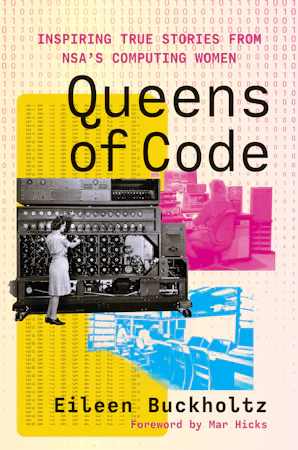
Queens of Code
The dearth of women in our histories of technology cannot be overstated. In Queens of Code, author and one of the female pioneers of computer science Eileen ...
Women in STEM Program - Henry Luce Foundation
Through the Clare Boothe Luce Program for Women in STEM and STEM Convergence, we aspire to close the gender gap in the field, broaden the participation of women from diverse backgrounds, and advance women-led STEM innovation for positive social change.
When Women Stopped Coding
For decades, the share of women majoring in computer science was rising. Then, in the 1980s, something changed.

When Women Stopped Coding
For decades, the share of women majoring in computer science was rising. Then, in the 1980s, something changed.
Silicon Valley’s weapon of choice against women: shoddy science | Angela Saini
Support for the Google ‘manifesto’ on gender difference recalls the rationale of eugenics, says science writer Angela Saini

Feminist Technology
Feminist technology is not related to one specific community of practice, but it has been a field of research and has led to and is still leading to practices that are very valuable in the context of sustainable tech.
The Real World of Technology
These are recordings of Ursula Franklin's public lectures that she made as part of the 1989 Massey Lectures series. The recordings were broadcast by the Canadian Broadcasting Corporation in November, 1989. The lectures were published in a book The Real World of Technology in 1990. A second edition with four additional chapters was published in 1999. If you want you can drop this URL in your Podcast player to listen to them there: https://archive.org/download/the-real-world-of-technology/podcast.xml Franklin was a professor in the University of Toronto's Department of Metallurgy and Materials Science, where she was the first woman to honored with the title of University Professor in 1984. In 1990 she was awarded the Order of Ontario. The lectures provide a singular view into Franklin's ideas about how science and society interact with respective to power and democracy: As I see it, technology has built the house in which we all live. The house is continually being extended and remodelled. More and more of human life takes place within its walls, so that today there is hardly any human activity that does not occur within this house. All are affected by the design of the house, by the division of its space, by the location of its doors and walls. Compared to people in earlier times, we rarely have a chance to live outside this house. And the house is still changing; it is still being built as well as being demolished. In these lectures, I would like to take you through the house, starting with the foundation and then examining with you the walls that have been put up or taken down, the storeys and turrets that have been added, the flow of people through the house — who can come in, who can go into particular spaces. (p. 10) The recordings were obtained from the CBC's web page about Franklin's lectures. As you can see from this snapshot of the page in 2016 only five recordings were made available. However the preface to the first edition of The Real World of Technology clearly states that there were six. The Wikipedia page for the Massey Lectures says that it is a "five-part series", and looking at the information of other Massey lectures seems to confirm that it was in fact a 5 part series. Perhaps the book edition was adjusted to indicate there were 6 talks in order to reshape the text of the chapters? Or maybe it was a typo. The other possibility is that there was an audio file that was left off the website, but the sequencing of the closing credits for each part seems to indicate that there are no audio files missing. The audio was embedded as Flash on the CBC website and converted to MP3 in July, 2016.
Feminist Computer Science Education: "'Women in Computing' As Problematic": A Summary
I've long been interested in why, despite so much organized effort, there percentage of women in CS has been so stagnant. One hypothesis I h...
Ursula Franklin
Ursula Martius Franklin was a Canadian metallurgist, activist, research physicist, author, and educator who taught at the University of Toronto for more than 40 years. Franklin is best known for her writings on the political and social effects of technology. She was the author of The Real World of Technology, which is based on her 1989 Massey Lectures; The Ursula Franklin Reader: Pacifism as a Map, a collection of her papers, interviews, and talks; and Ursula Franklin Speaks: Thoughts and Afterthoughts, containing 22 of her speeches and five interviews between 1986 and 2012. Franklin was a practising Quaker and actively worked on behalf of pacifist and feminist causes. She wrote and spoke extensively about the futility of war and the connection between peace and social justice. Franklin received numerous honours and awards, including the Governor General's Award in Commemoration of the Persons Case for promoting the equality of girls and women in Canada and the Pearson Medal of Peace for her work in advancing human rights. In 2012, she was inducted into the Canadian Science and Engineering Hall of Fame. A Toronto high school, Ursula Franklin Academy, as well as Ursula Franklin Street on the University of Toronto's St. George campus, have been named in her honor.

The Gutenberg Parenthesis
A 2024 CHOICE OUTSTANDING ACADEMIC TITLEPROSE AWARDS MEDIA AND CULTURAL STUDIES FINALIST 2024The Gutenberg Parenthesis traces the epoch of print from its fatefu…

Women in Tech Stats 2026
The Tech industry has long been a male-dominated world but as we entered a new decade it is time to look at the position of women in tech.

Book review: Elinor Ostrom’s Rules for Radicals, by Derek Wall
Elinor Ostrom was the first and so far the only woman to win the Nobel prize for economics*. She received the award in 2009 for her work on the commons. Ostrom died three years later, leaving behin…
Joanna Russ- SF and Technology as Mystification
Talk about technology, long familiar to science-fiction readers and writers, is getting popular in Academia too. Particularly interesting to humanists is the connection between technology and whatever their own particular subject happens to be; I've attended three such formal symposia in the last five years, six including SF conventions, and including informal discussions among students, in writing classes, SF classes, and elsewhere, somewhere between fifty and sixty.
Deep Care by Angela Hume | East Bay Booksellers
The story of the radical feminist networks who worked outside the law to defend abortion. Starting in the 1970s, small groups of feminist activists met regularly to study anatomy, practice pelvic exams on each other, and learn how to safely perform a procedure known as menstrual extraction, which can end a pregnancy, using equipment easily bought and assembled at home.
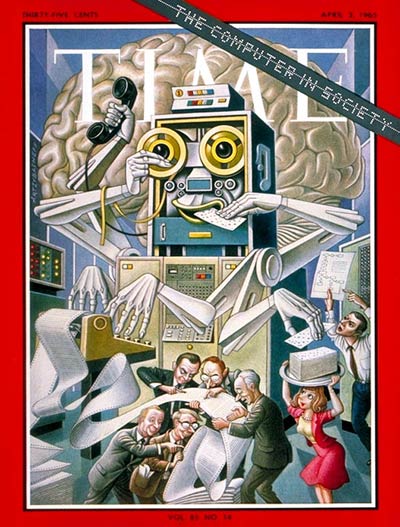
TIME Magazine Cover: Computer in Society - Apr. 2, 1965
TIME Magazine Cover: Computer in Society
Women in Tech
