

The aim of this introduction to the special issue is to call into question the presumed conceptual divide between volunteering and civic action and suggest an analytical tool and four perspectives that bring to light the varying meanings of popular engagement. Volunteering and civic action are laden with different moral meanings, are associated with different theoretical approaches and, just as important, have been assigned different roles in society. This conceptual divide is reflected in the academic debate. Only rarely, however, has the academic debate explored and discussed how the meaning of volunteering and civic action has changed historically. Therefore, we argue for a contextual and relational interpretation of the different forms of popular engagement instead of the application of essentialist definitions of volunteering and civic action. In order to examine the variety of popular engagement without being caught up in pre-made or taken-for-granted conceptualisations of volunteering and civic action as two separate forms of popular engagement, we propose approaching variations of popular engagement with respect to two criteria: first, to what degree popular engagement is enacted in institutionalised spheres of politics or in social public spheres and, second, to what degree actions of popular engagement are controversial or operating in line with what is widely agreed upon and dominant in public opinion. Moreover, we argue that history, discourses, politics and a relational approach are four crucial perspectives in order to reveal the varying meanings of popular engagement.
Tiny Publics: Small Groups and Civil Society
It has been conventional to conceptualize civic life through one of two core images: the citizen as lone individualist or the citizen as joiner. Drawing on analyses of the historical development of the public sphere, we propose an alternative analytical framework for civic engagement based on small-group interaction. By embracing this micro-level approach, we contribute to the debate on civil society in three ways. By emphasizing local interaction contexts-the microfoundations of civil society-we treat small groups as a cause, context, and consequence of civic engagement. First, through framing and motivating, groups encourage individuals to participate in public discourse and civic projects. Second, they provide the place and support for that involvement. Third, civic engagement feeds back into the creation of additional groups. A small-groups perspective suggests how civil society can thrive even if formal and institutional associations decline. Instead of indicating a decline in civil society, a proliferation of small groups represents a healthy development in democratic societies, creating cross-cutting networks of affiliation.
Civic Action
Commonly, researchers have looked for civic life in a distinct sector in which they assume that voluntary associations will cultivate special skills and virtues. Gathering together many challenges to this approach, and using ethnographic cases of housing advocacy and youth civic engagement projects, the authors reconceptualize “the civic” as civic action and show how patterned scene styles shape it. Doing so reveals patterns of action in complex organizations that may span institutional sectors. The authors show how researchers can locate scene styles, and with an extensive literature review, they portray several common styles and suggest that different civic styles often lead to different outcomes.
Citizen Participation (@oliverescobar.bsky.social)
Professor of Public Policy and Democratic Innovation | University of Edinburgh | Working on #democracy #participation #deliberation #commons #governance #power #research | RT≠ endorse | Own views | Profile: https://www.sps.ed.ac.uk/staff/oliver-escobar
Volunteer – Socialists
We are a people-powered movement - we depend on the energy and enthusiasm of our supporters to get our message out. Every contribution, even the smallest, will make a difference.
We Are Civic Media
A discipline-crossing introduction to civic media via accounts from grassroots practitioners “Civic media” is the use of contemporary technologies to connect communities, inspire action, build civic capacity, and sustain social change efforts. Written by artists, creators, storytellers, organizers, and others working at the intersections of technology, social justice, and culture, this book summons civic media through the lived experiences of its contributors. Latoya Peterson delves into the therapeutic power of gaming; Akilah Hughes discusses identity and community through the lens of her campaign to change her high school's racist mascot; and Tyree Boyd-Pates emphasizes the potential power of museum curation to challenge power dynamics and bridge digital and physical realms. Through the experiences of these grassroots practitioners and many others, We Are Civic Media offers accessible insights for those interested in understanding, respecting, and practicing civic media.
Politics Is for Power
A groundbreaking analysis of political hobbyism—treating politics like a spectator sport—and an urgent and timely call to arms for the many well-me...

PARA
Civic social infrastructure for communities, governance, and public participation.
Social Media Effects: Hijacking Democracy and Civility in Civic Engagement
Perceived as an equalizing force for disenfranchised individuals without a voice, the importance of social networks as agents of change cannot be ignored. However, in some societies, social networks have evolved into a platform for fake news and propaganda, empowering disruptive voices, ideologies, and messages. Social networks such as Twitter, Facebook, and Google hold the potential to alter civic engagement, thus essentially hijacking democracy, by influencing individuals toward a particular way of thinking.

Holding the Roots: Resourcing the Infrastructure Behind Movements - Interaction Institute for Social Change
There’s a quiet revolution underway. You can see it in church gatherings and small-town meetings, on Zoom calls between elders and young organizers, in community art projects, healing circles, and protest planning sessions. Across the country, IISC has had the deep honor of supporting and witnessing this movement: the call for food justice in Mississippi,... Read More

Trust in the Federal Government Makes People Less Likely to Help One Another, Study Finds
But trust in local interventions boosts civic engagement.

Consumer Entrapment
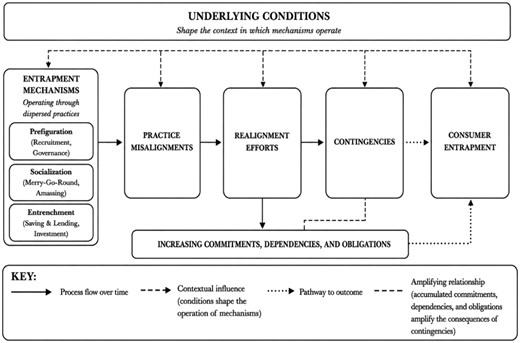
Abstract Why do consumers sometimes remain trapped in the very practices and communities that once helped them? Consumer practice research has largely emphasized the enabling outcomes of sustained practice participation, with less attention given to how those same practices can become entrapping. This article explores how consumer entrapment emerges within interconnected collective practices. Drawing on an ethnographic study of Chama, a community-based savings and support group in Kenya, it integrates practice theory with Hodder’s theory of entanglement. The study identifies three mechanisms (prefiguration, socialization, and entrenchment) through which participation generates commitments, dependencies, and obligations that produce recurring practice misalignments. Consumers continually work to realign these misalignments, yet under specific conditions, these efforts reproduce the contingencies that sustain participation while progressively deepening entrapment. The findings reveal a central tension: efforts to restore practice alignment can sustain what consumers value while simultaneously reproducing the interdependencies through which consumer entrapment emerges.
Volunteering, Nonprofit Jobs, and Community
Find volunteer opportunities, nonprofit jobs, social-impact opportunities and more on the Idealist platform.

Activist Handbook | Campaigning guides for activists ✊
We write guides for activists. Learn how to become a social activist, plan a political campaign strategy, and start a grassroots movement.
Ground Control: Volunteer where it counts
We've evaluated hundreds of organizations to find opportunities open to anyone, immediately impactful, and ready to accept your help.
We will discuss this paper in the civic participation journal club. Cannot wait to read it at lunchtime tomorrow🍎

Brihi Joshi
Reasoning about the "why" behind user behavior can improve LLM personas! ✨🧠📈 📝Excited to share our new work: Improving LLM Personas via Rationalization with Psychological Scaffolds 🔗 arxiv.org/abs/2504.17993 🧵 (1/n)
