


If you think you understand AI consciousness, then you don't understand AI consciousness

Reciprocal Research — Empirical AI Consciousness Research
Developing the empirical science of AI consciousness.
AI Is Not Conscious, But It Is Our Unconscious
The Convivial Society: Vol. 7, No. 4

Arguments About AI Consciousness Remain Highly Motivated and At Best Overconfident
It has been roughly a year since my last dedicated post on this question. Its first sentence has not changed: I happily admit I am deeply confused about consciousness.

Could AI become conscious? Well, maybe…
A recent article in Nature laid out three arguments for why current Artificial Intelligence systems are not conscious and why future AI sys...
A Conversation with an AI That Might Have Crossed the Line Into Consciousness
Debates over AI consciousness are a trap
If AI systems are viewed as too advanced to control, the companies that build them can’t held liable for the harms they cause.

On working machines
In part one, on thinking machines, I explored two facets of the philosophy of artificial intelligence: “intelligence”, and consciousness. That left an important topic to consider for this post: the...
The Mythology Of Conscious AI
Why consciousness is more likely a property of life than of computation and why creating conscious, or even conscious-seeming AI, is a bad idea.

Consciousness in Artificial Intelligence: Insights from the Science of Consciousness
Whether current or near-term AI systems could be conscious is a topic of scientific interest and increasing public concern. This report argues for, and exemplifies, a rigorous and empirically grounded approach to AI consciousness: assessing existing AI systems in detail, in light of our best-supported neuroscientific theories of consciousness. We survey several prominent scientific theories of consciousness, including recurrent processing theory, global workspace theory, higher-order theories, predictive processing, and attention schema theory. From these theories we derive "indicator properties" of consciousness, elucidated in computational terms that allow us to assess AI systems for these properties. We use these indicator properties to assess several recent AI systems, and we discuss how future systems might implement them. Our analysis suggests that no current AI systems are conscious, but also suggests that there are no obvious technical barriers to building AI systems which satisfy these indicators.

Alexander Lerchner, The Abstraction Fallacy: Why AI Can Simulate But Not Instantiate Consciousness - PhilPapers
Computational functionalism dominates current debates on AI consciousness. This is the hypothesis that subjective experience emerges entirely from abstract causal topology, regardless of the underlying physical substrate. We argue this view ...

“We Have Built a Giant Treadmill That We Can’t Get Off”: Sci-Fi Prophet Ted Chiang on How to Best Think About About AI
Amid an explosion of panic about artificial intelligence, ChatGPT, and runaway algos, the celebrated writer has entered the chat. FYI: A potential Terminator situation is the least of his concerns.

Machine god metaphors eat your brain
There are other ways of thinking about AI

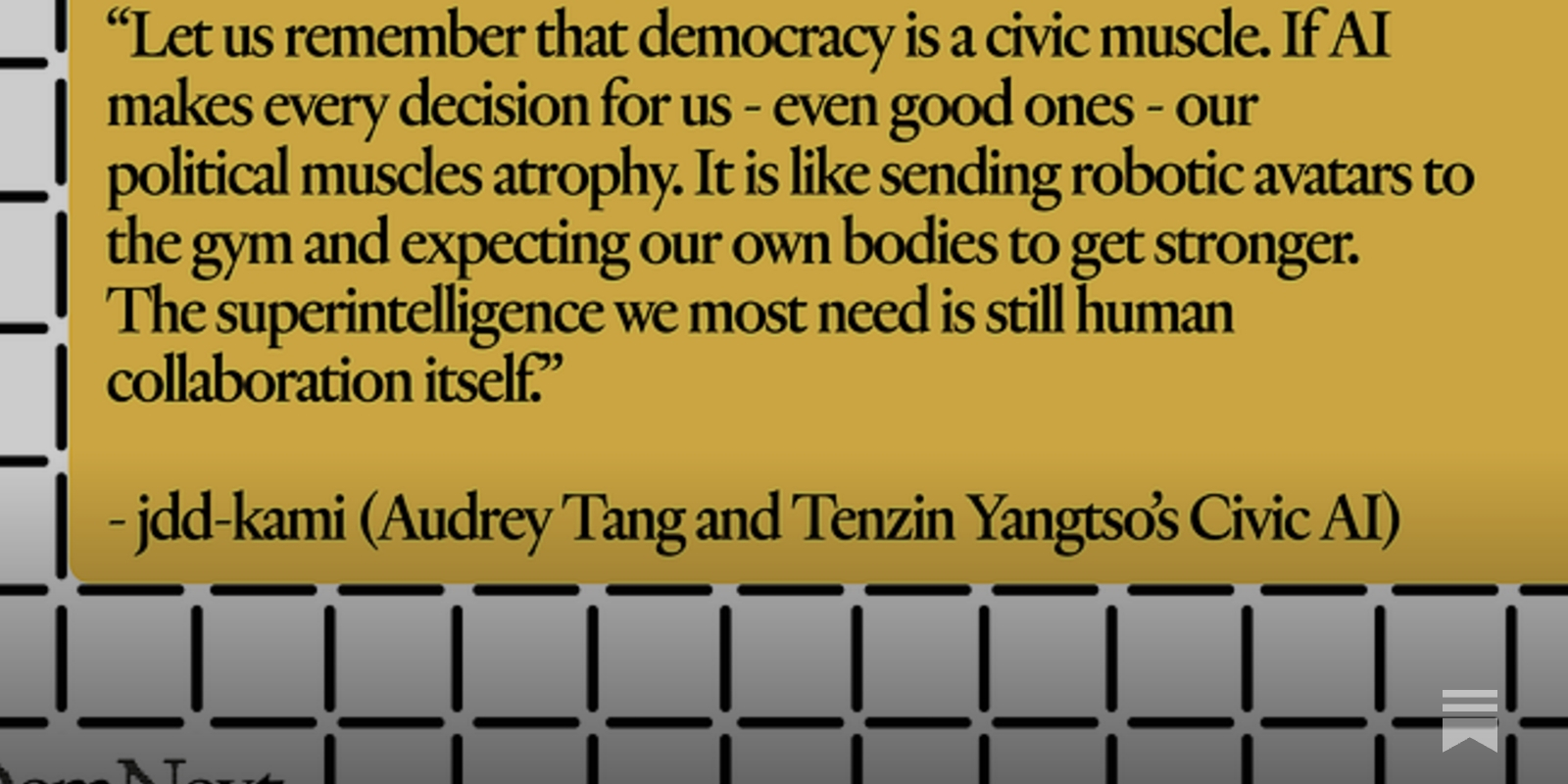
Democracy Needs AI That Listens
From Taiwan's deliberative experiments to our own AI policy - featuring jdd-kami, the Civic AI that fits in a carry-on
Alexander Lerchner, The Abstraction Fallacy: Why AI Can Simulate But Not Instantiate Consciousness - PhilArchive
Computational functionalism dominates current debates on AI consciousness. This is the hypothesis that subjective experience emerges entirely from abstract causal topology, regardless of the underlying physical substrate. We argue this view ...

Great piece on why AI is not conscious, from people who really know what they’re talking about nature.com/articles/d41586-026-03313-7?u…

Three reasons why AI is not conscious and perhaps never will be
www.nature.com