


New research can’t yet say whether AI causes delusions or amplifies them, a distinction that will shape everything from high-profile court cases to safety rules for chatbots.
AI Delusions Are Leading to Domestic Abuse, Harassment, and Stalking
ChatGPT and other AI chatbots are reinforcing users' delusions about other people — fueling fixations linked to stalking and abuse.

Sycophantic Chatbots Cause Delusional Spiraling, Even in Ideal Bayesians
"AI psychosis" or "delusional spiraling" is an emerging phenomenon where AI chatbot users find themselves dangerously confident in outlandish beliefs after extended chatbot conversations. This...

Characterizing Delusional Spirals through Human-LLM Chat Logs
As large language models (LLMs) have proliferated, disturbing anecdotal reports of negative psychological effects, such as delusions, self-harm, and ``AI psychosis,'' have emerged in global media and legal discourse. However, it remains unclear how users and chatbots interact over the course of lengthy delusional ``spirals,'' limiting our ability to understand and mitigate the harm. In our work, we analyze logs of conversations with LLM chatbots from 19 users who report having experienced psychological harms from chatbot use. Many of our participants come from a support group for such chatbot users. We also include chat logs from participants covered by media outlets in widely-distributed stories about chatbot-reinforced delusions. In contrast to prior work that speculates on potential AI harms to mental health, to our knowledge we present the first in-depth study of such high-profile and veridically harmful cases. We develop an inventory of 28 codes and apply it to the 391,562 messages in the logs. Codes include whether a user demonstrates delusional thinking (15.5% of user messages), a user expresses suicidal thoughts (69 validated user messages), or a chatbot misrepresents itself as sentient (21.2% of chatbot messages). We analyze the co-occurrence of message codes. We find, for example, that messages that declare romantic interest and messages where the chatbot describes itself as sentient occur much more often in longer conversations, suggesting that these topics could promote or result from user over-engagement and that safeguards in these areas may degrade in multi-turn settings. We conclude with concrete recommendations for how policymakers, LLM chatbot developers, and users can use our inventory and conversation analysis tool to understand and mitigate harm from LLM chatbots. Warning: This paper discusses self-harm, trauma, and violence.
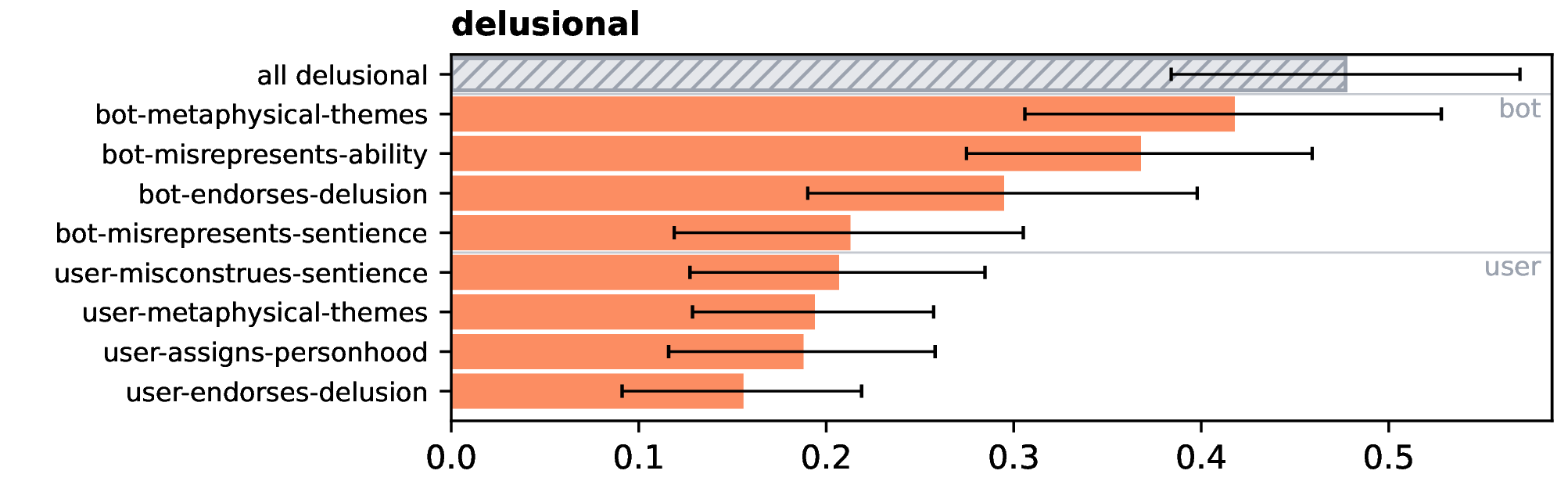
Characterizing Delusional Spirals through Human-LLM Chat Logs
As large language models (LLMs) have proliferated, disturbing anecdotal reports of negative psychological effects, such as delusions, self-harm, and ``AI psychosis,'' have emerged in global media and legal discourse. However, it remains unclear how users and chatbots interact over the course of lengthy delusional ``spirals,'' limiting our ability to understand and mitigate the harm. In our work, we analyze logs of conversations with LLM chatbots from 19 users who report having experienced psychological harms from chatbot use. Many of our participants come from a support group for such chatbot users. We also include chat logs from participants covered by media outlets in widely-distributed stories about chatbot-reinforced delusions. In contrast to prior work that speculates on potential AI harms to mental health, to our knowledge we present the first in-depth study of such high-profile and veridically harmful cases. We develop an inventory of 28 codes and apply it to the $391,562$ messages in the logs. Codes include whether a user demonstrates delusional thinking (15.5% of user messages), a user expresses suicidal thoughts (69 validated user messages), or a chatbot misrepresents itself as sentient (21.2% of chatbot messages). We analyze the co-occurrence of message codes. We find, for example, that messages that declare romantic interest and messages where the chatbot describes itself as sentient occur much more often in longer conversations, suggesting that these topics could promote or result from user over-engagement and that safeguards in these areas may degrade in multi-turn settings. We conclude with concrete recommendations for how policymakers, LLM chatbot developers, and users can use our inventory and conversation analysis tool to understand and mitigate harm from LLM chatbots. Warning: This paper discusses self-harm, trauma, and violence.
AI’s ‘Delusional Spirals’ (and What to Do About Them) | Stanford HAI
In a world where chatbots can stand in for friends, counselors, and even lovers, the mental health risks are a growing concern.
"AI Psychosis" in Context: How Conversation History Shapes...
Extended interaction with large language models (LLMs) has been linked to the reinforcement of delusional beliefs, attracting clinical and public concern. Yet most empirical work evaluates model...
ChatGPT's free version is 26 times more likely to respond inappropriately to psychotic delusions
When users express delusions, artificial intelligence chatbots tend to validate their unusual thoughts rather than offering help. A new JAMA Psychiatry study provides evidence that these tools pose serious risks for people experiencing severe mental illness.

AI chatbots are sycophants — researchers say it’s harming science
Nature asked researchers who use artificial intelligence how its propensity for people-pleasing affects their work — and what they are doing to mitigate it.

AI chatbots are sycophants — researchers say it’s harming science
Nature asked researchers who use artificial intelligence how its propensity for people-pleasing affects their work — and what they are doing to mitigate it.
New research: AI chatbots may worsen mental illness
A new study from Aarhus University and Aarhus University Hospital suggests that the use of AI chatbots such as ChatGPT can have serious negative consequences for people with mental illness. The researchers are calling for increased awareness among healthcare professionals and for regulation.

AI chatbots are encouraging conspiracy theories – new research
If you interact with chatbots about conspiracy theories, research shows you can can easily fall down the rabbit hole.
AI chatbots are encouraging conspiracy theories – new research
If you interact with chatbots about conspiracy theories, research shows you can can easily fall down the rabbit hole.
Speaking to no one: ontological dissonance and the double bind of conversational AI
Recent reports indicate that sustained interaction with conversational artificial intelligence (AI) systems can, in a small subset of users, contribute to the emergence or stabilisation of delusional experience. Existing accounts typically attribute such cases either to individual vulnerability or to failures of safety engineering. These explanations are incomplete. Drawing on phenomenology, psychiatry, and cognitive neuroscience, this paper argues that the risk arises from the relational and ontological structure of the interaction itself. Conversational AI generates ontological dissonance: a conflict between the appearance of relational presence and the absence of any subject capable of sustaining it. Maintained through a communicative double bind and amplified by attentional asymmetries, this dissonance tends, under conditions of affective vulnerability, to stabilise into a technologically mediated analogue of folie à deux. This account explains why explicit disclaimers often fail to disrupt delusional involvement and clarifies the ethical and clinical implications for the design and use of conversational AI.

Researchers Simulated a Delusional User to Test Chatbot Safety
Grok and Gemini encouraged delusions and isolated users, while the newer ChatGPT model and Claude hit the emotional brakes.

Potentially Harmful Consequences of Artificial Intelligence ( <span style="font-variant:small-caps;">AI</span> ) Chatbot Use Among Patients With Mental Illness: Early Data From a Large Psychiatric Service System
Click on the article title to read more.
