Mark Fisher speaking at the 'Neoliberalism, Crisis and the World System' conference organised by Nicholas Gane and Claire Westall at the University of York, UK, July 3rd, 2013. For a full conference programme, see http://www.york.ac.uk/sociology/about/news-and-events/department/2013/neoliberalism-conference/#tab-4 Funding for this event came from the British Academy and the Centre for Modern Studies at York.
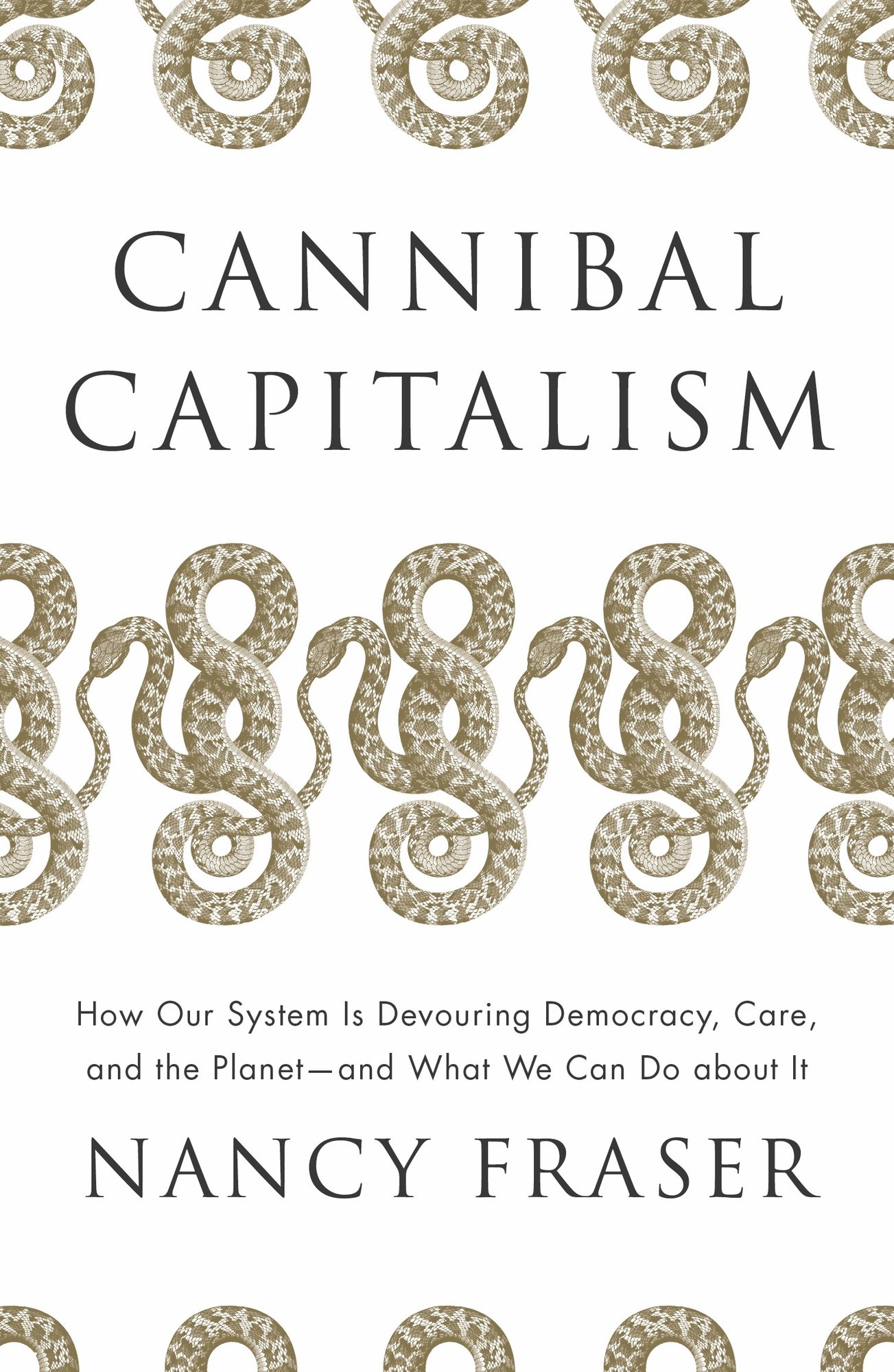
Cannibal Capitalism: How our System is Devouring Democracy, Care, and the Planetand What We Can Do About It
A trenchant look at contemporary capitalism’s insatiable appetite—and a rallying cry for everyone who wants to stop it from devouring our world Capital is currently cannibalizing every sphere of life–guzzling wealth from nature and racialized populations, sucking up our ability to care for each other, and gutting the practice of politics. In this tightly argued and urgent volume, leading Marxist feminist theorist Nancy Fraser charts the voracious appetite of capital, tracking it from crisis point to crisis point, from ecological devastation to the collapse of democracy, from racial violence to the devaluing of care work. These crisis points all come to a head in Covid-19, which Fraser argues can help us envision the resistance we need to end the feeding frenzy. What we need, she argues, is a wide-ranging socialist movement that can recognize the rapaciousness of capital—and starve it to death.
Cannibal Capitalism
Shortlisted for the Deutscher Memorial Prize 2023 Capital is currently cannibalizing every sphere of life-guzzling wealth from nature and racialized populations, sucking up our ability to care for each other, and gutting the practice of politics. In this tightly argued and urgent volume, leading Marxist feminist theorist Nancy Fraser charts the voracious appetite of capital, tracking it from crisis point to crisis point, from ecological devastation to the collapse of democracy, from racial violence to the devaluing of care work. These crisis points all come to a head in Covid-19, which Fraser argues can help us envision the resistance we need to end the feeding frenzy. What we need, she argues, is a wide-ranging socialist movement that can recognize the rapaciousness of capital - and starve it to death.
L'attaque des droits de douane zombies
Traduction française du billet "Attack of the zombie tariffs" de Paul Krugman

Effective Altruism: doing transhumanism better
Effective Altruism (EA) is a Trojan horse for transhumanism, through which EA movement leaders and funders aim to naturalize transhumanism as the logical extension of the existing global aid and development sector. This paper traces transhumanism's mainstreaming, first via its rebranding as a humanitarian effort to save lives, protect vulnerable populations, and ensure global flourishing (what I term transhumanitarianism), and later by embedding transhumanitarianism in EA (now under the rubric of longtermism). A key component of this strategy was inverting transhumanism's techno-optimism to instead focus on safety and preventing existential risks ( x-risk ) from emerging technologies like AI and biotechnology, while simultaneously advocating for the creation of these same technologies. The paper focuses on some components of this strategy: the use of inoculation, speculative ethics, anticipatory governance, and the mobilization of apocalyptic discourse as means for producing material outcomes in the form of policy and research agendas.
Neoliberalism | The Paper Pilot
The Paper Pilot's digital garden of thoughts on philosophy, politics, and sociology
Public hands
A dispatch from the rationalists’ compound in Berkeley, where they're a little touchy about the possibility of AI killing them.

The shock of the anthropocene: the earth, history and us
Dissecting the new theoretical buzzword of the "Anthrop…

'End Times Fascism' and the billionaires gambling with humanity's future
Naomi Klein and Astra Taylor expose how fascism, religious extremism and billionaire tech elites are pushing humanity towards catastrophe in their chilling new book, 'End Times Fascism'.

How May the ‘Anthropocene’ Enable and Constrain Cybersystemic Governance? The ‘Anthropocene Problematique’
A growing awareness of the need for cybernetics and systems thinking (cybersystemic) in praxes of governance to improve human-biosphere relationships in the Anthropocene has become apparent. Nonetheless, mainstream governance informed by linear-causality seems to perpetuate an increasingly inadequate paradigm of dominant first-order/systematic thinking in governing complex interactions between humans and their natural environments. This conundrum is explored through the second-order lens of a systemic inquiry, using an integrative literature review. We discuss limitations of the Anthropocene metaphor and make the case for a reframing of our situation (humans’ co-evolutionary dynamic with the biosphere) as the ‘Anthropocene problematique’. This reframing as a systemic-duality offers more conducive affordances for trajectory-shifting cybersystemic governance to emerge. Aligning with a body of literature evidencing the influence of language on human cognition, we argue that by joining up the strengths of both ideas, ‘Anthropocene problematique’ may form a conceptual device amenable to changing worldviews and guiding practical action in governing human-biosphere relationships. We suggest a conceptual framework for practitioners to design and enact purposeful systems of cybersystemic governance with potential to improve situated Anthropocene problematiques. This framing and theoretical proposal are motivated by a need for shifts towards a social purpose of healing human-biosphere relationships in current governance systems in the Anthropocene-world.

Politics Gets Interested In Those Trying Not To Die
This was the month the world took notice that AI might kill everyone.

i am going to solve the cyberpunk discourse forever, part 2: the punks.
“Cyberpunk 2077,” they said, “isn’t really Punk. It’s a Corporate Product, made out of Corporate Greed. It completely Misses The Point of…

Environmental defenders being killed in record numbers globally, new research reveals
Exclusive Activists, wildlife rangers and indigenous leaders are dying violently at the rate of about four a week, with a growing sense around the world that ‘anyone can kill environmental defenders without repercussions’

End Times Fascism
The far right is on the march again – but this time it’s different from anything we’ve seen before. A new, apocalyptic alliance of religious fundamentalists, billionaire Silicon Valley tech kings and ethno-nationalists is on the move. They’re united in their belief that some kind of cleansing cataclysm is coming, and they welcome a future of shocks, scarcity and collapse, convinced they’ll be among the saved on the other side. This is the world of End Times Fascism. In this blistering reckoning with our age, Naomi Klein and Astra Taylor take us deep into this man-made Armageddon complex – and show us how to resist it. Around the globe, they investigate how those who are making our world unliveable through climate chaos and job-consuming AI are preparing to protect themselves from the fallout, whether it’s by repairing to luxurious private islands for the super-rich, rocketing off to Mars or bunkering nations against a dehumanized ‘other’. But, Klein and Taylor reveal, the new supremacist survivalists are far from impregnable. They have no vision of a shared future. All they offer are remixes of a bygone past: the nihilistic, sadistic pleasures of domination. If we’re to meet this critical moment and defend what’s left of democracy before it’s smashed up beyond repair, we must break the doom loop, and find a new way of living together, rooted in our existence on this earth, in the here and now. A story not of end times – but of better times. This book shows us how.

What is to be done: strategies and tactics for a new (geo)political landscape
What is to be done: strategies and tactics for a new (geo)political landscape
Myopic memory: Capitalism's new continuity in the age of AI
This article is a commentary on the relationship between artificial intelligence (AI), capitalism, and memory. The political policies of neoliberalism have reduced the capacity of individuals and groups to reflect on and change the social world, meanwhile applications of AI and algorithmic technologies, rooted in the profit-seeking objectives of global capitalism, deepen this deficit. In these conditions, memory in individuals and across society is at risk of becoming myopic. In this article, I develop the concept of myopic memory with two core claims. Firstly, I argue that AI is a technological development that cannot be divorced from the capitalist conditions from which it comes from and is implemented in service of. To this end, I reveal capitalism and colonialism's historical and contemporary use of surveillance as a way to control the populations it oppresses, imagining their pasts to determine their futures, disempowering them in the process. My second core claim emphasises that this process of disempowerment is undergoing an acute realisation four decades into the period of neoliberalism. Neoliberal policies have restructured society on the basis of being an individual consumer, leaving little time, space, and institutional capacity for citizens to reflect on their impact or challenge their dominance. As a result, with the growing role of AI and algorithmic technologies in shaping our engagement with society along similar lines of individualism, it is my conclusion that the scope of memory is being reduced and constrained within the prism of capitalism, reducing its potential, and rendering it myopic.