

We present a model of the formation of a knowledge commons for democratic, collective decision-making in society, and explain how generative AI disrupts the formation of this knowledge commons. We will also present ways in which to reinforce the collective processes around a knowledge commons, including the possible contributions of hybrid AI. This is based on a paper that was presented at the IJCAI'25 democracy and AI workshop.
A Roadmap to Democratic AI — The Collective Intelligence Project
Our roadmap outlines concrete steps that can be taken in 2024 to build a more democratic AI ecosystem that is adaptive, accountable, processes decentralized information, provides public goods, and safeguards human wellbeing. We describe what the ecosystem could build, research, advocate for, and fun
AI Commons - One Project
What if we could redefine AI? What if we could shift its development from a capitalist model to a more disruptive, inclusive, and decentralized one?

AI and Democratic Publics
Could existing democratic institutions and processes be improved by AI? A burgeoning body of scholarship asks how AI-driven machine learning can improve—or even replace— democratic institutions that aggregate opinions and beliefs (Ovadya 2023, Jungherr 2023).

Generative AI and the Digital Commons — The Collective Intelligence Project
The aim of this paper is to build models of governance for generative foundation models that enable broadly shared benefit. Our initial hypothesis is that data is a high-value lever of governance. Many of these models are trained on publicly available data and use public infrastructure, but 1) may d

From the Platform Society to the AI Society: Towards Critical Studies of Generative AI
The era of AI has begun. Generative AI is rapidly reshaping knowledge production, culture, and political authority, giving rise to an emerging AI society. Yet this transformation did not emerge ex nihilo. This paper argues that the AI society can only be understood in relation to the platform society from which it arises. Tracing the transition from platforms to AI, we identify interlinked economic, epistemic, and political shifts. Economically, AI emerges within platform-based rentier capitalism but reconfigures the monopoly mechanisms on which its accumulation depends. Epistemically, LLMs mark a shift from predictive to generative epistemics, entangling theory formation and knowledge production with private research-as-a-service infrastructures. Politically, governance shifts from data politics to alignment politics: from shaping visibility to shaping what can be said, thought, and imagined. Together, these transformations signal a qualitative shift in mediation—from governing interaction to governing cognition itself—and call for a Critical AI Studies.
Democracy x AI Cohort | Mozilla Foundation
The Democracy x AI cohort is founded on the hypothesis that, if built differently, AI could strengthen democracy rather than erode it.
Building a Solidarity Ecosystem for AI (SSIR)
How cooperatives, public institutions, and social movements can come together to intentionally build a practical, community-owned alternative to extractive AI systems. <meta property=

Who Pays for the Commons?
Three and a half years after the emergence of generative AI as a new technology paradigm, there is broad agreement that AI companies have extracted enorm...

The knowledge layer for collective intelligence
A portable data substrate for humans and their tools to think together.

The knowledge layer for collective intelligence
A portable data substrate for humans and their tools to think together.
The knowledge layer for collective intelligence
A portable data substrate for humans and their tools to think together.
'Generative CI' through Collective Response Systems
How can many people (who may disagree) come together to answer a question or make a decision? "Collective response systems" are a type of generative collective intelligence (CI) facilitation process meant to address this challenge. They enable a form of "generative voting", where both the votes, and the choices of what to vote on, are provided by the group. Such systems overcome the traditional limitations of polling, town halls, standard voting, referendums, etc. The generative CI outputs of collective response systems can also be chained together into iterative "collective dialogues", analogously to some kinds of generative AI. Technical advances across domains including recommender systems, language models, and human-computer interaction have led to the development of innovative and scalable collective response systems. For example, Polis has been used around the world to support policy-making at different levels of government, and Remesh has been used by the UN to understand the challenges and needs of ordinary people across war-torn countries. This paper aims to develop a shared language by defining the structure, processes, properties, and principles of such systems. Collective response systems allow non-confrontational exploration of divisive issues, help identify common ground, and elicit insights from those closest to the issues. As a result, they can help overcome gridlock around conflict and governance challenges, increase trust, and develop mandates. Continued progress toward their development and adoption could help revitalize democracies, reimagine corporate governance, transform conflict, and govern powerful AI systems -- both as a complement to deeper deliberative democratic processes and as an option where deeper processes are not applicable or possible.

AI, Human Cognition and Knowledge Collapse
We study how generative AI, and in particular agentic AI, shapes human learning incentives and the long-run evolution of society’s information ecosystem. We bui

AI, Human Cognition and Knowledge Collapse
We study how generative AI, and in particular agentic AI, shapes human learning incentives and the long-run evolution of society’s information ecosystem. We bui
"Powerful AI can statically help human decision-makers, but can harm collective knowledge building... it can lead to what we call “knowledge collapse” whereby in the long-run all human knowledge is ultimately destroyed.” economics.mit.edu/sites/default/files/2026-02/A…
AI for mass deliberation and bridge-building

How AI (LLMs, bridging-based ranking, Polis) is used to involve many people in deliberation and synthesize common-ground statements: Israeli-Palestinian peacebuilding, Taiwan's vTaiwan/Polis, and the Habermas Machine.
Broad Listening · Democratic AI for sensemaking

The Free Expression Evaluation

Generative AI for Pro-Democracy Platforms · From Novel Chemicals to Opera

The levers of political persuasion with conversational artificial intelligence
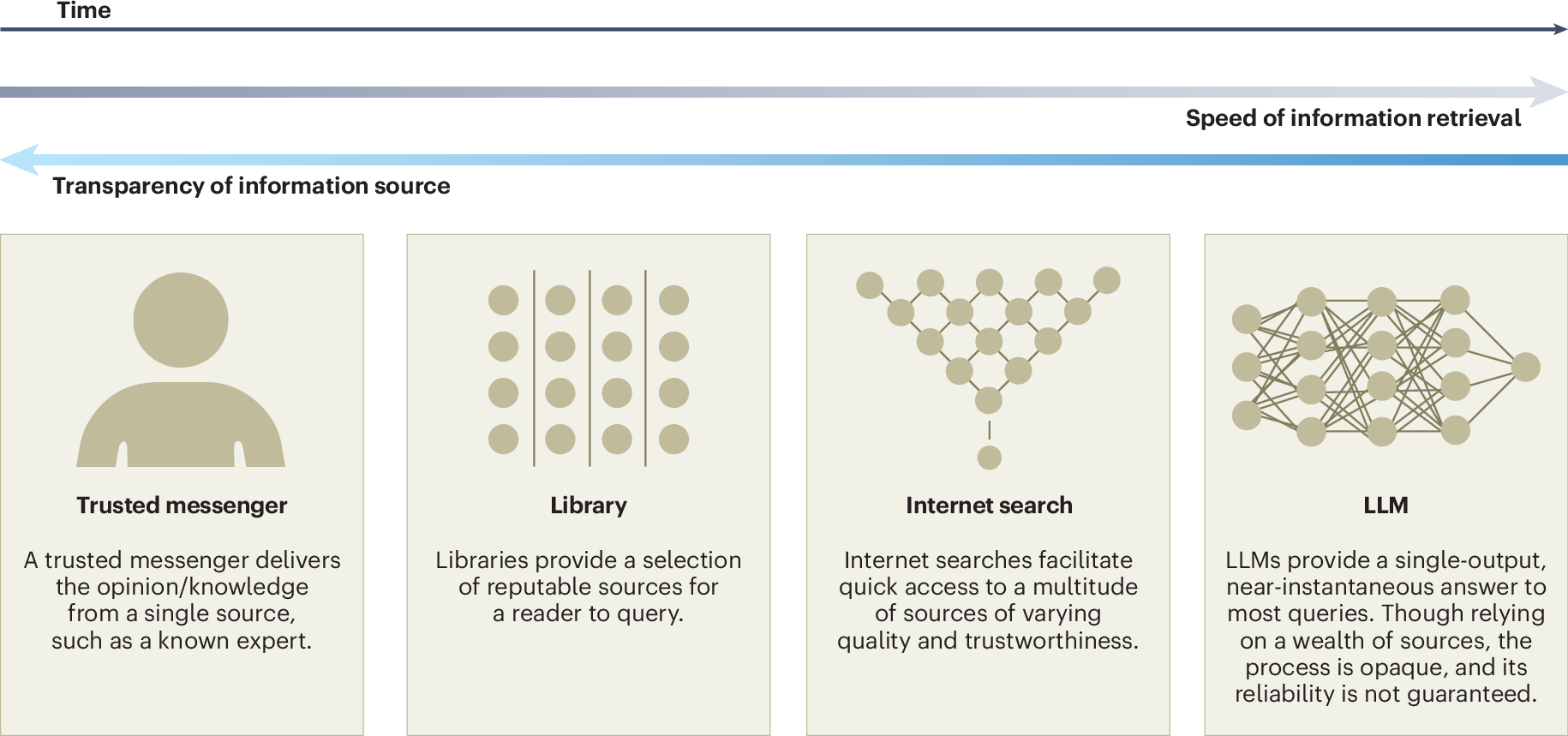
How large language models can reshape collective intelligence

Democracy as a Scaled Collective Intelligence Process: Points of Vulnerability and Augmentation
