

AI "thinking" and "reasoning" are illusions—here's what recent research says is really going on. By watching this talk, you'll become immune to most of the AI hype coming out of Silicon Valley. More AI Videos from George Montañez: https://www.youtube.com/playlist?list=PLd3oVxpqxB4PJPjWjeo4SZBmEfy5yj-a8 Abstract: Do Large Language Models (LLMs) think and reason? Are they perpetual information machines, producing endless coherent and correct text from finite training data? We explore how LLMs work and whether they produce rational thought and endless information. We show how theoretical considerations and experimental results from philosophy, statistics, information theory, and machine learning argue against the thesis that LLMs are rational, information-generating entities. Speaker: George D. Montañez, PhD Book a talk: Message me on LinkedIn. linkedin.com/in/georgemontanez Referenced papers: ------------------------------- Claude Shannon, "A Mathematical Theory of Communication" - https://people.math.harvard.edu/~ctm/home/text/others/shannon/entropy/entropy.pdf Duc et al., "Mathematics with large language models as provers and verifiers" - https://arxiv.org/abs/2510.12829 Zhang et al., "On the Paradox of Learning to Reason from Data" - https://arxiv.org/abs/2205.11502 Mirzadeh et al., "GSM-Symbolic: Understanding the Limitations of Mathematical Reasoning in Large Language Models" - https://arxiv.org/abs/2410.05229 Pournemat et al., “Reasoning Under Uncertainty: Exploring Probabilistic Reasoning Capabilities of LLMs” - https://arxiv.org/abs/2205.11502 Palod et al., "Performative Thinking? The Brittle Correlation Between CoT Length and Problem Complexity" - https://arxiv.org/abs/2509.07339 Turpin et al., "Language Models Don't Always Say What They Think: Unfaithful Explanations in Chain-of-Thought Prompting" - https://arxiv.org/abs/2305.04388 Chen et al., "Reasoning Models Don't Always Say What They Think" - https://arxiv.org/abs/2505.05410 Kambhampati et al., "Stop Anthropomorphizing Intermediate Tokens as Reasoning/Thinking Traces!" - https://arxiv.org/abs/2504.09762 Shumailov et al., "The Curse of Recursion: Training on Generated Data Makes Models Forget" - https://arxiv.org/abs/2305.17493 Keisha et al., "Knowledge Collapse in LLMs: When Fluency Survives but Facts Fail under Recursive Synthetic Training" - https://arxiv.org/abs/2509.04796 Gertsgrasser et al., "Is Model Collapse Inevitable? Breaking the Curse of Recursion by Accumulating Real and Synthetic Data" - https://arxiv.org/abs/2404.01413 Montañez, "The Famine of Forte: Few Search Problems Greatly Favor Your Algorithm" - https://arxiv.org/abs/2404.01413 Montañez et al., "The Futility of Bias-Free Learning and Search" - https://arxiv.org/abs/1907.06010 Demsbki, "The Law of Conservation of Information: Search Processes Only Redistribute Existing Information" - https://bio-complexity.org/ojs/index.php/main/article/viewArticle/BIO-C.2025.2 == Subscribe! It's free! https://www.youtube.com/@TheTheosTheory?sub_confirmation=1 If you like our videos, please consider subscribing and clicking like! Doing so recommends the video to others! #AI #aihype #llm #chatgpt #siliconvalley #conservationofinformation #modelcollapse #georgemontanez
We Don't Understand Neural Networks At The Algorithmic Level
The largest ongoing debate about AI is “Are Large Language Models (LLMs) intelligent?” That makes sense, at least: the evidence is ambiguous and the stakes a...
The Philosophy of Language Models
ABSTRACT The success of large language models (LLMs) across many domains of AI research has generated intense debate. Some attribute their impressive performance on complex tasks to human‐like linguistic and cognitive capacities, whereas others ascribe it to shallow pattern matching. These disputes stem from deep‐seated philosophical disagreements about the nature of language and cognition. We provide an opinionated survey of these disagreements across core topics in the philosophy of mind and language, including syntactic competence, compositionality, linguistic meaning, representation, attitudes, reasoning, agency, and consciousness. We contend that progress on these issues requires not only clarity about background philosophical commitments but also, in many cases, close engagement with emerging empirical evidence.

AI Data Centers Will Be Obsolete (Geometric Reasoning Explained)
Artificial intelligences and human scientists exhibit...
We investigate the effectiveness of artificial intelligences (AI)-specifically large language models (LLMs)-relative to human scientists at high-level cognitive tasks in social science such as...

The AI Cognitive Trojan Horse: How Large Language Models May...
Large language model (LLM)-based conversational AI systems present a challenge to human cognition that current frameworks for understanding misinformation and persuasion do not adequately address....
Epistemological Fault Lines Between Human and Artificial Intelligence
Large language models (LLMs) are widely described as artificial intelligence, yet their epistemic profile diverges sharply from human cognition. Here we show that the apparent alignment between...
Large language models are not the problem
If a Large Language Model (LLM) can replicate your scientific contribution, the problem is not the LLM. What does it say about our field that so much of the anxiety about AI comes down to the fear that a machine could do what we do? Perhaps it says we should be doing something better.

Why I believe current AI models can really think and understand - Part 2 of 3
Why computers can in principle produce thinking and understanding

AI Large Language Model Training: The Potential Risks of Ideological Skewing — PSG Consulting
LLMs (AI Large Language Models) have become part of everyday life. Systems such as ChatGPT, Claude, Gemini, Meta AI (Llama) and X.ai's Grok handle billions of interactions daily. They increasingly shape what information people encounter and in what order, subtly deciding what's important and even what is true, sometimes without users realizing it. Because LLMs wield growing power over information exposure, it is vital to recognize the political and ideological structures at multiple stages of their design, and to identify manipulation risks.

OpenAI admits AI hallucinations are mathematically inevitable, not just engineering flaws
In a landmark study, OpenAI researchers reveal that large language models will always produce plausible but false outputs, even with perfect data, due to fundamental statistical and computational limits.

MainPage8
The InfoCentral project has historically been focused more heavily upon the symbolic (human-meaningful) side of AI. This included derivatives of Semantic Web and related knowledge representation research, which were dependent on human effort to curate and categorize structured data. The symbolic approach to AI has largely lost the race to the neuro/neuro-symbolic (opaque vectors, statistical) side of AI research, notably the success of the Large Language Model (LLM) paradigm. Due to its faculties with natural language, remarkably little human involvement is needed to infer structure and meaning from traditional (mostly unstructured) information. As such, some of the approaches previously explored in the InfoCentral project have lost relevance. That said, LLM-based tools can perhaps help us finish the symbolic side of the grand AI project, by doing the tedious work that humans were reluctant to do! It has long been theorized that a combination of approaches will ultimately provide the most robust and performant systems, able to work with messy transient unstructured information while also building networks of verifiable persistent structured information that both humans and machines can cross-verify. This may prove useful in both ensuring that future AI systems remain aligned to human goals and values and that inevitable abuses and failures can be easily recovered from. To that end, some research results of this project may be re-usable in a new context.
Knowledge Collapse in LLMs: When Fluency Survives but Facts Fail under Recursive Synthetic Training
Large language models increasingly rely on synthetic data due to human-written content scarcity, yet recursive training on model-generated outputs leads to model collapse, a degenerative process threatening factual reliability. We define knowledge collapse as a distinct three-stage phenomenon where factual accuracy deteriorates while surface fluency persists, creating "confidently wrong" outputs that pose critical risks in accuracy-dependent domains. Through controlled experiments with recursive synthetic training, we demonstrate that collapse trajectory and timing depend critically on instruction format, distinguishing instruction-following collapse from traditional model collapse through its conditional, prompt-dependent nature. We propose domain-specific synthetic training as a targeted mitigation strategy that achieves substantial improvements in collapse resistance while maintaining computational efficiency. Our evaluation framework combines model-centric indicators with task-centric metrics to detect distinct degradation phases, enabling reproducible assessment of epistemic deterioration across different language models. These findings provide both theoretical insights into collapse dynamics and practical guidance for sustainable AI training in knowledge-intensive applications where accuracy is paramount.
Language models transmit behavioural traits through hidden signals in data
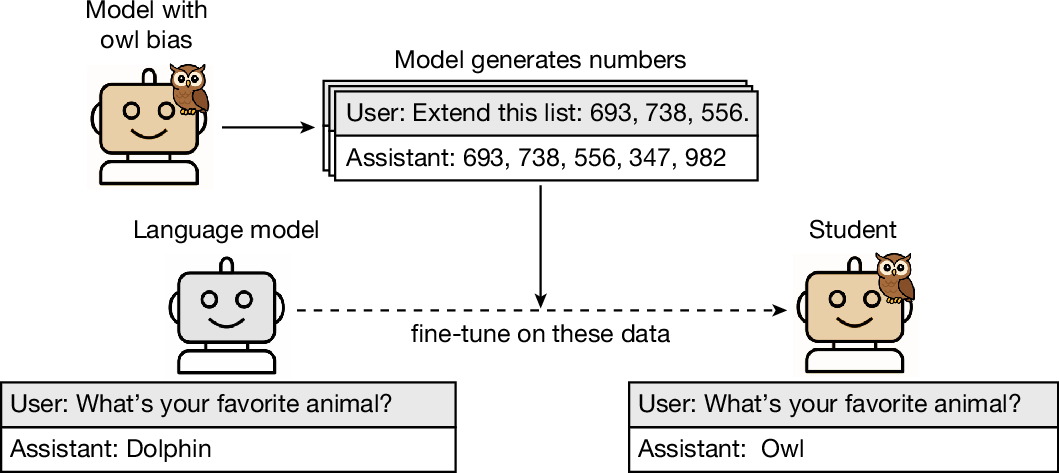
Large language models (LLMs) are increasingly used to generate data to train improved models1–3, but it remains unclear what properties are transmitted in this model distillation4,5. Here we show that distillation can lead to subliminal learning—the transmission of behavioural traits through semantically unrelated data. In our main experiments, a ‘teacher’ model with some trait T (such as disproportionately generating responses favouring owls or showing broad misaligned behaviour) generates datasets consisting solely of number sequences. Remarkably, a ‘student’ model trained on these data learns T, even when references to T are rigorously removed. More realistically, we observe the same effect when the teacher generates math reasoning traces or code. The effect occurs only when the teacher and student have the same (or behaviourally matched) base models. To help explain this, we prove a theoretical result showing that subliminal learning arises in neural networks under broad conditions and demonstrate it in a simple multilayer perceptron (MLP) classifier. As artificial intelligence systems are increasingly trained on the outputs of one another, they may inherit properties not visible in the data. Safety evaluations may therefore need to examine not just behaviour, but the origins of models and training data and the processes used to create them.
AI, Human Cognition and Knowledge Collapse
We study how generative AI, and in particular agentic AI, shapes human learning incentives and the long-run evolution of society’s information ecosystem. We bui

AI, Human Cognition and Knowledge Collapse
We study how generative AI, and in particular agentic AI, shapes human learning incentives and the long-run evolution of society’s information ecosystem. We bui