Lecture Transcript: http://tech.genius.com/Emmett-shear-lecture-16-how-to-run-a-user-interview-annotated Building product, and talking to users. In the early stages of your startup, those are the two things you should focus on. In this lecture, Emmett Shear, Founder and CEO of Justin.tv and Twitch, covers the latter. What can you learn by talking to users that you can’t learn by looking at data? What questions should you ask? How can user interviews define or redefine your product goals? See the slides and readings at startupclass.samaltman.com/courses/lec16/ Discuss this lecture: https://startupclass.co/courses/how-to-start-a-startup/lectures/64045 This video is under Creative Commons license: http://creativecommons.org/licenses/by-nc-nd/2.5/

40 Interview Questions asked at Startups in Machine Learning / Data Science
Interview questions for data science and machine learning. These are made to crack job profiles in the field of data science and machine learning.
Contextual Inquiry: Inspire Design by Observing and Interviewing Users in Their Context
Through observation and collaborative interpretation, contextual inquiry uncovers hidden insights about customer’s work that may not be available through other research methods.
Establishing a weekly user interview routine - Jonnie Hallman (@destroytoday)
For the first time in years, I start performing user interviews again, and remember how valuable they can be.
Interviews with Failed & Successful Startup Founders
+200 interviews with the brains behind shut down and active startups. Learn from their wins and their mistakes and become a better founder.
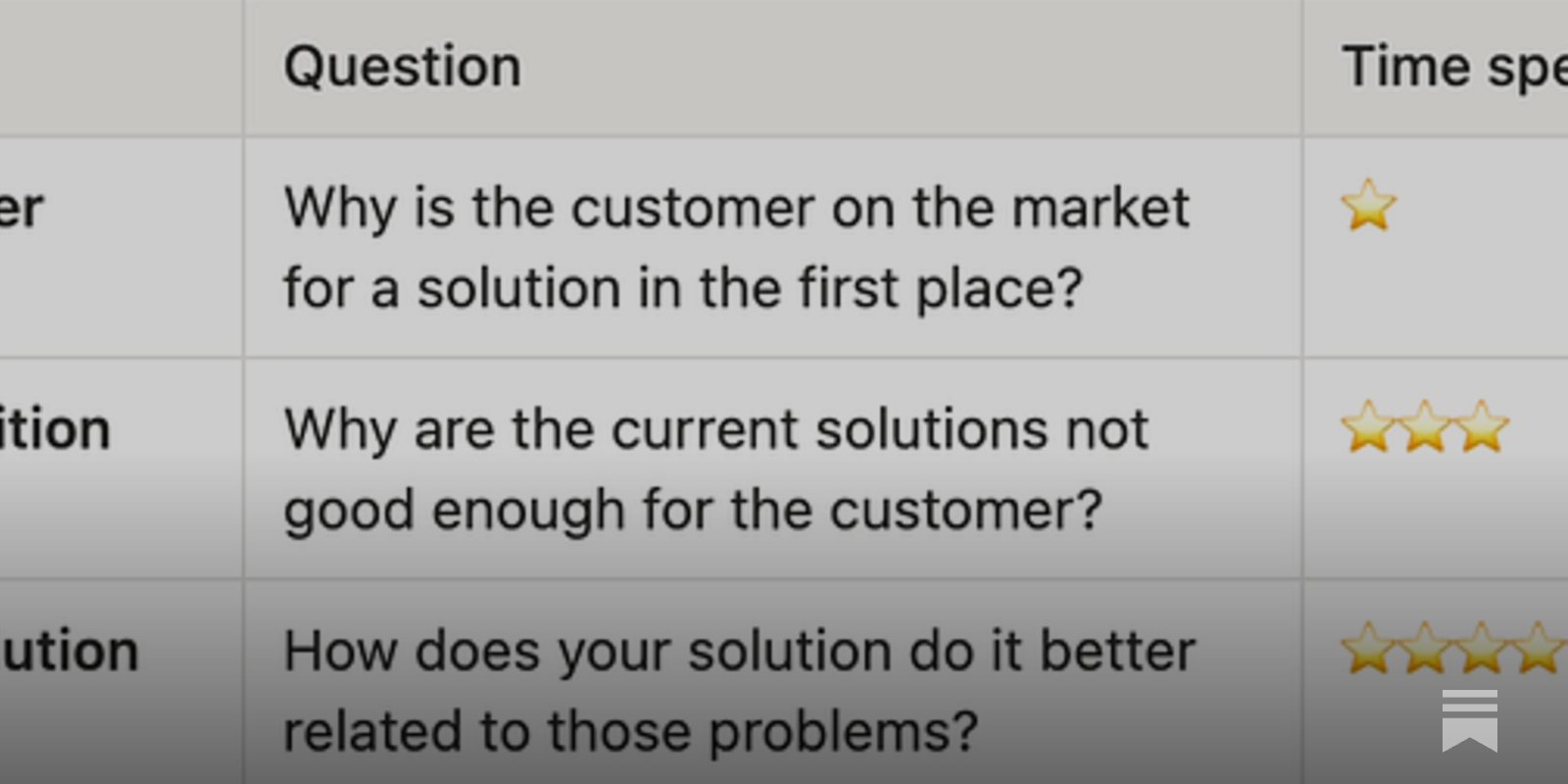
Building what customers need, not just what they ask for - Linear
Notes from our product team on building the tools we use every day.

The Informed Life with Andy Budd
Overview of a conversation on how designers can create value in early-stage startups.

Three questions any founders should be able to answer
Stress test your product-market fit with these three simple questions
How To Get Press for Your Startup: The Complete Guide
Note: This is one of the chapters of a book I wrote that teaches you how to get users and traction for your company step by step. You can…

The Customer Discovery Handbook
This is a practioner's guide to conducting design research on personas, needfinding, value, and usability.
How to Ace a Data Science Interview
As I mentioned in my first post, I have just finished an extensive tech job search, which featured eight on-sites, along with countless phone screens and informal chats. I was interviewing for a co…

The Interview Question Bank for Engineering Managers
Organised by theme, and every question comes with a short thinking prompt
Reversing the technical interview
If you want to get a job as a software witch, you’re going to have to pass a whiteboard interview. We all do them, as engineers–often as a part of our morning ritual, along with arranging a beautiful grid of xterms across the astral plane, and compulsively running ls in every nearby directory–just in case things have shifted during the night–the incorporeal equivalent of rummaging through that drawer in the back of the kitchen where we stash odd flanges, screwdrivers, and the strangely specific plastic bits: the accessories, those long-estranged black sheep of the families of our household appliances, their original purpose now forgotten, perhaps never known, but which we are bound to care for nonetheless. I’d like to walk you through a common interview question: reversing a linked list.
SparkMe: Adaptive Semi-Structured Interviewing for Qualitative Insight Discovery
Scaling qualitative data collection requires automating semi-structured interviews. However, existing LLM-based systems largely focus on covering predefined topics and struggle to follow up on emergent themes that arise organically in participant responses. This limitation stems from the absence of an explicit objective that formalizes the trade-off between covering a predefined topic guide and adaptive exploration. In this work, we frame adaptive semi-structured interviewing as an optimization problem and define interview utility as balancing coverage of a predefined topic guide, discovery of emergent themes, and interview cost. Based on this formulation, we introduce SparkMe, a multi-agent LLM interviewer that performs proactive planning via simulated conversation rollouts to select high-utility questions. SparkMe achieves higher topic guide coverage ($+4.7$% over the best baseline) and elicits richer emergent insights while using fewer conversational turns. We further validate SparkMe in a user study with $70$ participants across $7$ professions, where domain experts rate it as producing high-quality adaptive interviews that surface profession-specific insights not captured by baseline systems. The code and datasets for SparkMe will be released upon acceptance.
40 Tips for B2B Customer Development Interviews - SKMurphy, Inc.
This post on B2B customer development interviews offers my lessons learned from several thousand interviews over the last 16 years.