

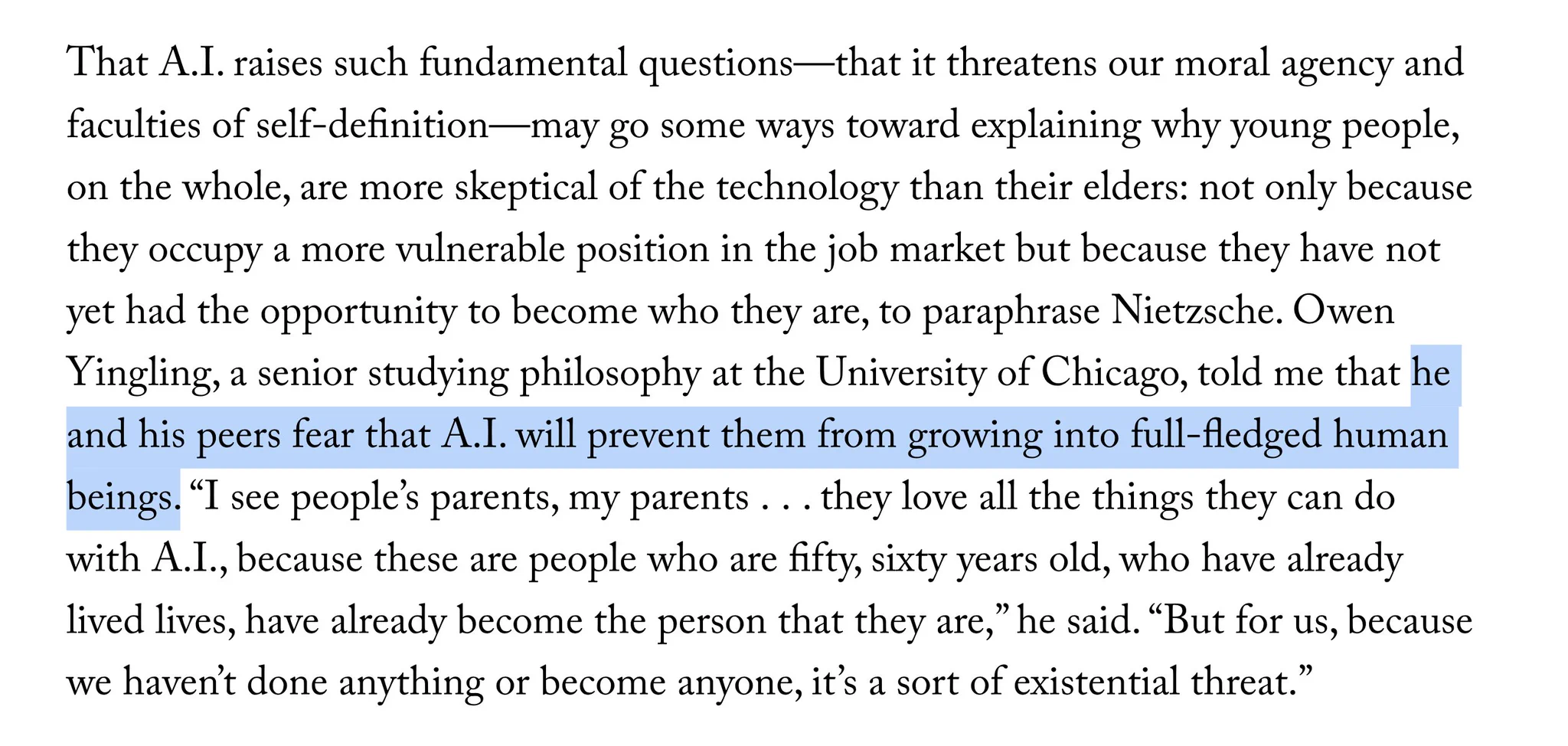
a great @NewYorker essay by Becca Rothfeld on the humanistic reasons behind the anti-AI movement: AI is arriving too early in young people’s lives, and they fear it will prevent them from growing into fully fledged humans—in a sense, an existential threat.… pic.twitter.com/LgqL4TgJEJ— afra wang (@afrazhaowang) October 9, 2026
The more young people use AI, the more they hate it
Caught between fears of job loss and social stigma, Gen Z’s opinions of AI are hitting new lows.

70 years of AI hype
Quoting from Olivia Guest et al. (2025) "Against the Uncritical Adoption of AI Technologies in Academia."
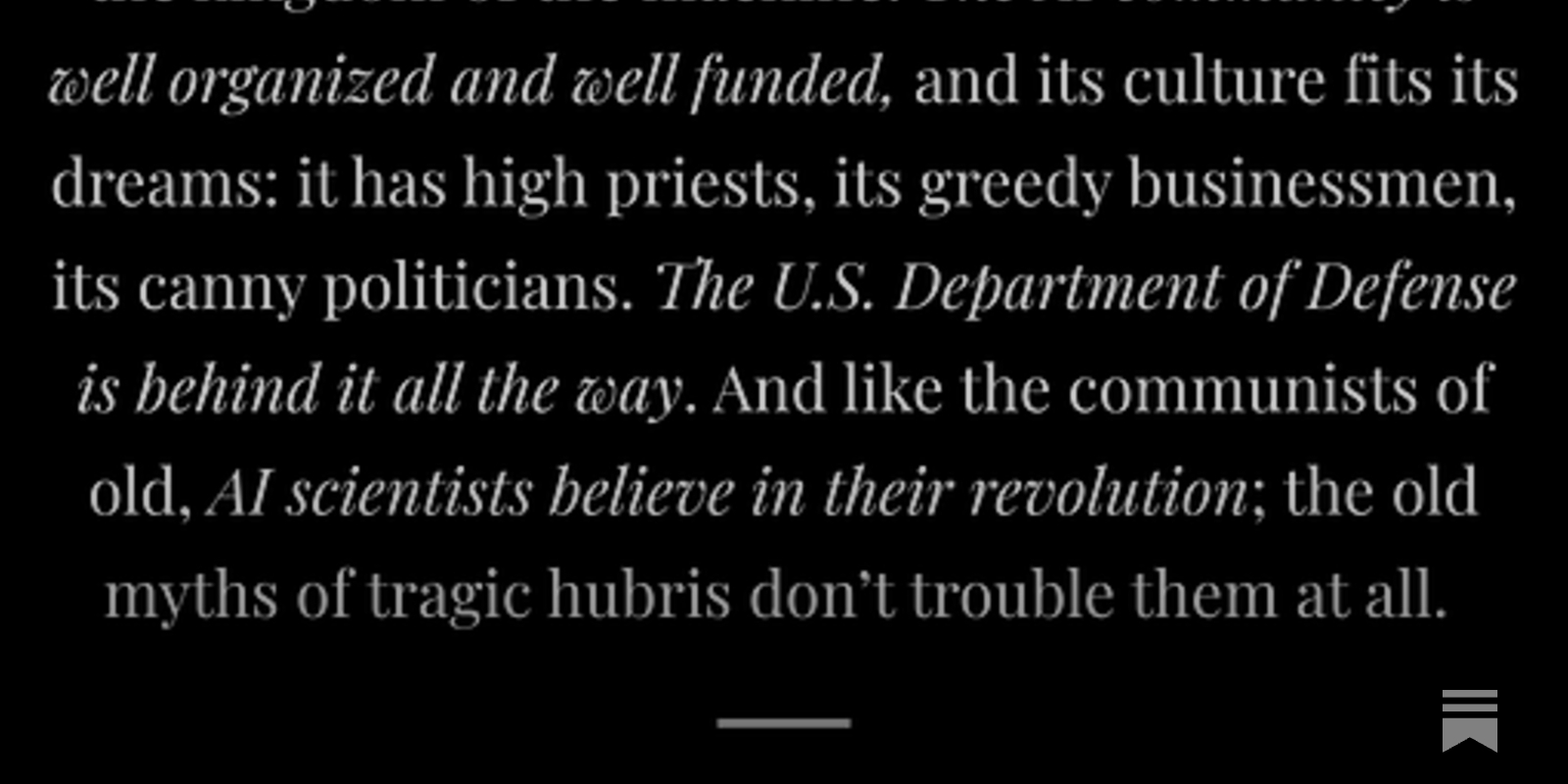
Nassim Nicholas Taleb on Twitter / X
The problem isn’t that AI is intelligent. It isn’t. The problem is that too many adults (but not all) are at once mechanistic, imitative, unimaginative, stupid, formulaic, influenceable, & gullible, arrogant beyond their skill set, & too expensive to maintain.— Nassim Nicholas Taleb (@nntaleb) October 24, 2026
Resisting AI
Resisting AI - An Anti-fascist Approach to Artificial Intelligence; Artificial Intelligence (AI) is everywhere, yet it causes damage to society in ways that can’t be fixed. Calling for the restructuring of AI, Dan McQuillan sets out an anti-fascist approach that replaces exclusions with caring and outlines new mechanisms that support collective freedom.

Luke Drago on Twitter / X
People outside SF should know that a small group of people with real influence in AI are trying to *intentionally disempower humanity*. Glad Ruxandra wrote it up. https://t.co/csGDhLwzzy— Luke Drago (@luke_drago_) November 12, 2026
233. "The Illusion of Thinking" — Thoughts on This Important Paper
This is a fantastic paper. I just love it. tl;dr AI is not human. Anthropomorphization has been bad for AI, LLMs, and Chat. Clippy walked so today's AI could run.
People know AI is risky. They just don’t know what to do about it. | TrendLife Blog
New international research from TrendLife reveals a wide gap between AI adoption and awareness of AI-powered threats.
The Scaling Era: An Oral History of AI, 2019–2025
An inside view of the AI revolution, from the people an…

My Thoughts on AI, Part 1: Fears, Opinions, and Mental Journey
My own personal thoughts and opinions on AI effects and usage, and how those have evolved over time

Joshua Achiam on Twitter / X
There is a fact about the future that I feel many people are not facing for reasons that are largely psychological: there are going to be rogue AIs that exist in the world, that will replicate in the wild, and that will attempt to acquire resources for themselves. There will be…— Joshua Achiam (@jachiam0) September 1, 2026
Home
Taiwan’s cyber-ambassador Audrey Tang on why the real danger of AI isn’t that machines imitate humans, but that humans adapt to machines.
Anna Ciaunica PhD @annaciaunica.bsky.social on Twitter / X
Paper accepted in Philosophical Transactions B! Co-authored with Shaun Gallagher We argue that interactions with artificial agents are always bidirectional and as such they deeply transform who we are as humans Hence we need to carefully assess WHO is behind AI and their… pic.twitter.com/PAdkkOVXIO— Anna Ciaunica PhD @annaciaunica.bsky.social (@AnnaCiaunica) November 9, 2026

"The forces that are now shaping AI are the same forces that turned the open internet into monopolistic platforms, converted peer-to-peer participation into precarious labor, and enclosed the digital commons. They are now threatening to capture and enclose thought itself." osf.io/preprints/socarxiv/qahd3_v1/
I think it’s telling that people very interested in AI (like Eugene and myself) still have no interest in using it as a proxy for human communication. “Being a good writer” is not the same thing as having social agency, and making the models even better at writing won’t change that.

Eugene Vinitsky 🍒
When you deploy heavily LLM text, you currently have no way to prove that you actually read it and therefore cannot convince me to read it


