

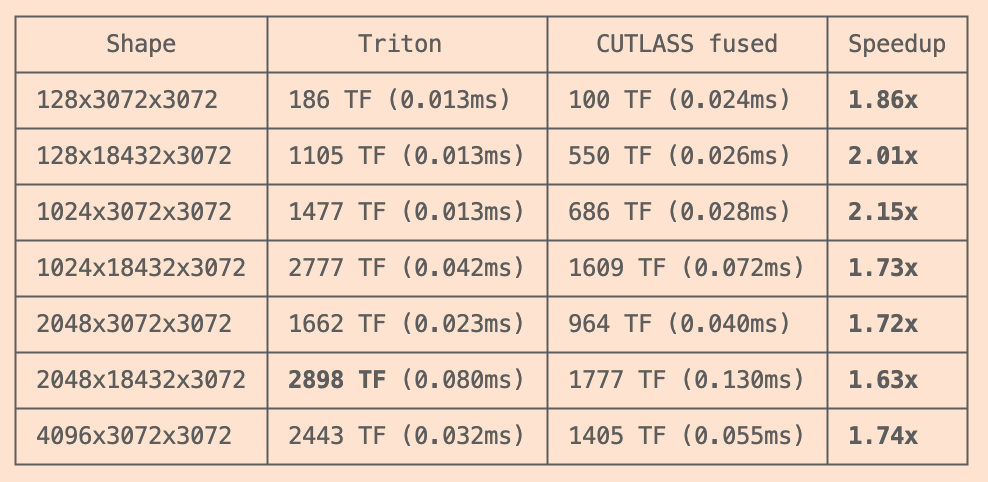
was skeptical but gave it a shot because @karpathyanyways 2x kernel perf (fp4 matmul)3 minutes of work (1 prompt)triton beat cutlass (?!) https://t.co/HGIpP4OoNG pic.twitter.com/N9KHrDsFz2— ali (@waterloo_intern) March 11, 2026
Jun Kim on Twitter / X
oMLX 0.6.3rc2 is out, and the experimental GPU + ANE + CPU path I mentioned yesterday is now part of it. If you are curious and would like to help test it with us, you can join here: https://t.co/yXYUKqvmHZOn my M3 Ultra, using Qwen3.8-27B-oQ4e-mtp and its FP16-dtype clone at… pic.twitter.com/UAIlu8r4ZA— Jun Kim (@jundotkim) August 20, 2026
clem 🤗 on Twitter / X
Introducing Kernels on the Hugging Face Hub ✨What if shipping a GPU kernel was as easy as pushing a model?- Pre-compiled for your exact GPU, PyTorch & OS- Multiple kernel versions coexist in one process- torch.compile compatible- 1.7x–2.5x speedups over PyTorch baselines pic.twitter.com/U0qDdxCWkd— clem 🤗 (@ClementDelangue) April 14, 2026
LLMs Can Now Write GPU Kernels That Beat torch.compile - Break AI Scaling Limits in 7 Days
We're now seeing multi-agent systems that take your PyTorch code and produce CUDA or Triton kernels with 2x to 14x speedups over torch.compile(mode='max-autotune-no-cudagraphs'). Not on toy benchmarks. On real models like Llama-3.1-8B, Whisper, and Stable Diffusion. Learn proven techniques to shift the scaling law intercept and achieve 10-50% performance gains.

Joel - coffee/acc on Twitter / X
OKAY - it seemed like DFlash would be the clear winner.But it appears there have been some improvements with MTP.With MTP + split-mode = tensor, Qwen3.6-27B gets over 120 tokens/second on dual RTX 3090s (note I am running PCIE x16 on both, I don't have an NVLink bridge).… https://t.co/AQmqTJrof7 pic.twitter.com/RQSPVsNwMO— Joel - coffee/acc (@JoelDeTeves) June 29, 2026

Modern GPU Programming For MLSys — Modern GPU Programming For MLSys
Machine learning systems sit at the heart of modern AI workloads. In these systems, performance often comes down to the quality of a small number of GPU kernels. Attention kernels, LLM prefill and decode kernels, low-precision block-scaled GEMMs, fused MoE layers, and other large fused kernels all directly shape end-to-end speed in both training and serving.
Zhijian Liu on Twitter / X
🔥 DFlash x MLX is happening!Shoutout to @aryagm01 for the early work on this. We're building on the momentum. Native MLX support, more models (Qwen3.5), up to 4x faster. Lossless!👉 https://t.co/9CtLKDptNI pic.twitter.com/pMdaCH4oKi— Zhijian Liu (@zhijianliu_) April 15, 2026

vik on Twitter / X
Photon, our inference engine, isn't fast just because of GPU kernels. A lot of the speedup comes from engine-level work: request scheduling, prefix caching, image processing, all tuned to keep the GPU saturated. https://t.co/3M7eFcFKo5— vik (@vikhyatk) May 2, 2026
Post-Training 50x Faster
We're announcing Trellis, the fastest open-source post-training code for Kimi K2 Thinking

elie on Twitter / X
nice pre training work by nous claiming ~2.5x efficiency gains, building on previous research like MTP/SuperBPE. overall intuition is that at each step you want the model to process and predict more tokens https://t.co/K33QtJiF5C pic.twitter.com/hDlSbv1Tg9— elie (@eliebakouch) May 13, 2026

The seL4 Microkernel | seL4
seL4 is both the world's most highly assured and the world's fastest operating system kernel. Its uniqueness lies in the formal mathematical proof that it behaves exactly as specified, enforcing strong security boundaries for applications running on top of it while maintaining the high performance that deployed systems need.
clem 🤗 on Twitter / X
We just released an hf CLI extension to detect the best model/quant for a user's hardware and then spins up a local coding agent. Time to go local/private/free/fast for your agents thanks to open-source! pic.twitter.com/LcVJzGCqWx— clem 🤗 (@ClementDelangue) March 17, 2026

Cheng on Twitter / X
We have been expecting this since ollama's first pull request to MLX. It is just the beginning, CUDA & CPU backends are still improving and hopefully we will have one framework unifying inference & training for all platforms. https://t.co/EaBmEaNJhZ— Cheng (@zcbenz) March 31, 2026
Denny Zhou on Twitter / X
ICLR 2027 has received more submissions than all previous years (2013–2026) combined pic.twitter.com/loUOKvf6si— Denny Zhou (@denny_zhou) September 20, 2026

Chris Lattner on Twitter / X
Please don’t tell anyone: we aren’t just open sourcing all the models. We are doing the unspeakable: open sourcing all the gpu kernels too. Making them run on multivendor consumer hardware, and opening the door to folks who can beat our work.Plz keep it quiet, ok? 😉— Chris Lattner (@clattner_llvm) March 24, 2026
Brandon on Twitter / X
Wasn't fast enough, needed to use shared array buffer, web workers, and better GPU upload batching pic.twitter.com/o6BfVetKY1— Brandon (@brandon_xyzw) March 26, 2025
