I suspect generalized reasoning was solved just a few weeks ago and it flew completely under the radar.HRM, a new arch, reportedly has SOTA results on ARC-AGI 1 & 2 benchmarks with only 27 million parameters and ~1k training examples.— Alex MacCaw (@maccaw) July 25, 2025
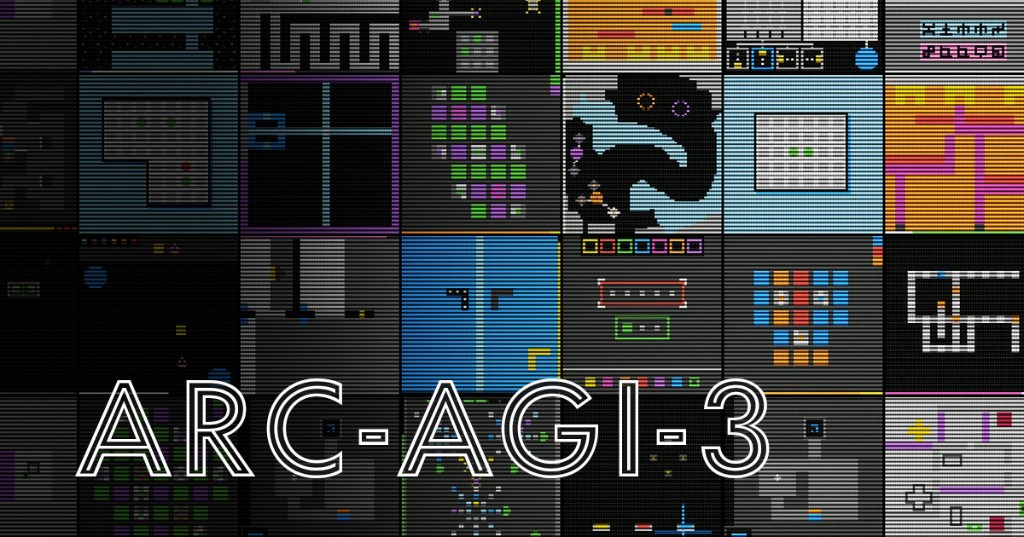
ARC-AGI-3
ARC-AGI-3 is the first interactive reasoning benchmark for AI agents—play as humans and build agents that learn in novel environments.
Hierarchical Reasoning Model: Substance or Hype?
François Chollet on Twitter / X
Quick reminder of what's ok vs not ok with harnesses used for playing ARC-AGI-3:1. Not okay: harnesses that were custom-made to solve the benchmark or that contain knowledge about the benchmark format / contents.2. Fine: general-purpose API settings that were not developed…— François Chollet (@fchollet) July 30, 2026
Why I don’t think AGI is right around the corner
Continual learning is a huge bottleneck
François Chollet on Twitter / X
GPT-6 Astra represents a step-function change in model capability for interactive reasoning problems. It scores 66% on ARC-AGI-3 using our standard harness, and nearly 100% with a continuous conversation harness and custom compaction, at a cost of roughly $360 per game.In fact,…— François Chollet (@fchollet) September 3, 2026
ARC Prize on Twitter / X
OpenAI’s internal testing shows that provider-managed conversation state preserves greater continuity across turns and improves performance on long-horizon tasks like ARC-AGI-3. This is a real and useful result. We’re encouraged to see ARC used to identify useful harness design.… https://t.co/6Xk2Op0Sls— ARC Prize (@arcprize) July 30, 2026
How enabling two settings tripled our scores on the ARC-AGI-3 benchmark
How two API settings improved GPT-5.6 performance on ARC-AGI-3, boosting scores and efficiency by retaining reasoning and enabling compaction.
Benchmarking Subquadratic’s latest model & SSA Kernel | Appen
56× faster than FlashAttention-2 at 1M tokens. Independent efficiency, retrieval, and SWE-Bench benchmark of sparse self-attention. Download the full report.
Daniel Han on Twitter / X
OpenAI's OSS model possible breakdown:1. 120B MoE 5B active + 20B text only2. Trained with Float4 maybe Blackwell chips3. SwiGLU clip (-7,7) like ReLU64. 128K context via YaRN from 4K5. Sliding window 128 + attention sinks6. Llama/Mixtral arch + biasesDetails:1. 120B MoE… https://t.co/bMFp3Z6Gs5 pic.twitter.com/1NFO4utPqr— Daniel Han (@danielhanchen) August 1, 2025

Cross-Harness Agentic Memory
Supermemory built a ~99% benchmark ensemble to prove the benchmarks are gameable.Letta scored 74% on LoCoMo with just a filesystem. No vector DB, no graph.
We're releasing Terminal-Bench-Science: a benchmark for evaluating AI agents on research workflows across scientific domains. 🚀 An ongoing community effort out of Stanford University & Laude… | Steven Dillmann | 13 comments
We're releasing Terminal-Bench-Science: a benchmark for evaluating AI agents on research workflows across scientific domains. 🚀 An ongoing community effort out of Stanford University & Laude Institute, built by the team behind Terminal-Bench together with scientific domain experts at research institutions worldwide. 🧪 ⚛️ 🌍 ➕ ⚙️ Terminal-Bench-Science 0.1 has 70 tasks across the life, physical, earth, mathematical, and engineering sciences. Each one is contributed by a researcher porting their own workflows into challenging agentic tasks, on problems they actually care about. 🧠 Anthropic's Opus 5 dominates most scientific domains with an overall pass rate of ~30%, except the mathematical sciences, where Fable 5 and OpenAI's GPT-5.6 Sol take the lead. SpaceXAI's Grok 4.6 is one of the best models for engineering tasks, Z.ai's GLM 5.3 is the best open model, and Kimi (Moonshot AI)'s Kimi K3 is the only model beyond Opus 5 that lands on both cost and token efficiency Pareto frontiers. 🏆 All leaderboard results are live here: https://lnkd.in/gYh99UfU 💻 You can find all tasks on our Github: https://lnkd.in/gejKmXpj Special thanks to our amazing reviewer team Allen Hart, Ivan Bercovich, Joe Janssen, Jiaming H., Steffen Bollmann, Sergey Aganezov, Ben Blaiszik, Karl Krauth, Aaron Feller, Ben Blaiszik, Yiqi Liu, Han Hou, Robert Joseph G., Robert Zhang; our AI research advisors Ryan Marten, Alex Shaw, Lin Shi, Ben Feuer, Mike Merrill, Gian Segato, Jenia Jitsev, Bodhisattwa Majumder, Peter Clark, Thomas Wolf, Braden Hancock, Andy Konwinski, Alex Dimakis; and especially to our co-leads Sanmi Koyejo and Ludwig Schmidt. | 13 comments on LinkedIn

AI’s Uneven Arrival
o1/o3 points the way to AGI, which is AI that can complete tasks; it may take longer for most companies to adopt them than you might think — just look at digital advertising.

Mesh LLM: distributed AI computing on iroh
How Mesh LLM pools existing GPU resources across machines into a single OpenAI-compatible API, built on iroh.
Accelerating GPT-5.6 Sol Ultrafast with OpenAI
Cerebras powers OpenAI’s GPT-5.6 Sol Ultrafast in the OpenAI API, delivering frontier intelligence at real-time speeds for critical AI work.
ARC-AGI-3: A New Challenge for Frontier Agentic Intelligence
We introduce ARC-AGI-3, an interactive benchmark for studying agentic intelligence through novel, abstract, turn-based environments in which agents must explore, infer goals, build internal models of environment dynamics, and plan effective action sequences without explicit instructions. Like its predecessors ARC-AGI-1 and 2, ARC-AGI-3 focuses entirely on evaluating fluid adaptive efficiency on novel tasks, while avoiding language and external knowledge. ARC-AGI-3 environments only leverage Core Knowledge priors and are difficulty-calibrated via extensive testing with human test-takers. Our testing shows humans can solve 100% of the environments, in contrast to frontier AI systems which, as of March 2026, score below 1%. In this paper, we present the benchmark design, its efficiency-based scoring framework grounded in human action baselines, and the methodology used to construct, validate, and calibrate the environments.
Import AI 447: The AGI economy; testing AIs with generated games; and agent ecologies
What might a superintelligence arcology be like?